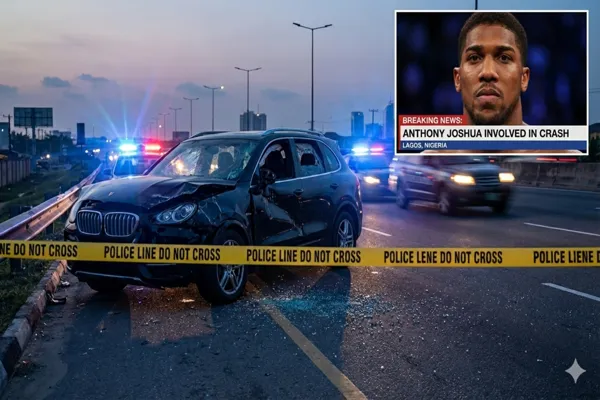
LAGOS, NIGERIA — The boxing world is in shock after a tragic Anthony Joshua accident in Ogun State, Nigeria, that claimed two lives. The British-Nigerian heavyweight champion, who was visiting to celebrate a recent victory, was involved in a collision on the Lagos-Ibadan Expressway on Monday, December 29, 2025.
While Joshua escaped with minor injuries, the deadly crash has cast a dark cloud over what should have been a celebratory visit. This report breaks down what happened, the champion’s condition, and the wider issues of road safety in Nigeria.
The Context: A Homecoming Turned Tragic
The Anthony Joshua accident comes only weeks after Joshua’s high-profile victory over Jake Paul in Miami—a match that drew global attention and boosted his standing in the heavyweight division.
Joshua, proud of his Nigerian roots, often returns to Sagamu in Ogun State to visit family and support local projects. This trip followed that tradition. He arrived in Lagos ahead of the New Year celebrations and planned meetings with community leaders.
The December holiday period—popularly called “Detty December”—typically sees a surge in travel across Nigeria. With that surge comes increased road danger. The Anthony Joshua accident is a painful example of just how risky travel becomes during this season.
The Incident: What Happened on the Expressway?
According to early reports from the Ogun State Police Command and local media, the Anthony Joshua accident occurred late Monday afternoon while Joshua was travelling in a convoy in a luxury Lexus SUV.
The Mechanics of the Crash
Eyewitnesses say the SUV struck a broken-down heavy-duty truck that had been left on the road without warning signs—a common hazard on Nigerian highways.
- The Collision: The impact severely damaged Joshua’s SUV.
- The Victims: Two men believed to be the truck driver and his assistant were killed instantly.
- Joshua’s Condition: Joshua was pulled from the vehicle conscious but shaken.
Police spokesperson Ahmed Iliyasu confirmed Joshua suffered cuts and bruises and was treated at a private hospital in Sagamu. He added that investigations are ongoing to determine whether the convoy’s speed or the truck’s faulty condition contributed most to the crash.
Analysis: The Perils of the Lagos-Ibadan Expressway
Beyond the headline-grabbing nature of the Anthony Joshua accident, the tragedy highlights deeper infrastructure and safety failures. The Lagos-Ibadan Expressway, Nigeria’s busiest route, is also one of the most dangerous.
Systemic Road Safety Issues
GSN’s review of Federal Road Safety Corps (FRSC) data shows troubling patterns:
- Stationary Trucks: Poorly maintained trucks often break down without signs.
- December Traffic Surge: Traffic triples during the holiday season.
- Convoy Risks: VIP convoys often travel fast due to security concerns.
This Anthony Joshua accident exposes how deadly the combination of poor vehicle maintenance and high-speed convoy travel can be.
According to the World Health Organization, Africa has one of the highest road fatality rates in the world. WHO Road Safety Data
Reactions: Shock and Condolence
News of the Anthony Joshua accident spread quickly on social media, drawing responses from officials and sports figures worldwide.
Eddie Hearn, Joshua’s promoter, said:
“Anthony is being assessed by doctors and is physically okay. Our thoughts go to the families of those who died. We ask for privacy at this time.”
Official Responses
- Nigerian Presidency: Sent condolences to the families of the deceased.
- Boxing Community: Stars like Tyson Fury and Oleksandr Usyk posted messages of support.
However, Nigerian social media is deeply divided. Many blame VIP convoy speeding, while others argue that unmarked broken-down trucks are a constant deadly threat. The Anthony Joshua accident has become a national conversation starter.
Global and Local Impact
1. Psychological Impact on Joshua
Although Joshua suffered only minor injuries, psychologists note that being involved in a fatal crash can trigger survivor’s guilt and long-term mental stress. These emotional effects could impact his future fights.
2. Tourism and Diaspora Travel
This high-profile crash may deter some in the diaspora from travelling during the holiday season. Ogun State, in particular, could see a decline in tourism-related visits following the Anthony Joshua accident.
3. Regulatory Pressure
Public pressure is already mounting on the FRSC to clear highways of abandoned trucks. Historically, major accidents lead to temporary enforcement crackdowns. Time will tell whether this tragedy yields real policy change.
Related GSN Reports
Additional External Resources
Conclusion
The Anthony Joshua accident is a heartbreaking mix of relief and sorrow—relief that the boxing superstar survived, and sorrow for the two men who did not. As investigations continue, the tragedy highlights the need for improved road safety policies across Nigeria.
Global Standard News will continue tracking updates on Joshua’s recovery and the official inquiry into the circumstances of the crash.