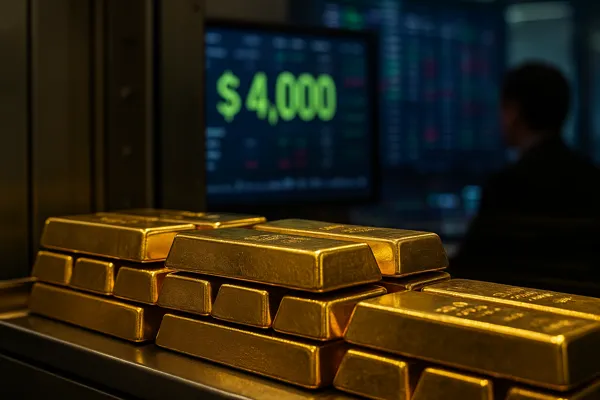
A Historic Threshold in Precious Metals
Gold hits $4,000 on October 8, 2025, rewriting financial history as the precious metal breaks one of the most symbolic barriers in modern markets. Spot prices surged to around $4,050, with futures contracts climbing even higher in early trading. The psychological weight of the $4,000 milestone underscores how shaken investors are by mounting political dysfunction in the United States, slowing global growth, and persistent fears of monetary instability.
Analysts warn that this rally is not merely about short-term trading dynamics but about a deeper reallocation of capital into safe-haven assets. For everyday savers and institutional investors alike, the moment when gold surges to $4,000 marks both an opportunity and a warning: faith in traditional financial systems is faltering.
Roots of the Rally: Context Before the Breakthrough
Gold’s place in the financial ecosystem has always been shaped by its dual role — as a commodity and as a reserve of trust. Historically, gold rallies emerge when confidence in fiat currencies erodes. In the 1970s, stagflation propelled bullion to historic highs. In the 2008 financial crisis, gold surged as investors fled equities. During the COVID-19 pandemic, the metal briefly tested new peaks as uncertainty grew.
But never before had markets seen gold surge to $4,000, despite years of speculation. Through 2023 and 2024, analysts spoke of resistance at the $3,800–$3,950 range, yet central bank buying, geopolitical instability, and U.S. fiscal strains kept mounting. By September 2025, Deutsche Bank had already raised its 2026 gold forecast to $4,000 — a prediction realized sooner than expected.
This backdrop highlights how the rally is part of a longer narrative: declining trust in political systems, global debt at record levels, and the search for alternatives to dollar-denominated reserves.
The Surge Explained: Why Gold hits $4,000 Now
Market Mechanics
On October 8, spot bullion traded past $4,000 an ounce, peaking at $4,050 intraday, while COMEX futures edged toward $4,075. The rally reflected both heavy institutional flows and strong retail buying. ETF inflows surged, while physical demand from Asia remained robust.
Key Drivers
- U.S. Shutdown and Fiscal Jitters
With the American government paralyzed by a protracted shutdown, confidence in U.S. policymaking eroded. Investors sought refuge in an asset immune to default risk. - Federal Reserve Policy Shifts
Market expectations of upcoming rate cuts added momentum. Lower yields reduce the opportunity cost of holding gold. - Central Bank Accumulation
Countries from China to India accelerated bullion purchases, aiming to diversify away from the U.S. dollar. - Dollar Weakness
A softer greenback amplified international demand, making gold more affordable in local currencies. - Momentum & Fear of Missing Out
As gold surges to $4,000, traders piled in to ride the wave, driving short-term spikes that reinforced the rally.
Expert Assessments and Market Voices
“Gold’s surge above $4,000 reflects not just fear but a structural rethinking of portfolios,” said HSBC analysts.
Bank of America cautioned: “Seven straight weeks of gains are rare; some form of correction is statistically likely.”
According to Kitco, the psychological barrier was always going to spark volatility: “When gold surges to $4,000, it changes the rules of engagement for traders and central banks alike.”
Even institutional investors who once dismissed bullion as a “dead asset” are revisiting its importance in a climate of record debt, fragile currencies, and political instability.
Implications and Interpretations
Strategic Shifts in Finance
The fact that gold surges to $4,000 signals profound unease with global monetary stability. Sovereigns may accelerate diversification strategies, while hedge funds use bullion to balance exposure.
Impact on Gold-Producing Nations
For producers like Ghana, South Africa, and Australia, the milestone translates into revenue windfalls. Ghana, one of Africa’s top exporters, could see increased foreign reserves — though risks include illegal mining surges and environmental damage.
Retail and Household Effects
In many emerging economies, households already see gold as a savings hedge. A record at $4,000 enhances this view, though affordability becomes a barrier.
Strategic Outlook: Beyond the Record
Financial experts outline three scenarios:
- Bull Case: If U.S. dysfunction continues and central banks keep buying, prices could climb toward $4,500–$5,000.
- Base Case: Consolidation between $3,800–$4,200 as traders digest gains.
- Bear Case: A correction toward $3,500 if bond yields rebound or risk aversion eases.
Unlike past rallies, this surge has deeper structural roots. The fact that gold reaches $4,000 now suggests that global finance is not merely undergoing turbulence but systemic transformation.
Global Ripples of the Rally
- Currency Alternatives
Some emerging markets may accelerate moves to peg reserves partially to gold rather than the dollar. - Trade Implications
Importers face rising costs, while exporters benefit from windfalls. - Investment Rotation
With equity markets volatile, pension funds and sovereign wealth vehicles are revisiting gold allocations. - Crypto vs. Gold Debate
Bitcoin advocates frame digital assets as “digital gold.” But the enduring fact that gold surges to $4,000 proves physical bullion retains unmatched trust.
What This Milestone Means
When future historians look back at October 2025, they will note that gold reaches $4,000 not as an isolated market event but as a signal of broader global anxiety. The rally reflects fading trust in paper currencies, the fragility of fiscal governance, and the search for timeless hedges.
Whether the price consolidates or pushes higher, one truth endures: gold’s role as humanity’s ultimate insurance has been reaffirmed.
Internal Links
- GoldBod Refining in October: Ghana Moves to End Raw Exports
- Ghana Signs USD 1.5 Billion Deal with Eni and Vitol to Boost Oil and Gas Production
External Links