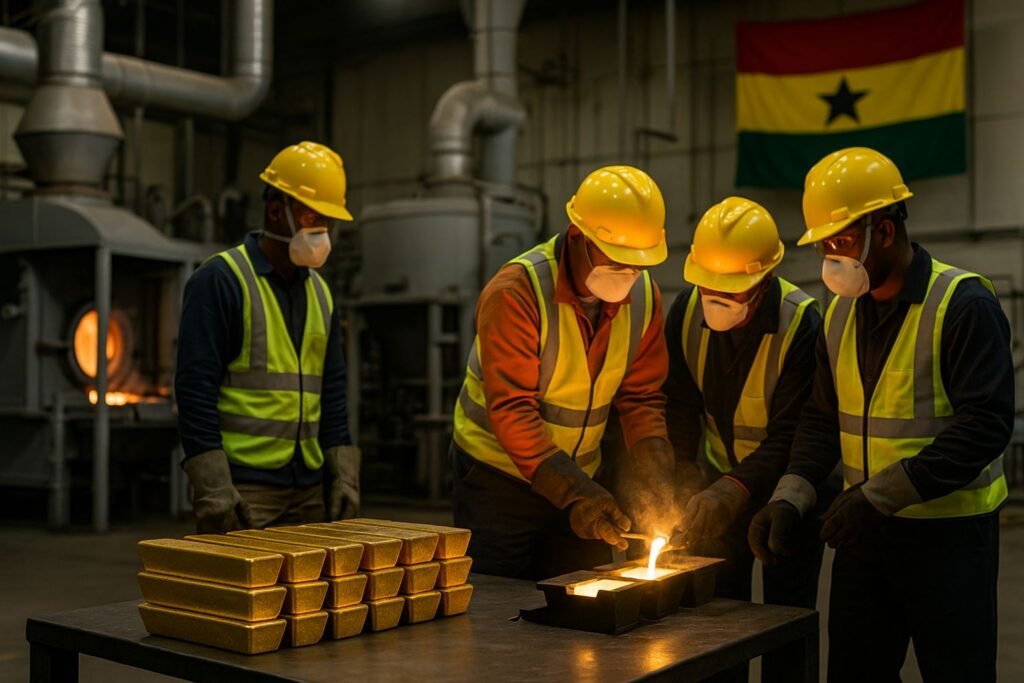
Ghana’s Gold Industry Reaches a Defining Milestone
GoldBod Refining is set to begin operations in October 2025, a landmark step that will redefine how Ghana manages and benefits from its most valuable natural resource. For decades, Ghana—Africa’s leading gold producer—exported raw bullion with minimal local processing, losing billions in potential earnings.
That outdated model is now ending. Backed by the Bank of Ghana (BoG) and coordinated by the Ghana Gold Board (GoldBod), the country will refine, assay, and certify all gold locally before export. Officials say this reform will increase foreign exchange earnings, create thousands of jobs, and position Ghana as a continental hub for gold-based manufacturing and exports.
Decades of Lost Value in Raw Gold Exports
For more than a century, Ghana’s gold industry operated under an extractive model—dig, export, and earn minimal returns. Despite being one of the world’s top ten gold producers, the country captured less than 5% of the total global value from its exports.
Attempts to establish local refining capacity were made as early as the 1990s but faced regulatory and technical barriers. In 2022, the government created the Ghana Gold Board (GoldBod) to consolidate oversight of production, trading, and refining. The establishment of GoldBod Refining under this framework is the first comprehensive effort to convert raw resource wealth into sustainable domestic value.
The reform mirrors other local content drives in oil and gas but goes further—targeting full value-chain control within the gold industry itself.
Strategic Launch Timeline: Why October 2025 Was Chosen
GoldBod officials have confirmed that October 2025 was selected after extensive technical preparation. By that date, all refining plants, fire-assay laboratories, and certification systems will be fully operational.
According to a senior official, “Every ounce of gold leaving Ghana will now be refined and certified within our borders. This is the foundation of true economic independence.”
The GoldBod Refining rollout symbolizes Ghana’s determination to end raw gold exports permanently. The country will now export only internationally certified refined gold that meets London Bullion Market Association (LBMA)standards. This change is expected to generate higher export premiums and attract investors seeking transparent, traceable supply chains.
Value Addition and Industrialization: The Vision Behind GoldBod Refining
At the core of GoldBod Refining lies a transformative national vision — to keep value creation within Ghana’s borders. By refining locally, the country can sell gold at global benchmark prices while reducing exposure to undervaluation and smuggling.
Plans for a “Gold Village” industrial complex are already underway. The project will host jewellery manufacturers, training institutions, and artisans’ workshops to convert refined gold into high-value products such as ornaments and investment coins.
Officials estimate that the initiative could generate over 15,000 direct and indirect jobs, spanning refining, quality testing, logistics, and export management. Beyond revenue, the long-term goal is to evolve Ghana from a raw-material exporter into a gold-manufacturing powerhouse.
Ghana’s Record Gold Performance in 2025
The introduction of GoldBod Refining coincides with record-breaking output and exports. From January to August 2025, Ghana exported 66.7 tonnes of gold worth approximately $6.3 billion, according to the Ghana Gold Board.
However, analysts believe this figure understates Ghana’s real potential. If refined domestically, that same volume could have yielded an additional $800 million to $1 billion in retained value.
Trial operations conducted earlier in 2025 at the Gold Coast Refinery, one of GoldBod’s licensed partners, demonstrated Ghana’s technical readiness, achieving purity levels above 99.5%, meeting LBMA requirements. The October launch will make these results official — and commercial.
Regulatory Framework and Institutional Collaboration
GoldBod Refining forms part of a broader ecosystem built on transparency and regulation. The Bank of Ghana provides monetary oversight, ensuring refined gold trades align with national foreign-exchange policies. Meanwhile, the Ghana Revenue Authority (GRA) and Minerals Commission oversee compliance and export taxation.
Under the new directive:
- All gold exports must be refined and assayed locally.
- Exporters must register on the centralized GoldBod digital platform.
- Export data will synchronize directly with the BoG for transparent foreign exchange tracking.
This system ensures traceability, prevents under-invoicing, and aligns with Ghana’s One District, One Factory (1D1F)industrialization program, linking mining outputs with manufacturing capacity.
Economic Analysis: What GoldBod Refining Means for Ghana’s Economy
Economists regard GoldBod Refining as a structural upgrade to Ghana’s economic model. Currently, the country earns only a fraction of the global value chain — largely from royalties and limited export duties. Local refining changes that equation entirely.
Key Economic Gains Expected:
- Revenue Retention: Retaining processing margins could increase Ghana’s annual gold revenue by 15–20%.
- Currency Stability: Refined gold exports will boost forex reserves, supporting the Ghana cedi.
- Investment Confidence: Transparent, LBMA-compliant operations attract credible investors.
- Industrial Linkages: Stimulates auxiliary industries — energy, transport, and fabrication.
According to independent analysts, the move could raise Ghana’s GDP contribution from the mining sector by at least 2.5 percentage points within three years.
Professional Insights: Expert Opinions on the Refining Transition
Industry experts are calling GoldBod Refining a once-in-a-generation reform.
One financial analyst observed:
“Ghana is shifting from being a price taker to a value creator. This is the first true step toward mineral-based industrialization in West Africa.”
A mining operations consultant added:
“This initiative isn’t just about refining gold — it’s about refining policy, governance, and national pride.”
Small-scale miners, long marginalized by middlemen, will also benefit. The Ghana Gold Board has pledged to integrate them into the refining ecosystem, providing fair prices, safety training, and standardized channels for sales.
Continental and Global Implications: Ghana’s Rising Influence
The impact of GoldBod Refining extends beyond national borders. Experts at the World Gold Council say Ghana’s move could shift a portion of refining activity away from traditional hubs such as Dubai, India, and Switzerland — redistributing global market influence.
As Africa’s leading gold producer, Ghana’s success could encourage regional neighbours like Mali, Burkina Faso, and Sudan to adopt similar domestic refining policies. This would deepen intra-African trade under the African Continental Free Trade Area (AfCFTA) and strengthen collective bargaining power in global bullion markets.
In this sense, GoldBod’s launch represents not just a domestic achievement but a continental precedent.
Projected Macroeconomic Impact
The introduction of GoldBod Refining is expected to deliver broad economic dividends:
| Indicator | Projected Impact (2026–2028) |
|---|---|
| Foreign Exchange Reserves | Up by 15–20% annually |
| Employment Creation | 15,000+ new jobs (direct & indirect) |
| Annual Retained Revenue | $800 million – $1 billion |
| Industrial Output Growth | +18% in jewellery and gold-based manufacturing |
| Market Credibility | Enhanced pathway to LBMA accreditation |
These projections align with Ghana’s long-term industrialization agenda under Vision 2030, which seeks to transform resource sectors into high-value industries.
Governance, Sustainability, and the Path Forward
For GoldBod Refining to achieve its transformative goals, governance and sustainability must remain top priorities. Experts warn that lax oversight or environmental non-compliance could erode credibility.
The refineries must adhere to strict emission controls, waste management standards, and responsible sourcing policies consistent with OECD Due Diligence Guidelines.
GoldBod officials insist they are ready:
“We’re not just refining gold; we’re refining governance. Our processes are transparent, environmentally sound, and globally benchmarked.”
Such assurance positions Ghana as a responsible global player, blending economic ambition with sustainability.
A Golden Future Anchored in Self-Reliance
The launch of GoldBod Refining this October marks a defining moment in Ghana’s industrial evolution. For the first time in its modern history, the nation’s gold will leave its borders as a fully refined, certified product — not a raw export.
This milestone signals the dawn of a new economic era, one rooted in value retention, job creation, and fiscal sovereignty. As Ghana turns its natural wealth into sustainable prosperity, GoldBod Refining stands as both a national achievement and a continental model for resource-based transformation.
Internal Links
- BoG UBA Ghana Suspension: A Wake-Up Call for Ghana’s Financial Sector
- Engineers and Planners Takeover Sparks Ghana Mining Revival
- UK Anti-Immigration Protest Turns Violent as 110,000 March Through London