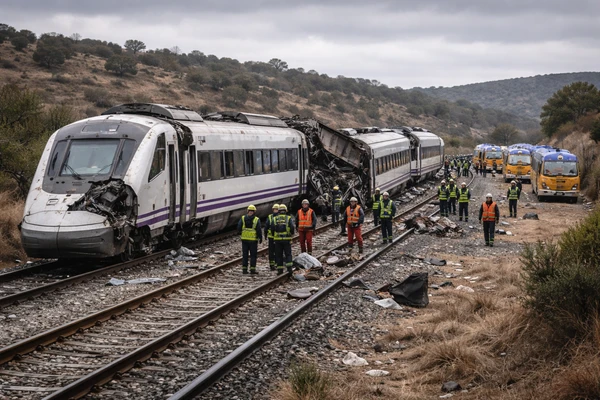
The Spanish train crash near Adamuz, in the southern province of Córdoba, has become one of Europe’s deadliest rail disasters in recent memory. On January 18, 2026, two high-speed trains collided head-on, killing at least 50 people and injuring over 100. Among the casualties was an entire family from Huelva — all except a six-year-old girl who survived with minor injuries. This article explores what happened, why it matters, and the global implications for rail safety.
Spain has long been lauded for its high-speed rail network — Alta Velocidad Española (AVE) — connecting major cities with punctuality and speed. Since its inception in the early 1990s, AVE expanded rapidly, boasting one of the longest high-speed networks in Europe. According to international transport safety data, Spain’s high-speed lines have maintained a strong safety record — until now.
The collision occurred near Adamuz, a small town in Córdoba province, approximately 460 km south of Madrid. Initial rail traffic reports indicate the crash involved two high-speed trains — one traveling northbound from Málaga to Madrid, and the other southbound toward Sevilla. Preliminary data suggest both trains were on the same track, a rare but catastrophic occurrence.
Rail disasters of this nature are uncommon in Western Europe, though not unheard of. For comparison with other major rail accidents, see Goldman Sachs Profit Surge 2026 and Thailand Crane Train Crash.
What Happened
On the evening of January 18, 2026, at approximately 18:40 local time, two high-speed trains collided near Adamuz. Emergency services received the first distress call within minutes. Local authorities described the site as chaotic, with carriages mangled and debris strewn across tracks.
Rescue operations mobilized firefighters, paramedics, civil protection units, and military engineers. Survivors were transported to hospitals in Córdoba and Málaga, while specialized units searched for victims. As of the latest official update, 50 people are confirmed dead and over 100 injured, with many in critical condition. Numbers remain provisional as recovery continues.
Spanish Prime Minister María Rodríguez declared three days of national mourning, signaling the scale of the tragedy and its impact on the national psyche.
The Lone Child Survivor
Amid the devastation, the story that captured global attention is that of a six-year-old girl, identified as a passenger traveling with her family from Huelva to Madrid for a weekend trip to see The Lion King musical and visit the Santiago Bernabéu Stadium. After the collision, she was found walking alone along the tracks, with only a minor head injury. Police officers on scene cared for her through the night before she was reunited with her grandmother in Córdoba.
Officials described her survival as a “miracle,” while psychological support teams have been assigned to assist her care and long-term recovery.
Cause and Investigation
Authorities have not yet released a definitive cause, but early technical reports cite a potential signal failure or track misalignment. Spanish rail infrastructure is managed by ADIF, while operations are run by Renfe. Investigations are ongoing, with the National Transportation Safety Committee (STSB) leading the inquiry alongside independent experts.
For authoritative updates on the investigation and rail safety protocols, see the BBC’s ongoing coverage: BBC – Spanish Train Crash Updates, and detailed analysis from Reuters: Reuters – Spanish Train Crash Investigation.
Systemic Failures or Isolated Incident?
Determining whether this crash is an isolated error or symptomatic of deeper system flaws is crucial. Spain’s rail network has historically been robust, yet rapid expansion and aging components in certain corridors could create vulnerabilities. Infrastructure experts note that high-speed lines require redundant safety systems — including automated train control that overrides human error. If evidence points to a signaling breakdown, this could reflect maintenance shortfalls or integration failures between old and new technology.
Comparative Rail Safety
Globally, high-speed rail generally maintains strong safety records compared to road travel. Japan’s Shinkansen and France’s TGV have gone decades without fatal high-speed collisions. In contrast, multicarriage derailments in Europe and Asia often trace back to infrastructure neglect or extreme weather events. The International Union of Railways (UIC) emphasizes continuous investment in Positive Train Control (PTC) and equivalent systems to prevent collisions. Should investigators find lax implementation of such systems, broad regulatory reforms may follow.
Economic and Political Implications
Beyond immediate human loss, this crash could affect public confidence in rail travel, a backbone of Spain’s transport economy. Political pressure will mount on transport ministries to justify past infrastructure spending and future budgets. Additionally, neighboring EU countries may reassess cross-border rail protocols, especially where high-speed networks intersect.
Government Officials:
- Prime Minister María Rodríguez said: “This is a day of sorrow for Spain. We owe it to the victims to understand what went wrong.”
- The Minister of Transport pledged full transparency and swift action.
Rail Unions and Workers:
Union representatives called for better safety measures: “Our workers and passengers deserve systems that prevent collisions, not just respond to them.”
International Leaders:
Leaders from France, Germany, and the UK expressed condolences, reaffirming solidarity with Spain. The European Commission offered technical assistance for the investigation.
Families and Public:
Witnesses described scenes of bravery and horror. One first responder told GSN, “We did everything we could — but the damage was immense.” Online tributes poured in for victims, especially the young family lost in the tragedy.
Implications for European Rail Networks
Europe’s interconnected rail systems prioritize safety standards that often exceed international norms. Following this crash, the European Union Agency for Railways (ERA) may update directives on signaling technology and emergency response coordination. If systemic issues are confirmed, it could reshape infrastructure funding priorities across the EU. Cross-border operators will also evaluate interoperability protocols.
Local Economic and Social Impact
Communities near Adamuz — reliant on tourism and agriculture — face disruptions. Rail closures have affected local commuters and freight routes, with ripple effects on supply chains. The psychological toll on nearby residents and first responders is profound, prompting counseling services and community support initiatives.
Travel Behavior and Public Trust
Mass transit ridership often reflects public confidence. Surveys indicate that major disasters can depress ridership for months, especially among occasional travelers. Authorities may launch public information campaigns to reassure citizens about safety measures implemented post-crash.
The Spanish train crash has shaken a nation and drawn international attention to the fragility and importance of rail safety. Amid grief, the survival of a young girl offers a poignant reminder of human resilience. As investigations proceed, Spain and partner nations face urgent choices about investing in infrastructure, technology, and oversight to prevent future tragedies. The world watches — and learns.