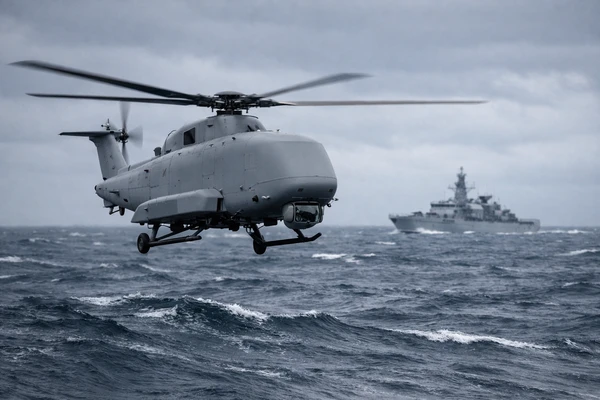
The United Kingdom has taken a decisive step into the future of naval warfare with the successful maiden flight of Proteus, the Royal Navy’s first full-scale crewless helicopter. More than a technology demonstration, the autonomous aircraft represents a strategic shift in how Britain—and its NATO allies—intend to monitor, deter, and respond to emerging threats in the North Atlantic. As geopolitical competition intensifies beneath the waves, Proteus signals a new era where endurance, autonomy, and data dominance increasingly shape maritime security.
Why the North Atlantic Matters Again
For decades after the Cold War, the North Atlantic drifted from the center of military planning. That complacency has evaporated. Subsea cables, energy infrastructure, and shipping lanes remain vital to modern economies, and strategic chokepoints such as the Greenland-Iceland-UK (GIUK) gap have regained prominence as undersea activity increases.
Rising concern around submarine operations and the protection of undersea infrastructure has forced Western navies to rethink how they secure vast maritime spaces. Traditional anti-submarine warfare platforms—crewed helicopters, frigates, and maritime patrol aircraft—remain effective but are manpower-intensive and constrained by human endurance, weather exposure, and operating costs.
In parallel, rapid advances in autonomy, sensor fusion, and navigation software have accelerated the shift toward uncrewed systems at sea. The UK Ministry of Defence has tested smaller drone platforms for maritime surveillance, but Proteus marks a major leap: autonomy applied to a full-size rotary-wing aircraft—more complex, heavier, and operationally more consequential than the small systems previously used.
Proteus Makes History
On January 16, 2026, the Royal Navy confirmed that Proteus completed its first autonomous flight from Predannack Airfield in Cornwall, a key hub for naval aviation testing and development. The platform is being developed by Leonardo Helicopters UK under a government-industry programme designed to prove how autonomous rotorcraft can enhance maritime operations.
What the first flight proved
While the maiden sortie was deliberately controlled and closely monitored from the ground, its value lies in what it demonstrated: a large rotorcraft can take off, fly, and land safely without a pilot on board. That capability opens the door to missions that are traditionally demanding for human crews—long patrols, repetitive surveillance patterns, and operations in severe weather—without risking personnel.
Design and capabilities
- No cockpit requirement: With no onboard pilot, internal space can be reallocated for sensors, fuel, or mission payloads.
- Modular mission bay: Designed to support different payload configurations, from maritime surveillance packages to equipment relevant to anti-submarine warfare tasks.
- Extended endurance potential: Autonomy reduces fatigue constraints and may allow longer loiter times than comparable crewed helicopter missions.
- Autonomous decision-support: Onboard systems are intended to interpret environmental inputs and support safe navigation without constant human control.
Operational focus
The Royal Navy has framed Proteus as especially relevant to missions such as persistent maritime surveillance and anti-submarine operations—tasks that depend on staying on-station and collecting reliable data over wide sea areas. In the North Atlantic, where conditions can change rapidly and operational distances are vast, persistence is a decisive advantage.
A Strategic Shift in Naval Aviation
Proteus is not simply “a new aircraft.” It represents a shift toward human-machine teaming at sea. Modern naval operations increasingly depend on who can detect, track, and interpret information first. Uncrewed platforms excel at persistent sensing and presence—staying in the air longer, returning to the same patrol areas repeatedly, and reducing the strain on limited crewed fleets.
Why autonomy changes the operational calculus
- Persistence: Longer loiter times can improve detection and tracking, especially against quiet underwater threats.
- Risk reduction: Removing pilots from harsh conditions lowers the human cost of accidents and dangerous missions.
- Force multiplication: Uncrewed systems can support wider coverage with fewer people, helping navies do more with finite resources.
Limits and the road to operational service
Proteus is currently a technology demonstrator, not a frontline combat platform. Key tests still lie ahead: operating from moving ships, handling complex maritime weather, integrating safely into busy airspace, and proving reliability across repeated deployments. Future versions may also require clearer doctrine and rules around responsibility, human oversight, and operational decision-making in contested environments.
Government, Industry, and Expert Perspectives
UK defence and naval leaders have described the flight as a marker of national innovation and a sign of the Royal Navy’s push toward modernized maritime aviation. Industry voices have similarly framed Proteus as a step-change in what helicopters can contribute—taking on long-duration surveillance and other high-demand missions without placing crews in harm’s way.
Defence analysts, meanwhile, caution against viewing autonomy as a simple replacement for crewed helicopters. The most realistic near-term model is a blended fleet: autonomous systems handle endurance-heavy surveillance tasks, while crewed aircraft remain central for complex operations requiring human judgment, rapid improvisation, and command leadership.
What Proteus Means Beyond Britain
For NATO and allied deterrence
Autonomous maritime aviation strengthens NATO’s ability to monitor critical underwater zones and protect infrastructure. If scaled, uncrewed helicopters could become a common feature supporting allied task groups—expanding surveillance coverage while reducing pressure on crewed fleets.
For naval warfare’s next decade
Proteus reinforces a broader trajectory: maritime defence is becoming more data-driven and autonomy-enabled. Systems that can remain on-station, feed intelligence back to commanders, and operate in tougher conditions will shape how navies deter, detect, and respond across vast ocean spaces.
For the UK defence industrial base
Proteus also signals the UK’s intent to remain competitive in advanced aerospace development. Demonstrator programmes can mature into deployable capabilities, support high-skill engineering jobs, and open pathways for international partnerships and exports.
Conclusion
The first flight of Proteus marks a pivotal moment for the Royal Navy and for modern maritime security. Autonomy offers a powerful response to the core challenges of the North Atlantic: distance, harsh weather, and the need for persistent surveillance. While Proteus still has major tests ahead before it becomes operational, the message is clear—future maritime defence will be increasingly autonomous, endurance-focused, and integrated with human decision-making. With Proteus, the UK has taken a decisive step into that future.