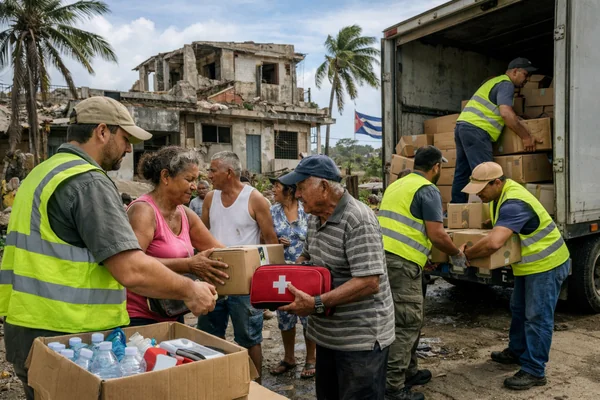
Cuba’s decision to accept humanitarian aid from the United States following a devastating hurricane marks a rare and uneasy convergence of necessity and diplomacy between two longtime adversaries. While the move offers immediate relief to storm-hit communities, it has also reignited deep political tensions, with Washington issuing explicit warnings against Cuban government interference in the aid’s delivery. The episode illustrates how humanitarian assistance, particularly between ideologically opposed states, rarely exists in a political vacuum.
Decades of Distrust and Conditional Engagement
Relations between the United States and Cuba have been defined by hostility since the early years of the Cold War. Following the 1959 Cuban Revolution, Washington imposed a sweeping economic embargo that remains largely in place today. Over the decades, the embargo has restricted trade, financial transactions, and development assistance, profoundly shaping Cuba’s economic and political landscape.
Humanitarian cooperation has occasionally punctured this wall of hostility, but rarely without controversy. After major disasters—including hurricanes in the 1990s and early 2000s—the United States has offered aid, sometimes accepted, sometimes rejected by Havana on grounds of sovereignty or political conditionality.
The most significant thaw occurred during the Obama administration, when diplomatic relations were restored, embassies reopened, and limited cooperation resumed. That period saw modest improvements in travel, remittances, and people-to-people exchanges. However, relations sharply deteriorated again following the reimposition of sanctions under subsequent U.S. administrations.
Today, Cuba faces acute economic stress: food shortages, fuel scarcity, power outages, inflation, and declining public services. Climate change has intensified hurricanes, flooding, and coastal erosion, increasing the country’s dependence on external assistance at a moment when geopolitical isolation remains profound.
Aid Acceptance Under Diplomatic Strain
The immediate trigger for the current episode was a powerful hurricane that struck Cuba in late 2025, causing widespread damage to housing, agriculture, electricity networks, and healthcare facilities. Thousands were displaced, and already fragile supply chains were further disrupted.
In response, the United States announced a $3 million humanitarian aid package, including emergency medical supplies, food assistance, water purification equipment, and shelter materials. After initial hesitation and criticism, Cuban authorities confirmed they would accept the aid.
Crucially, U.S. officials stipulated that the assistance would not be distributed through Cuban state institutions. Instead, Washington plans to route the aid through independent humanitarian channels, notably faith-based organizations such as the Catholic Church, which has a longstanding presence and social role in Cuba.
A senior U.S. State Department official publicly warned that any interference, diversion, or politicization of the aid by Cuban authorities could lead to consequences, including potential diplomatic or policy responses. The unusually direct warning underscored Washington’s mistrust of Havana’s governance structures and its desire to ensure transparency.
Cuba’s government, while accepting the aid, responded with strong rhetoric. Officials accused the United States of attempting to bypass state authority and exploit humanitarian suffering for political leverage. State media framed the aid offer as “opportunistic,” while acknowledging the scale of damage caused by the hurricane.
Humanitarian Access and International Law
Beyond bilateral politics, the situation touches on broader principles of international humanitarian law. Under global norms, humanitarian assistance should be guided by neutrality, impartiality, and independence. However, in practice, aid delivery often becomes entangled in political disputes, particularly in sanctioned or authoritarian states.
The U.S. approach—channeling aid through non-governmental actors—is not unprecedented. Similar strategies have been used in countries such as Venezuela, Syria, and Myanmar, where donor governments seek to prevent diversion by authorities. Supporters argue this enhances accountability; critics say it undermines state sovereignty and can create parallel governance systems.
For Cuba, which maintains tight state control over most sectors, the presence of externally funded aid mechanisms operating independently poses both logistical and ideological challenges. Yet rejecting the aid outright risks worsening humanitarian conditions and fueling domestic discontent.
Why This Moment Matters
The fact that Cuba accepts US aid at all is significant. It reflects the depth of the current crisis and signals a pragmatic calculation by Havana that humanitarian need outweighs political symbolism—at least temporarily.
For Washington, the move provides an opportunity to demonstrate concern for the Cuban people while maintaining pressure on the government. It also allows the U.S. to reinforce its narrative that sanctions target the state, not civilians, even as critics dispute that claim.
This moment also exposes the limits of isolation as a long-term strategy. Climate change is increasing the frequency and severity of disasters across the Caribbean, making regional cooperation unavoidable. Refusing engagement during humanitarian emergencies risks reputational damage and regional instability.
At the same time, the episode highlights why deeper normalization remains elusive. Mutual suspicion, domestic political considerations in the U.S., and Cuba’s resistance to external influence continue to constrain meaningful rapprochement.
Reactions: Regional and Global Responses
International reactions have reflected broader geopolitical alignments. Russia criticized U.S. warnings to Cuba as “blackmail” and framed the issue as another example of Western pressure on sovereign states. Some Latin American governments echoed calls for depoliticizing humanitarian assistance and urged the lifting of sanctions that complicate disaster response.
Humanitarian organizations have taken a more cautious tone. Several international NGOs emphasized that aid effectiveness depends on cooperation with local authorities, while also acknowledging concerns about transparency. Faith-based groups involved in distribution have called for restraint on all sides, stressing that politicization risks delaying relief.
Within Cuba, public reaction has been mixed. While many citizens welcome any assistance amid shortages, others express skepticism about whether aid will reach those most in need or whether political disputes will interfere with delivery.
Lives at the Center of the Crisis
On the ground, the stakes are immediate and human. Communities affected by the hurricane face damaged homes, contaminated water supplies, disrupted healthcare, and lost livelihoods. Rural and coastal areas—already among the most vulnerable—have been hit hardest.
Power outages and fuel shortages complicate recovery efforts, while inflation and food scarcity limit households’ ability to cope. For many families, external aid may determine whether recovery takes weeks or months.
Delays caused by diplomatic friction could exacerbate suffering, reinforcing calls from civil society groups to prioritize humanitarian needs over political messaging.
Global Implications: Aid, Climate, and Diplomacy
The situation in Cuba is emblematic of a broader global challenge: how to deliver humanitarian assistance in politically polarized contexts amid escalating climate risks. As disasters increase in frequency, donor governments will face growing pressure to engage even with adversarial states.
The episode also raises questions about the future of sanctions regimes in an era of climate vulnerability. Critics argue that broad sanctions can undermine disaster preparedness and response, while supporters contend they remain necessary tools of pressure.
For the Caribbean region, the case underscores the need for coordinated disaster resilience strategies that transcend ideological divides. Hurricanes do not respect political boundaries, and fragmented responses increase regional risk.
What Comes Next
The success or failure of the aid operation will shape future interactions. If assistance reaches communities efficiently and without interference, it could open limited space for confidence-building measures. If disputes escalate, it may reinforce hardline positions on both sides.
Longer-term, the episode adds to growing international debate about whether U.S.–Cuba relations require recalibration in light of humanitarian realities and climate change. While full normalization remains unlikely in the near term, pragmatic engagement during crises may become increasingly necessary.
Conclusion
Cuba’s acceptance of U.S. humanitarian aid amid sharp diplomatic warnings highlights the complex intersection of compassion, politics, and power. While the immediate priority is relief for hurricane-affected communities, the broader implications touch on sovereignty, trust, and the future of regional cooperation. As climate-driven disasters intensify, moments like this may become less exceptional—and more revealing—forcing adversaries to choose between confrontation and pragmatic coexistence.