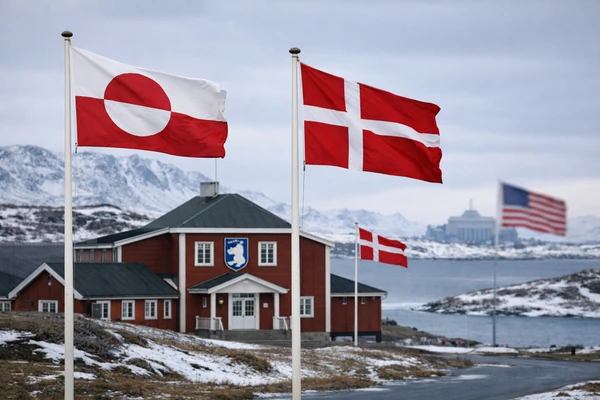
Talk of Greenland annexation resurfaced this week after U.S. President Donald Trump reiterated that the United States “needs” Greenland — suggesting strategic motives for control. The island’s Prime Minister Jens-Frederik Nielsen responded with a firm rejection, declaring “enough is enough” and insisting that Greenland’s future is for its people and Denmark to decide. European allies quickly backed this stance, warning that any annexation push would have far-reaching implications for global security and alliances. Reuters
The Greenland Question
Greenland is the world’s largest island, strategically positioned between North America and Europe and rich in untapped mineral resources. It has been an autonomous territory within the Kingdom of Denmark since 1979 and remains heavily subsidized by Copenhagen. Under international law, Greenlanders and Danes exclusively determine its future, with independence a constitutional right under the 2009 Self-Government Act.
Interest in Greenland is not new. As early as 2019, Donald Trump suggested the U.S. should “purchase” Greenland, triggering sharp diplomatic pushback from Denmark. That idea resurfaced multiple times during his second presidency, with Trump framing Greenland as critical to U.S. defense, largely due to its location and military value.
In December 2025, Trump appointed Louisiana Governor Jeff Landry as an informal special envoy focused on Greenland — a role that Denmark condemned, arguing it undermines sovereignty and constitutes unwelcome interference. Landry has publicly advocated for making Greenland part of the United States.
Trump’s Renewed Comments
On January 5, 2026, Trump again thrust Greenland into the geopolitical spotlight. Speaking shortly after a controversial U.S. military operation in Venezuela that removed Nicolás Maduro from power, Trump linked that action to his wider global defense strategy and reiterated his view that Greenland is essential to U.S. security and defense logistics.
Trump told reporters — and later in interviews — that he believes the United States “absolutely needs” Greenland, citing concerns about Russian and Chinese presence in Arctic waters and the region’s strategic value for missile defense systems. These remarks revived fears in Denmark and Greenland that territorial ambitions might go beyond mere rhetoric.
In response, Greenland’s Prime Minister Jens-Frederik Nielsen published a pointed message: “Enough is enough. No more fantasies about annexation. Threats, pressure, and talk of annexation have no place between friends.”
Nielsen also sought to ease public anxiety, noting that Greenland remains a democratic society and that there is no realistic risk of an immediate takeover. He emphasized Greenland’s interest in stronger ties with the United States — just not through forced integration or annexation. <
Denmark’s Prime Minister Mette Frederiksen echoed the critical tone. She warned that any U.S. attempt to seize another NATO ally’s territory would spell the end of the alliance itself — and stressed that the U.S. has no right to annex Greenland, which is covered by NATO’s collective defense guarantees.
France also reiterated support for Danish and Greenlandic sovereignty, stating unequivocally that territorial control belongs only to the people and governments of Denmark and Greenland. The broader European Union endorsed this position as well.
Geopolitical Implications
The Greenland controversy illustrates a deeper shift in international relations where great-power competition intersects with Arctic geopolitics. As polar ice melts and shipping lanes open, Greenland’s position becomes ever more critical. Its significant deposits of rare earth minerals make it attractive not just for military planning, but for economic and technological strategic purposes, particularly for reducing reliance on Chinese supply chains.
From a U.S. perspective, strategic control of Greenland could offer advantages in missile defense, early warning systems, and Arctic maritime dominance. However, such ambitions collide with international norms on sovereignty and self-determination. Attempting to alter territorial status by force or coercion — even implicitly — undermines the United Nations Charter and could destabilize established alliances. United Nations Charter
For Denmark and the EU, Greenland symbolizes the limits of external influence and the robustness of Western diplomatic norms. European backing for Greenland’s autonomy also reflects fears that U.S. assertiveness might embolden Russia or challenge existing security architectures in the Arctic. Analysts also warn of domestic political effects within Greenland: Trump’s remarks have bolstered both independence movements and resistance to foreign interference, complicating Copenhagen’s traditional role and Greenland’s internal politics.
Reactions and Voices
Greenland Government: Greenland’s leadership, under Nielsen, stood firm — denouncing annexation rhetoric and urging calm but clear autonomy. Nielsen’s call for dialogue emphasizes maintaining diplomatic relationships without threatening sovereignty.
Denmark: Frederiksen described U.S. threats as “unacceptable” and reiterated Denmark’s rights over its territory. She stated that any attack or annexation attempt would irreparably harm NATO, one of the cornerstone institutions of Euro-Atlantic security.
European Allies: France, Finland, Sweden, and other Nordic countries publicly backed Denmark and Greenland, underscoring that territorial decisions must not be dictated by external powers.
International Observers: Commentators from global think tanks warned that the controversy could strain U.S.–EU relations and affect cooperation on security issues beyond the Arctic, including climate, trade, and defense.
Global and Local Impact
Internationally, the debate over Greenland’s future has spotlighted Arctic geopolitics. With climate change opening new sea routes and global powers vying for influence, Greenland sits at the nexus of environmental, economic, and security interests — making it far more than a peripheral issue.
For the Greenlandic public, fears of U.S. annexation — however improbable — have activated political engagement and public debate about independence, identity, and long-term strategy. A majority of Greenlanders historically oppose U.S. incorporation, seeing it as incompatible with their culture and self-determination aspirations.
Regionally, Nordic cooperation on Arctic issues is likely to strengthen as Denmark and its neighbors coordinate responses and security planning, reinforcing the role of NATO and EU frameworks. Washington’s stance may force European capitals to reassess defense cooperation dynamics with the United States.
Economically, investment decisions in Greenland — from mining to infrastructure — will be influenced by perceptions of stability and geopolitical risk, affecting global supply chains tied to rare minerals.
Conclusion
The Greenland annexation debate has escalated from rhetoric to a full-blown geopolitical flashpoint. President Trump’s renewed comments have triggered widespread diplomatic pushback, united European support for sovereignty, and intensified public discourse in Greenland itself. As Arctic geopolitics evolves, the core principle remains unchanged: territorial futures must be decided by the people who live there, within the framework of international law and mutual respect. The coming months will test alliances and shape Arctic strategy for years to come.