The incident has triggered intense international debate over sovereignty, legality, and the future of Venezuela’s political leadership, marking one of the most consequential U.S. interventions in Latin America in decades.
Venezuela’s Political and Security Landscape
Venezuela’s prolonged political crisis has unfolded over more than a decade, driven by economic collapse, international sanctions, and deep political polarization. Under President Nicolás Maduro, the country experienced hyperinflation, shortages of basic goods, and a mass exodus of citizens seeking refuge abroad.
Maduro’s survival in power relied heavily on a loyal security apparatus, composed of elite military and intelligence units tasked with protecting the presidency and suppressing internal dissent. These units operated alongside state institutions and were widely seen as instrumental to regime stability.
The United States and several allies accused Maduro’s administration of corruption, election manipulation, and ties to transnational criminal networks. Despite diplomatic pressure and sanctions, Maduro remained entrenched, increasing the likelihood of a more direct confrontation.
The U.S. Military Operation
What Happened
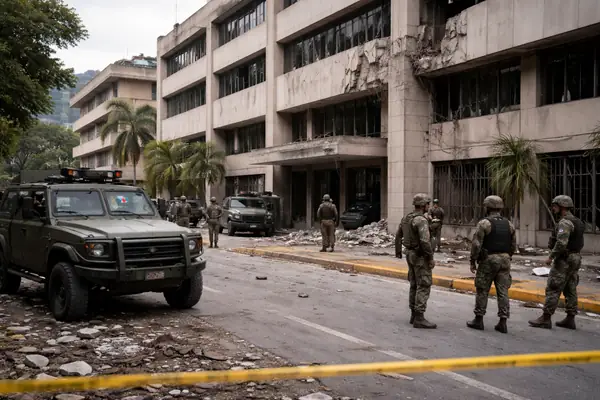
According to Venezuela’s defense minister, a significant portion of Maduro’s security detail was killed during a U.S. military action that targeted key locations tied to the president’s inner circle. While exact casualty figures were not disclosed, officials described the losses as substantial.
The operation reportedly involved coordinated air and ground components, with explosions heard near Caracas and surrounding areas. Residential neighborhoods suffered damage, and several homes were destroyed. Authorities have not released an official civilian casualty count.
Maduro and his wife, Cilia Flores, were detained and transferred to the United States to face federal charges related to narcotics trafficking and organized crime. Washington characterized the mission as lawful and necessary, while Venezuelan leaders condemned it as a violation of sovereignty.
The sudden escalation echoes other global crises where state authority and security were tested, such as the instability following the Mexico earthquake of 2026 , which similarly exposed governance vulnerabilities during national emergencies.
Why the U.S. Acted
U.S. officials justified the operation on national security grounds, arguing that Venezuela had become a hub for transnational criminal activity with direct implications for regional stability. From Washington’s perspective, sanctions and diplomacy had failed to alter Maduro’s behavior.
Geopolitically, Venezuela’s alliances with U.S. rivals heightened strategic concerns. Analysts note that Latin America has increasingly become an arena for global power competition, making the Maduro government a focal point for U.S. interventionist policy.
Critics, however, warn that unilateral military action undermines international law and could set a precedent for future interventions. Supporters counter that extraordinary threats require extraordinary measures.
Reactions and Official Responses
Vice President Delcy Rodríguez, recognized by Venezuela’s Supreme Tribunal as interim president, denounced the attack and demanded international condemnation. She accused Washington of imperial overreach and pledged resistance.
U.S. officials defended the mission, stating that it was narrowly targeted and intended to facilitate a political transition. Former President Donald Trump warned Venezuelan leaders against defying U.S. directives.
Across Latin America, reactions were divided. Some governments condemned the action, while others quietly welcomed Maduro’s removal after years of instability.
Global and Local Impact
Regionally, the operation has sent shockwaves through Latin America. Governments are reassessing security strategies, while markets react cautiously to uncertainty surrounding Venezuela’s oil sector.
Humanitarian organizations have urged restraint and emphasized the need to protect civilians. With infrastructure damaged and governance in flux, aid delivery remains a pressing concern.
Energy analysts compare the situation to other high-risk policy shifts, including Japan’s controversial return to nuclear power, detailed in GSN’s report on the Japan nuclear restart , where strategic decisions carried long-term regional consequences.
Conclusion
The deaths reported among the Maduro security team killed during the U.S. operation represent a turning point in Venezuelan and regional history. The capture of a sitting president through foreign military action raises profound legal, political, and ethical questions.
As Venezuela enters an uncertain transition period, the international community faces the challenge of balancing accountability, stability, and humanitarian responsibility in a deeply divided nation.