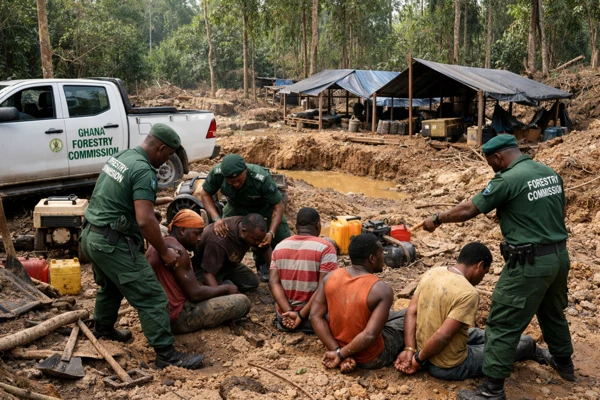
Illegal mining arrests in Ghana have surged after forestry officials detained 31 suspects in the Apamprama Forest Reserve, exposing deep-rooted environmental and governance challenges.
Ghana’s Long Battle With Illegal Mining
Ghana’s struggle with illegal mining, locally known as galamsey, is longstanding and deeply complex. What started as informal livelihood activities by small rural communities has ballooned into a large informal economy with extensive environmental and social consequences.
Forest reserves like Apamprama were legally protected to conserve biodiversity, shield water bodies, and safeguard community livelihoods. However, weak enforcement, economic desperation, and political entanglements have eroded those protections. National data indicates that at least 44 out of Ghana’s 288 forest reserves have been degraded by illegal mining activities, costing over 5,000 hectares of forest land in recent years — with severe impacts on ecosystems and water systems.
The use of toxic chemicals such as mercury and cyanide in illicit gold extraction has further contaminated rivers and inland water sources, threatening public health and agricultural productivity. According to environmental studies, rampant mining pollution has rendered many water bodies unsafe and increased treatment costs for urban water services.
What Happened in Apamprama Forest
On December 30, 2025, the Forestry Commission’s Rapid Response Team executed a coordinated operation in Compartment 17 of the Apamprama Forest Reserve in the Ashanti Region. Officials arrested 31 suspected illegal miners — 28 Chinese nationals and three Ghanaian citizens who were preparing to mine without valid authorization.
Authorities reported that the group had established a camp under the guise of “reclamation work” but lacked any legally verifiable permit. The Commission seized assets on site, including:
- Four makeshift structures
- One pickup truck
- One mini truck
- One generator
Officials believe nearly 50% of the Apamprama Forest Reserve has already been degraded by mining intrusions and related activities — a stark indicator of how pervasive galamsey has become within protected ecosystems.
The arrested individuals were turned over to law enforcement with intent to prosecute under Ghana’s mining and environmental protection laws. The Forestry Commission has framed these actions as a deterrent to other would-be violators.
Why Illegal Mining Arrests Keep Repeating
While operations like the one in Apamprama highlight enforcement efforts, analysts argue that arrests alone cannot end galamsey. Three structural issues continue to fuel the cycle:
Economic Pressures
High levels of unemployment — particularly among Ghanaian youth — drive many into informal mining, which often pays more than traditional farming or wage work. Without alternative livelihood programs, economic desperation remains a core driver. Experts note that this dynamic is not unique to Ghana but is common where natural resources offer lucrative yet unsustainable income opportunities.
Foreign Involvement and Transnational Networks
The presence of foreign nationals in illegal mining operations has raised diplomatic sensitivities and operational challenges. While some may seek opportunity, others are reportedly part of transnational networks that move equipment, finance, and extracted minerals across borders — complicating enforcement. According to reporting on Ghana’s broader mining crackdown, similar dynamics have involved armed groups and sophisticated logistics.
Policy and Enforcement Gaps
Despite recent policy shifts — including a nationwide ban on mining in declared forest reserves aimed at curbing environmental damage — enforcement remains uneven. Critics argue that laws must be accompanied by stronger monitoring mechanisms, transparent prosecution, and community participation to be effective.
Comparative lessons from countries like Peru and Indonesia show that enforcement backed by satellite monitoring and community engagement can significantly reduce illegal extraction in sensitive zones.
Officials, Experts, and Communities
Officials from the Forestry Commission hailed the arrests as a decisive step toward protecting national assets. “These actions are necessary to safeguard our forests and uphold the rule of law,” a Commission spokesperson said.
Environmental groups, however, warned that arrests must be matched by legal accountability. “Arrests are critical, but without swift prosecution, they risk becoming symbolic rather than catalytic,” said an environmental advocate in Accra.
Local residents near Apamprama expressed mixed sentiments. Some applauded the crackdown, while others highlighted the lack of employment opportunities as a key driver of illegal mining participation. Civil society organizations have called for expanded economic support and environmental education programs in rural communities.
Global and Local Impact
The implications of illegal mining arrests in Ghana extend beyond local ecosystems. At home, continued forest degradation endangers water supplies, local agriculture, and public health. Nations and international partners have recognized the broader consequences of unchecked mining pollution, including climate impacts from deforestation and contamination of transboundary water systems.
Internationally, Ghana’s fight against galamsey contributes to global environmental governance debates, particularly in how resource-rich developing countries balance economic growth with sustainability. These dynamics tie into broader discussions on climate resilience, rural development, and cross-border environmental crime.
This case complements other recent investigations by GSN into governance and crisis response, including:
Conclusion
The latest illegal mining arrests in Ghana demonstrate a renewed enforcement push but also reveal systemic challenges that enforcement alone cannot solve. Protecting critical forest reserves like Apamprama will require integrated policies: stronger law enforcement, community engagement, economic alternatives for vulnerable populations, and international cooperation.