Germany’s Banking Security Reputation
Germany has long been regarded as one of Europe’s safest banking environments. Its savings banks, particularly the publicly owned Sparkasse network, are trusted institutions serving millions of customers, from pensioners to small businesses. Safe deposit boxes in German banks are often perceived as more secure than private safes or home storage, especially for high-value assets such as jewelry, gold, inheritance documents, and cash savings.
However, history suggests otherwise. Over the past decade, Germany has witnessed several high-profile burglaries involving safe deposit facilities, often linked to organized crime groups with expertise in construction, engineering, and surveillance evasion. Similar vulnerabilities have been exposed globally, including cases of institutional negligence and delayed detection, echoing broader security failures reported in other sectors such as education and public safety, including incidents like the recent nursery school security case reported by Global Standard News.
What Happened in the Heist
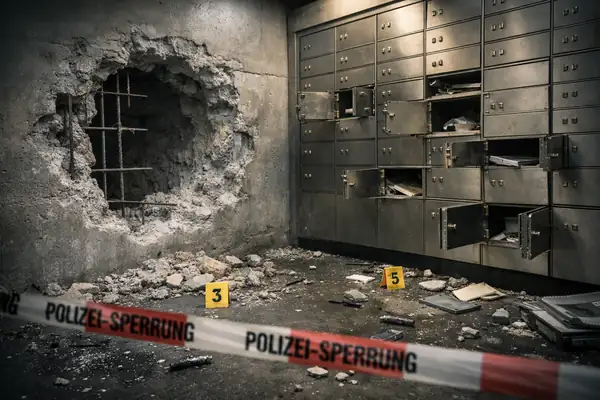
The burglary occurred at a Sparkasse branch in Gelsenkirchen, a city in Germany’s industrial Ruhr region. According to police investigations, the criminals drilled through a thick concrete wall to access the bank’s underground vault. Once inside, they systematically broke into thousands of individual safe deposit boxes, removing cash, jewelry, gold, and personal valuables.
The operation is believed to have taken place between December 24 and December 29, a period when banks were closed for the Christmas holidays. The crime was only discovered after a fire alarm was triggered, alerting authorities to unusual activity inside the building.
Witnesses later reported seeing several men carrying large bags through a nearby parking garage late at night. Security cameras also captured a black Audi RS6, later confirmed to have been stolen in another German city, fleeing the scene. The suspects reportedly wore masks and gloves, leaving investigators with limited physical evidence.
As of publication, no arrests have been made. German police believe the operation may be connected to a broader network of organized financial crime, similar in sophistication to cyber-enabled and cross-border criminal syndicates previously highlighted in investigations such as Global Standard News’ report on cybercrime crackdowns.
How Could a Bank Vault Be Breached So Easily?
The German bank vault heist highlights a troubling reality: traditional vault security may no longer be sufficient against modern criminal tactics. Experts identify several critical weaknesses exposed by the incident.
Holiday Timing and Reduced Oversight
Criminals deliberately targeted a period when banks were closed and inspections were delayed. Reduced staffing created a window of opportunity for prolonged, uninterrupted access.
Limits of Physical Security
While reinforced concrete vaults are designed to deter forced entry, they are not impenetrable. With industrial-grade drilling equipment and time, even the strongest barriers can be breached.
Privacy Versus Surveillance
Many vaults lack internal monitoring due to customer privacy laws. This creates blind spots that sophisticated criminals exploit.
Organized Crime Expertise
German authorities have repeatedly warned that organized crime groups increasingly employ engineers and technicians capable of executing complex, low-noise operations with precision.
Customers, Authorities, and Experts Respond
The discovery of the theft sparked anger and anxiety among affected customers. Dozens gathered outside the Sparkasse branch demanding answers, many fearing that irreplaceable family heirlooms and life savings had been lost.
Several customers told local media that their safe deposit boxes contained valuables passed down through generations. Others expressed frustration at what they described as delayed communication from the bank.
Police officials have confirmed that investigations are ongoing but declined to comment on specific security failures. Financial security analysts, however, have warned that safe deposit boxes often provide a false sense of absolute security.
Global and Local Impact
The implications of the German bank vault heist extend well beyond Gelsenkirchen. In Germany, the incident risks undermining trust in Sparkasse banks, which form the backbone of the country’s retail banking system. Legal questions may also arise regarding liability and compensation, as many safe deposit box contents are not insured by default.
Across Europe, banks are likely to reassess holiday security protocols and vault monitoring standards. Regulators may face increased pressure to mandate clearer disclosure on insurance coverage and risk exposure.
Internationally, the case mirrors a broader rise in sophisticated financial crime reported by outlets such as Reuters and BBC News, underscoring the need for modernized security frameworks.
Conclusion
The German bank vault heist is more than a headline-grabbing crime. It is a warning to financial institutions and customers alike that traditional assumptions about security are increasingly outdated. As criminal methods evolve, banks must adapt quickly or risk eroding public trust. Whether this incident becomes a catalyst for reform or another forgotten scandal will depend on the lessons learned—and acted upon—in the weeks ahead.
Author: Patrick Sasu
Senior International Affairs Correspondent, Global Standard News
Category: World News / Finance
Tags: German bank vault heist, Germany crime, Sparkasse bank, bank security failure, Europe financial crime, safe deposit boxes, organized crime