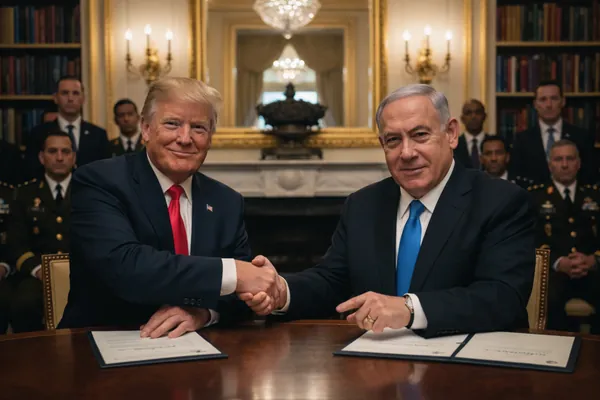
PALM BEACH, FL — In a pivotal moment for Middle Eastern stability, the Trump Netanyahu Gaza plan entered a critical new chapter on Monday as U.S. President Donald Trump hosted Israeli Prime Minister Benjamin Netanyahu at Mar-a-Lago. The high-level summit focused on operationalizing the long-delayed second phase of the ceasefire agreement signed earlier this October.
With Gaza still reeling from more than two years of devastating conflict, the meeting underscored mounting pressure to transition from active warfare to post-conflict stabilization. Emerging briefly before the press, President Trump asserted that “significant progress” had been made, though senior officials caution that major obstacles remain.
The Road to Phase Two
The origins of the current Trump Netanyahu Gaza plan lie in the fragile October 2025 ceasefire framework brokered by Washington after months of stalled diplomacy. The agreement laid out a multi-phase roadmap designed to halt hostilities, secure the release of hostages, and restructure Gaza’s governance model.
Phase One, which has been in effect for approximately ten weeks, centered on a limited ceasefire and the initial exchange of civilian hostages. However, negotiations around Phase Two stalled amid accusations of “slow-walking” compliance—particularly regarding Israeli troop withdrawals and humanitarian access.
Regional volatility continues to loom large. Tensions with Iran remain elevated, while intermittent clashes with Hezbollah along Israel’s northern border underscore the fragility of any Gaza-focused de-escalation.
Inside the “Winter White House” Talks
The December 29 Mar-a-Lago summit—often referred to by aides as Trump’s “Winter White House”—served as both a strategic planning session and a political reset. The Trump Netanyahu Gaza plan remains heavily dependent on the personal rapport between the two leaders, which Netanyahu reportedly leveraged to bypass skepticism within parts of the U.S. national security apparatus.
The “Board of Peace” Governance Model
One of the most consequential developments from the talks was further clarification of Gaza’s proposed post-war governance structure. Central to this vision is the creation of a so-called “Board of Peace.”
According to officials familiar with the discussions, the board would be chaired nominally by President Trump and oversee a council of Palestinian technocrats tasked with managing essential services, reconstruction, and civil administration.
The structure is explicitly designed to marginalize both Hamas and traditional Palestinian political factions, replacing them with administrators vetted by Israel and the United States.
The International Stabilization Force (ISF)
Another core pillar of the Trump Netanyahu Gaza plan is the deployment of an International Stabilization Force (ISF) following the phased withdrawal of the Israel Defense Forces from populated areas.
While the final composition of the ISF remains under negotiation, discussions at Mar-a-Lago focused on logistics, funding mechanisms, and rules of engagement. President Trump emphasized that the United States would coordinate the effort but expects regional Arab partners to contribute the majority of personnel.
Solving Problems “In Five Minutes”
During a brief press appearance, President Trump claimed that several longstanding obstacles had been resolved rapidly. While no specifics were provided, analysts suggest these breakthroughs likely involved reconstruction financing and vetting criteria for Gaza’s interim administrators.
Analysis: Friction Points and Political Tensions
The Disarmament Dilemma
Despite optimistic rhetoric, the most fragile component of the Trump Netanyahu Gaza plan remains the issue of Hamas disarmament. President Trump reiterated his position that Hamas must relinquish its weapons—a demand the group has categorically rejected.
The Hostage Sticking Point
Prime Minister Netanyahu faces intense domestic pressure over the remaining hostages. Israeli officials confirmed that discussions at Mar-a-Lago included demands for the return of the remains of Ran Gvili, with Netanyahu signaling that full Phase Two implementation cannot proceed without resolution.
Bypassing the Cabinet
The summit also exposed internal U.S. tensions. Reports indicate that Vice President JD Vance and Secretary of State Marco Rubio have expressed frustration with Netanyahu’s negotiating posture. By appealing directly to President Trump, Netanyahu effectively sidestepped the traditional diplomatic chain.
GSN Insight: “Netanyahu understands Trump’s preference for headline victories over procedural detail. Securing Trump’s public endorsement provides valuable political insulation,” said Elena Ross, GSN Senior Geopolitical Analyst.
Global and Regional Implications
The Iranian Equation
Iran loomed large over the talks. President Trump issued renewed warnings regarding Tehran’s nuclear ambitions, reinforcing Washington’s security guarantees to Israel even as it presses for concessions in Gaza.
Parallels With Ukraine
The timing of the meeting was notable. Just one day earlier, President Trump hosted Ukrainian President Volodymyr Zelensky at Mar-a-Lago, reinforcing a broader narrative of global conflict resolution.
Related coverage on GSN includes Canada’s expanding economic aid to Ukraine and an analysis of policy-driven leadership shifts inside the U.S. government.
International Reactions
Palestinian Leadership: Officials in Ramallah expressed skepticism over the proposed “Board of Peace,” warning it could permanently detach Gaza from the West Bank politically.
International Observers: The United Nations welcomed movement toward Phase Two but cautioned that peacekeeping efforts require a robust mandate. More context is available via the United Nations.
External Reporting: According to Reuters, U.S. envoys continue pressing Israeli officials over delays in humanitarian access and aid corridor implementation.
Conclusion
As the Mar-a-Lago summit concludes, the Trump Netanyahu Gaza plan stands at a defining moment. Phase Two offers a rare opening for sustainable stabilization in Gaza—but only if its most contentious elements can be enforced.
For President Trump, success would reinforce his deal-making legacy. For Prime Minister Netanyahu, it represents political survival. For Gaza’s civilians, the question remains whether this plan can finally deliver durable peace.
The world now watches to see whether the “Board of Peace” can move from a concept negotiated in Florida to a functioning reality on the ground.