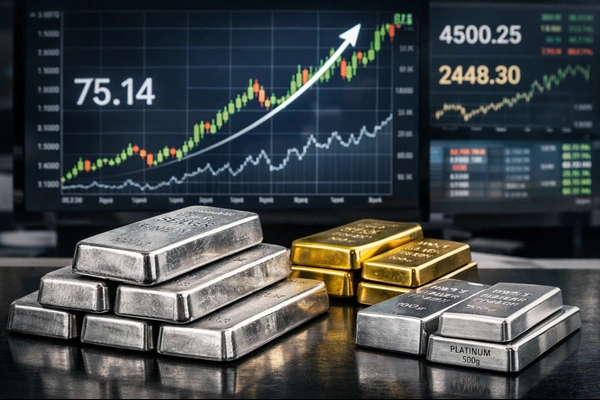
Silver prices surge past $75 an ounce for the first time in history, marking one of the most dramatic moments in modern commodities trading. The milestone, recorded on December 26, 2025, comes amid a broader rally in precious metals, with gold and platinum also climbing to record highs. Analysts say the surge reflects a potent mix of global economic uncertainty, tightening supply, industrial demand, and expectations of looser monetary policy in major economies.
This unprecedented rally is not merely speculative. It underscores structural changes in how precious metals are valued, traded, and consumed worldwide.
Why Precious Metals Matter
Precious metals have long played a dual role in the global economy. Gold has traditionally served as a store of value and hedge against inflation, while silver straddles both investment and industrial uses. Platinum and palladium, meanwhile, are critical to automotive, energy, and clean-technology sectors.
Historically, silver traded at a significant discount to gold, often called “the poor man’s gold.” However, over the past decade, silver’s growing importance in renewable energy, electronics, and battery technology has tightened supply-demand dynamics.
According to market historians, silver markets are structurally smaller and more volatile than gold, making them particularly sensitive to supply disruptions, speculative flows, and macroeconomic shifts. These characteristics have amplified the scale and speed of the current rally.
A Historic Rally Unfolds
On December 26, spot silver prices surged to $75.14 per ounce, surpassing all previous records, according to Reuters. The metal has now gained more than 150% year-to-date, dramatically outperforming gold and most other commodities.
Gold also climbed to fresh highs, trading above $4,500 per ounce, while platinum surged over 7% in a single session, briefly touching $2,448 per ounce—a record level. Palladium joined the rally, extending gains fueled by supply constraints and renewed industrial demand.
Market participants attributed the sharp price moves partly to thin year-end liquidity, which tends to magnify volatility. However, analysts emphasize underlying drivers are fundamentally strong rather than purely technical.
What Is Driving Silver’s Outsized Gains
Silver’s rally stands out even among the broader precious metals surge.
Industrial demand has expanded sharply as silver remains essential for solar panels, electric vehicles, telecommunications equipment, and medical technologies. According to the BBC, global clean-energy investment has intensified demand for critical metals, placing long-term pressure on supply chains.
The U.S. government’s designation of silver as a critical mineral has further elevated its strategic value. Institutional investors have responded by increasing allocations, while supply growth remains constrained by limited mining expansion.
At the same time, falling real yields and expectations of future interest-rate cuts have reduced the opportunity cost of holding non-yielding assets like silver, reinforcing its appeal as both a hedge and a speculative instrument.
Reactions and Expert Commentary
Market analysts describe the rally as a structural re-rating rather than a temporary spike.
“Silver has been undervalued for years relative to its industrial importance,” one commodities strategist told Reuters. “What we are seeing now is a delayed price response to long-term supply and demand imbalances.”
However, analysts also caution that silver remains volatile and could experience sharp pullbacks if monetary policy expectations change or global growth weakens.
What This Means for Economies and Consumers
The surge in precious metals prices has significant implications for governments, industries, and households.
Emerging economies with strong mining sectors may benefit from higher export revenues, while manufacturers face rising input costs that could be passed on to consumers. Central banks, particularly in Africa and Asia, are also increasing precious-metal reserves as part of broader diversification strategies.
This trend aligns with developments highlighted in Global Standard News’ coverage of Ghana’s record gold exports in 2025 and Nigeria and Kenya expanding gold reserves, signaling a broader global shift toward hard assets.
Conclusion
Silver prices surging past $75 represents a turning point for precious metals markets. Alongside record gold and platinum prices, the rally reflects deep-rooted economic and industrial changes rather than short-term speculation. While volatility remains, precious metals are increasingly central to global economic strategy, investment planning, and energy transitions.