Mount Kilimanjaro and High-Risk Rescue Operations
Mount Kilimanjaro, Africa’s highest peak at 5,895 metres (19,341 feet), attracts an estimated 50,000 climbers annually. While widely considered a “non-technical” mountain, Kilimanjaro poses severe risks due to altitude sickness, unpredictable weather, and rapidly changing visibility.
Over the past decade, the number of emergency evacuations on the mountain has increased, driven by rising tourism and the commercialization of climbing expeditions. Helicopter rescues, though rare, are used in extreme cases when climbers or guides develop life-threatening conditions such as cerebral or pulmonary edema.
However, aviation experts consistently warn that high-altitude helicopter operations on Kilimanjaro are among the most dangerous in Africa. Thin air reduces lift capacity, weather changes can be sudden and violent, and landing zones are often improvised on rocky, uneven terrain. The Mount Kilimanjaro helicopter crash underscores how narrow the margin for error can be.
What Happened in the Mount Kilimanjaro Helicopter Crash
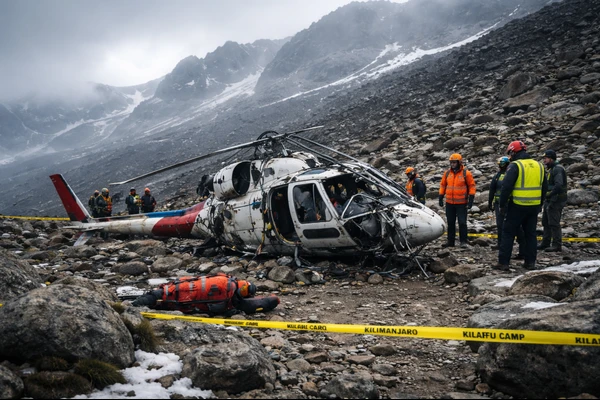
According to the Tanzania Civil Aviation Authority (TCAA), the helicopter crashed on Wednesday, December 25, 2025, near the Barafu Camp area, a high-altitude section commonly used by climbers attempting the summit via the Lemosho and Machame routes.
Victims Identified
Authorities confirmed that all five people on board were killed. They included:
- A Tanzanian medical doctor
- A Tanzanian tour guide
- A Zimbabwean pilot
- Two Czech nationals believed to be tourists
The helicopter was reportedly conducting a medical evacuation mission when it encountered difficulties and went down at an altitude estimated between 4,670 and 4,700 metres above sea level.
Rescue Turned Recovery
Due to the altitude and harsh conditions, emergency responders faced significant challenges reaching the crash site. Recovery efforts were delayed as authorities coordinated with park officials, aviation experts, and local rescue teams.
The wreckage was found scattered across rocky terrain, suggesting the aircraft may have lost control during approach or maneuvering—though officials have stressed that the cause of the Mount Kilimanjaro helicopter crash has not yet been determined.
An official investigation has been launched under international aviation safety protocols, similar to other complex security and emergency incidents reported globally, including major threats covered in Global Standard News’ UK terrorism plot investigation.
Why Helicopter Operations on Kilimanjaro Are Exceptionally Dangerous
1. Thin Air and Reduced Engine Performance
At high altitudes, helicopters suffer reduced engine power and lift. Even minor miscalculations in weight, wind, or temperature can prove catastrophic.
2. Unpredictable Weather
Kilimanjaro is notorious for sudden fog, high winds, and rapid temperature drops. Visual flight conditions can deteriorate within minutes, leaving pilots with few safe options.
3. Limited Infrastructure
Unlike urban rescue zones, Kilimanjaro lacks designated helipads at higher elevations. Pilots must rely on narrow, uneven clearings that offer little room for error.
4. Increasing Tourism Pressure
As climbing permits rise, so does demand for emergency evacuations. Experts warn that commercial pressures may be pushing aviation services closer to operational limits, a challenge mirrored in other high-risk sectors such as nuclear infrastructure restarts reported in Global Standard News’ Japan nuclear restart coverage.
The Mount Kilimanjaro helicopter crash is likely to intensify scrutiny of whether current safety standards are sufficient for such missions.
Reactions and Official Statements
The Tanzania Civil Aviation Authority expressed condolences to the families of the victims, calling the crash “a deeply tragic incident.”
Local police officials confirmed cooperation with aviation investigators, while park authorities temporarily restricted certain activities in the affected area.
International reaction has also been swift. Czech officials acknowledged the loss of two citizens and said they were working closely with Tanzanian authorities for repatriation and investigation support.
Aviation safety analysts quoted by international media, including Reuters and DailyNation, emphasized that rescue missions, while noble, must never compromise flight safety margins, especially in extreme terrain like Kilimanjaro.
Global and Local Impact
Impact on Tanzania’s Tourism Industry
Tourism is a critical pillar of Tanzania’s economy, and Mount Kilimanjaro is its most iconic attraction. While such incidents are rare, the Mount Kilimanjaro helicopter crash could prompt renewed safety reviews and stricter regulations.
Impact on Global Mountaineering
The tragedy reinforces calls within the global climbing community for better acclimatization standards, improved guide training, and clearer evacuation protocols.
Policy and Regulation Implications
Aviation authorities across Africa may reassess high-altitude rescue frameworks, potentially leading to tighter flight approval standards, enhanced pilot training requirements, and improved coordination between medical and aviation services.
The Mount Kilimanjaro helicopter crash may become a reference case in future aviation safety reforms.
Conclusion
The Mount Kilimanjaro helicopter crash is a sobering reminder that even life-saving missions carry profound risks in extreme environments. As investigations continue, the tragedy leaves behind grieving families, unanswered questions, and a renewed urgency to strengthen aviation safety protocols.
For Tanzania and the international community, the challenge now lies in ensuring that rescue operations on Africa’s highest peak honor both the mission to save lives and the imperative to protect those who undertake that dangerous duty.