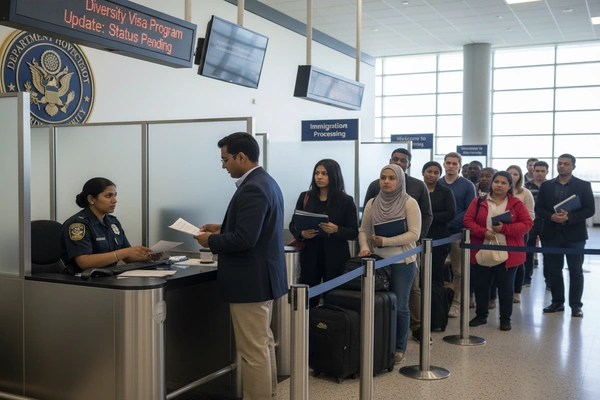
Green Card Lottery Suspension has emerged as a defining flashpoint in the latest chapter of U.S. immigration policy, following President Donald Trump’s directive to halt the Diversity Immigrant Visa (DV) Program. The decision, announced after a deadly university shooting involving a foreign-born legal resident, has reignited debate over national security, executive authority, and the future of one of America’s most controversial legal migration pathways. While supporters argue the move strengthens public safety, critics warn it risks politicizing tragedy and undermining congressionally mandated immigration systems.
What Is the Diversity Visa Program?
The Diversity Immigrant Visa Program, commonly known as the green card lottery, was created by the U.S. Congress in 1990 to diversify immigration flows into the United States. Each year, up to 50,000 visas are allocated to individuals from countries with historically low rates of U.S. immigration. Applicants are randomly selected but must still pass extensive background checks, interviews, and security screenings before receiving permanent residency.
For decades, the program has played a significant role in legal migration from Africa, Eastern Europe, and parts of Asia. However, it has also faced persistent criticism from conservative policymakers who argue that random selection undermines merit-based immigration systems.
President Trump has long opposed the program, calling it a security risk and an outdated pathway. Previous attempts to abolish it during his first term were blocked by Congress, making the current Green Card Lottery Suspension one of the most consequential actions taken against the program so far.
Why the Program Was Suspended
The immediate catalyst for the Green Card Lottery Suspension was a violent campus shooting in the United States involving a foreign-born legal permanent resident who reportedly entered the country through the DV program several years earlier.
According to U.S. Department of Homeland Security statements reported by JoyNews, Homeland Security Secretary Kristi Noem confirmed that U.S. Citizenship and Immigration Services (USCIS) had been instructed to pause all diversity visa processing while a security review is conducted.
Administration officials framed the move as a temporary national security measure, arguing that the incident exposed weaknesses in immigration screening procedures. However, immigration lawyers note that because the DV program is established by statute, a prolonged suspension could face serious legal challenges in federal court.
The decision comes amid broader immigration pressure in the United States, including changes to skilled-worker visas and enforcement actions. Similar disruptions were seen recently when policy shifts triggered anxiety among Indian professionals following proposed H-1B visa fee hikes, a development previously examined by Global Standard News.
India H-1B Visa Hike Sparks Panic Among Migrants
Security, Politics, and Executive Authority
The Green Card Lottery Suspension raises critical questions about the scope of presidential authority over immigration systems created by Congress. While the executive branch can influence enforcement and processing priorities, outright suspension may test constitutional boundaries.
From a security standpoint, experts caution against linking immigration pathways directly to violent crime. Research cited by international agencies consistently shows that immigrants are statistically less likely to commit violent offenses than native-born citizens. Analysts argue that focusing solely on immigration status risks diverting attention from domestic issues such as gun access, mental health services, and campus security protocols.
Politically, the suspension aligns with Trump’s long-standing immigration agenda and reinforces tough-on-border messaging. It also resonates with voter blocs concerned about national security, even as it alarms civil rights groups and legal scholars.
Reactions and Public Response
Reactions to the Green Card Lottery Suspension have been sharply divided. Senior Homeland Security officials defended the decision as a necessary step to protect public safety, while conservative lawmakers renewed calls for the permanent elimination of the diversity visa program.
Immigrant advocacy organizations criticized the move as reactionary, warning that suspending legal migration pathways could push more people toward irregular routes. Legal experts interviewed by international media outlets cautioned that the suspension could face swift judicial review.
International reaction has been particularly strong in Africa and parts of Eastern Europe, where the DV program represents one of the few accessible legal migration routes to the United States.
Global and Local Impact
Globally, the Green Card Lottery Suspension has significant implications for migration patterns, remittances, and educational mobility. Many families rely on the program to pursue higher education and employment opportunities in the United States, contributing to economic development through remittances.
Locally within the U.S., universities, healthcare institutions, and small businesses that depend on immigrant labor may feel indirect effects if the suspension evolves into permanent policy. Immigration attorneys also warn of uncertainty for thousands of applicants already selected in previous lottery rounds.
Global Standard News has previously documented how U.S. immigration actions ripple internationally, including the social and economic consequences faced by deported migrants returning to their home countries.
Ghana Received Deported Migrants as U.S. Enforcement Intensified
Conclusion
The Green Card Lottery Suspension represents a pivotal moment in U.S. immigration policy, blending national security concerns with long-standing political objectives. Whether the pause becomes permanent will depend on court rulings, congressional action, and sustained public debate.
As the United States reassesses its immigration priorities, the global community will be watching closely—not only to see what decisions are made, but how those decisions reshape international migration norms and America’s global standing.