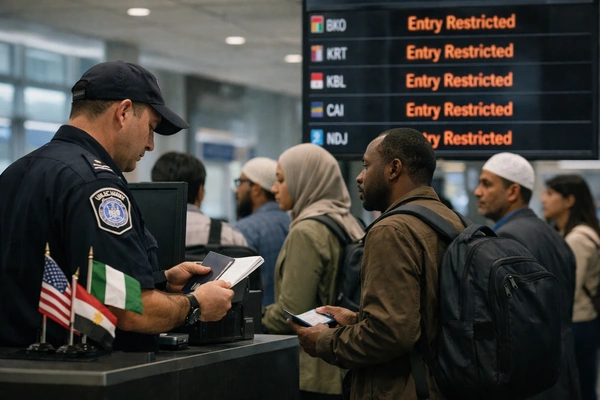
The US Travel Ban Expansion signed by President Donald Trump on December 16, 2025 broadens U.S. travel and immigration restrictions to 39 countries, including several African and Middle Eastern states. The expanded policy, set to take effect on January 1, 2026, aims to strengthen border security and vetting mechanisms, though it has already drawn international criticism for its broad nationality-based approach.
Policy Origins and Evolution
Restrictions on foreign nationals entering the United States under the Trump administration began with a series of proclamations earlier in 2025, which initially targeted 12 countries with full bans and additional nations with partial limits. Under the expanded proclamation, those restrictions have nearly doubled in scope, citing “deficiencies in vetting, screening and information sharing” as key reasons for inclusion.
White House officials have pointed to recent security incidents as catalysts for the policy’s expansion, while supporters argue that the measure is necessary to close gaps in immigration enforcement and border control. Opponents counter that nationality-based bans have limited effectiveness and can deteriorate diplomatic cooperation.
Full Travel Bans: Countries Now Restricted Entirely
The expanded US Travel Ban Expansion adds several countries to the list of those whose citizens are completely barred from entering the United States (outside very limited exemptions). These include:
- Burkina Faso
- Mali
- Niger
- South Sudan
- Syria
- Laos (upgraded from partial ban)
- Sierra Leone (upgraded from partial ban)
- Palestinian Authority Travel Document holders
- Afghanistan (already on ban list)
- Burma / Myanmar
- Chad
- Republic of the Congo
- Equatorial Guinea
- Eritrea
- Haiti
- Iran
- Libya
- Somalia
- Sudan
- Yemen
This full ban list reflects both newly added countries and those already under prior restrictions. Nationals from these countries are generally barred from obtaining non-immigrant and immigrant visas, with narrow exceptions for diplomats, green card holders, and some waivers.
Partial Travel Restrictions
In addition to full bans, the proclamation extends partial travel restrictions affecting visa categories such as tourism (B-1/B-2), students (F/M), and exchange visitors (J). These nations include:
- Angola
- Antigua and Barbuda
- Benin
- Côte d’Ivoire
- Dominica
- Gabon
- The Gambia
- Malawi
- Mauritania
- Nigeria
- Senegal
- Tanzania
- Tonga
- Zambia
- Zimbabwe
Partial restrictions mean that citizens of these countries may still apply for some visa categories but face tighter vetting, longer processing, and additional documentation requirements.
What the White House Claims
According to the White House proclamation, countries on the expanded list demonstrate “serious deficiencies” in key areas such as:
- Identity document integrity
- Providing criminal history data
- Cooperation on deportation agreements
- Reliable visa vetting and screening systems
The administration argues that these deficiencies hinder the United States’ ability to assess risk and uphold national security. While emphasizing that exemptions exist — including for current visa holders, diplomats, and individuals serving U.S. interests — the broad nationality-based approach has drawn criticism
Broader Implications
Experts warn that the expanded US Travel Ban Expansion could weaken U.S. diplomatic relations, particularly with African partners engaged in counterterrorism and trade cooperation. Industry groups also caution that such sweeping travel restrictions can disrupt global mobility patterns, complicate academic exchanges, and reduce tourism and business travel.
Human rights advocates highlight that these bans may disproportionately affect civilians rather than the targeted threats they are intended to address. They also question the consistency of applying broad national bans in a world where security risks are often individualized rather than nationality-based.
Reactions from Governments and Civil Society
Governments of affected countries — particularly in Africa and the Middle East — have expressed concern about the potential diplomatic impact and the effect on citizens’ mobility. Civil society groups argue that such measures can exacerbate economic and social inequalities, especially for students, families, and professionals seeking opportunities abroad.
Global and Local Impact
The expanded travel ban is expected to impact:
- Student mobility, as international students may face deferred or denied visa applications
- Business travel and investment flows
- Family reunification and long-term residency planning
- Remittance flows to affected countries
For countries relying heavily on diaspora and academic exchange programs with the United States, these restrictions could have long-term social and economic effects.
Conclusion
The US Travel Ban Expansion represents a significant escalation in American immigration and border policy, with effects that reach beyond security rhetoric to touch diplomacy, economics, and everyday lives of millions of people. As enforcement begins in January 2026, governments, institutions, and individuals must prepare for new complexities in international travel and visa processes.
Further Reading
- Technology Prosperity Deal: What It Means for Global Development
- Inside Susie Wiles’ Interview with Donald Trump