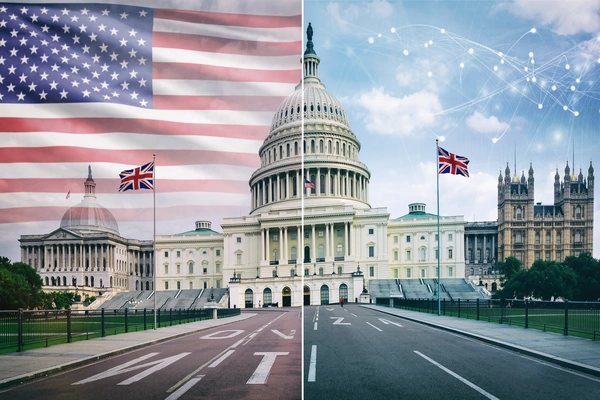
The United States has formally suspended the implementation of its Technology Prosperity Deal with the United Kingdom
, a landmark agreement that was intended to deepen cooperation in artificial intelligence (AI), quantum computing, and civil nuclear energy. The pause comes amid growing frustration in Washington over stalled broader trade talks and regulatory disagreements, raising strategic and economic questions for both governments.Origins of the Technology Prosperity Deal
In September 2025, during a state visit by U.S. President Donald Trump to the United Kingdom, leaders from both nations signed the Technology Prosperity Deal — a memorandum of understanding designed to build one of the strongest bilateral technology partnerships of the 21st century. The pact was billed as a platform to unlock shared innovation, enhance scientific collaboration, and expand investments from major American tech firms into the UK, potentially creating thousands of jobs and accelerating research across multiple advanced sectors.
The official government declaration outlined plans for joint initiatives in:
- Artificial intelligence research and shared computational infrastructure
- Civil nuclear energy cooperation, including regulatory alignment
- Advanced quantum computing and secure communications technologies
- Standards and benchmarks to drive global tech adoption
According to the memorandum of understanding, the deal was also intended to strengthen the “special relationship” between the two nations and support innovation ecosystems across both economies.
Details of the US Suspension
On December 15-16, 2025, British officials confirmed that the United States had paused the implementation of the Technology Prosperity Deal, citing broader concerns about unresolved trade issues. This action was first reported by leading international outlets and later confirmed in government statements.
U.S. officials reportedly grew frustrated with the pace of negotiations on unrelated trade matters, including non-tariff barriers, regulatory standards, and Britain’s digital services tax. These issues have become sticking points in broader economic negotiations that Washington wants resolved before advancing tech cooperation.
Despite the suspension, both sides maintain that dialogue continues and that the pause is not a cancellation of the pact, but rather a response to complex negotiations across multiple policy fronts. British press briefings emphasised that the “special relationship” endures even as disagreements are addressed.
Economic and Strategic Stakes
The Technology Prosperity Deal was one of the most ambitious bilateral agreements in recent UK–US relations. Under its provisions, American tech companies had pledged significant investments into the UK’s technology infrastructure — including major commitments from firms such as Microsoft and Google — with potential economic impact measured in the tens of billions of pounds.
Central UK development plans included the creation of an AI “growth zone” in northeast England, designed to attract international investment, innovative firms, and high-skills jobs. Analysts had argued that such initiatives could transform regional economies in the UK, bridging longstanding productivity and employment gaps.
Strategically, the pact was seen as a move to counterbalance growing technology competition from China and other global players, reinforcing Western leadership in AI, quantum, and next-generation energy technologies. The pause in implementation, therefore, carries implications not just for economic outcomes, but also for geopolitical technology rivalry. Critics of the suspension argue that failing to advance cooperation could slow innovation momentum in areas vital to both nations’ economic futures.
Trade Negotiations and Regulatory Disagreement
At the core of the suspension are broader disagreements in the wider UK–US trade framework. U.S. negotiators have pressed Britain for greater regulatory alignment on food safety standards, industrial goods, and digital taxation, which they argue create non-tariff barriers to market access for American exports. The UK, for its part, has emphasised the importance of maintaining regulatory autonomy and its own standards for consumer protection and digital sovereignty.
One of the most contentious points has been Britain’s digital services tax — a levy on large technology companies’ revenues aimed at ensuring fair taxation on digital profits. The United States views this tax as disproportionately affecting American firms, and has urged the UK to revise or eliminate it as part of broader trade negotiations. The UK government has so far resisted major changes to the tax, highlighting its role in funding domestic initiatives.
Food safety standards have also been an area of tension. Washington has sought recognition of American agricultural standards as part of trade talks, particularly for beef and other products, but the UK has maintained its own rules and protections, arguing they are essential to public health and consumer confidence.
Perspectives from Industry and Policy Experts
Industry leaders welcomed the Technology Prosperity Deal when it was announced, seeing it as a catalyst for accelerating technological progress and cross-border investment. However, some analysts warned that tying such cooperation to broader trade outcomes could create vulnerabilities in implementation if negotiations faltered — a concern that now appears realised.
Policy experts note that the suspension reflects the increasingly complex intersection between technology policy and trade diplomacy. In a world where digital and regulatory frameworks are central to economic competitiveness, aligning standards across borders has become as important — and as difficult — as traditional tariff negotiations.
Reactions from Governments and International Leaders
British government representatives responded to the suspension by reaffirming the UK’s commitment to delivering benefits through technology cooperation, while emphasising that negotiations remain active on both sides. They also pointed out that other aspects of UK–US economic relations — including a separate pharmaceutical tariff agreement — continue to progress independently.
Trade officials in Washington have remained largely quiet in public, with further statements expected as negotiations evolve through early 2026. Observers suggest that future high-level meetings will be crucial in determining if the pact can be revived or recalibrated in light of broader trade dynamics.
Significance for Global Technology Governance
The pause of the Technology Prosperity Deal carries implications beyond bilateral US–UK relations. As nations worldwide grapple with how to govern emerging technologies like AI and quantum computing, cooperative frameworks have been touted as critical to setting global standards, managing ethical risks, and ensuring equitable economic growth.
If major alliances falter in advancing cooperative mechanisms, this could slow progress in establishing interoperable and widely adopted technology standards — potentially leading to fragmented regulatory regimes that complicate international research collaboration and global market access.
Connection to Broader GSN Coverage
For readers interested in related geopolitical and global economic topics, see our recent analysis of the US seizure of oil tanker and international maritime law tensions, and our coverage of US policy shifts on migration and developing nations, which explore other dimensions of evolving US foreign policy impacts worldwide.
Conclusion
The suspension of the Technology Prosperity Deal represents a pivotal moment in transatlantic technology cooperation and trade diplomacy. While neither side has declared the deal dead, the pause underscores the challenges of reconciling national regulatory priorities with shared economic ambitions. As 2026 negotiations unfold, the future of this pact will serve as a key bellwether for how major economies balance sovereign policy objectives with the imperatives of global technological leadership.