A Disputed Election and Growing Frustration
The turmoil began shortly after Tanzania held its general election on October 29, 2025. Several opposition parties reported that they had been barred or disqualified from running, leaving many Tanzanians feeling the election was predetermined. The ruling party won by an overwhelming margin, but instead of calming tensions, the results triggered demonstrations across major cities including Dar es Salaam, Arusha, Mwanza, and Tanga.
Young people led many of the protests, demanding fair elections, transparency, and an end to intimidation against opposition figures. Civil society groups had already warned of a shrinking democratic space in the months leading up to the vote. Opposition leader Tundu Lissu, one of the strongest voices against the ruling party, had been imprisoned since April on a treason charge, which carries the death penalty. Human rights organizations reported that other critics had disappeared, been arrested, or were allegedly abducted by police before polling day.
This was not the first time a political confrontation shook a major African nation. Similar tensions have been seen
elsewhere, including in Ivory Coast during President Alassane Ouattara’s controversial fourth-term bid.
» Related GSN analysis:
Ouattara Fourth Term Bid Redefines Ivory Coast’s Political Landscape
Tanzania, once seen as one of the more stable democracies in the region, entered the election already on fragile ground. The heavy security presence during voting and the absence of meaningful opposition participation created a perfect storm that exploded once results were announced.
Deadly Crackdown, CNN Findings, and Bitter Disputes
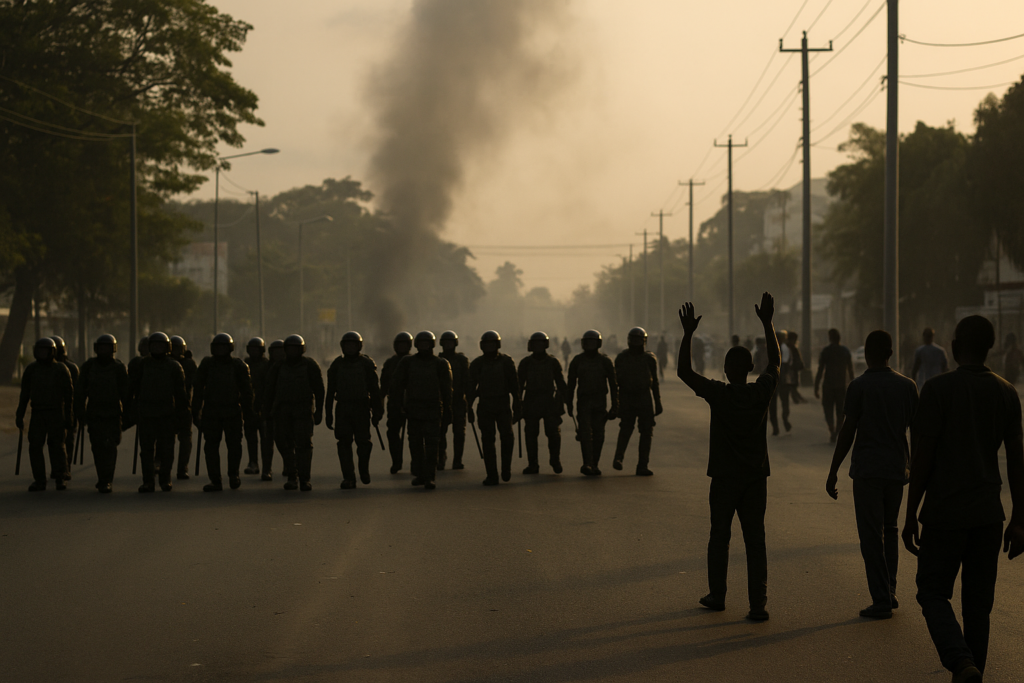
As protests spread, security forces responded with tear gas, water cannons, rubber bullets, and, according to numerous reports, live ammunition. Witnesses say most of the protesters were unarmed and posed no threat. Human rights groups and the U.N. Human Rights Office say they believe hundreds of people were killed, calling the situation “deeply alarming.” Opposition party CHADEMA claims the real number may be over 2,000, though the government insists this figure is “hugely exaggerated.”
A major development came when CNN released an exclusive investigation. The investigation used satellite imagery, eyewitness accounts, and video evidence and concluded that police fired at unarmed protesters who posed no threat, and that there were signs of mass graves located north of Dar es Salaam. Investigators also suggested that security forces may have attempted to hide bodies to reduce the number of confirmed deaths. The Tanzanian government rejected CNN’s reporting as misleading, but notably, it did not dispute any specific facts presented in the investigation.
Families have shared heartbreaking stories of searching hospitals, police stations, and makeshift holding areas for their missing loved ones. Some reported that bodies were quietly moved by night, making it nearly impossible to confirm how many people died or where they were buried. These claims align with what CNN and human rights investigators documented through on-the-ground testimonies and remote sensing evidence.
Despite widespread criticism, President Samia Suluhu Hassan defended the security forces. She claimed the protests were not genuine political expressions but rather violence “with malicious intentions.” She also alleged—without providing evidence—that young people were paid to protest by unknown actors. The president insisted that police used “proportionate force” to stop what she described as an attempt to overthrow her government.
In her national address, she also criticized international governments for questioning Tanzania’s actions, saying:
“Those foreigners keep saying Tanzania should do one, two, three—who are you? Do they still think they’re our colonizers?”
Her remarks increased diplomatic tensions and drew even more attention to Tanzania’s crisis. Meanwhile, the United States announced a review of its relationship with Tanzania, citing concerns about religious freedom, suppression of free speech, violence against civilians, and restrictions on foreign investment—concerns highlighted in reporting by Reuters. European governments and African regional organizations have also urged Tanzania to permit an independent international investigation. To address mounting pressure, the government announced a state-appointed commission of inquiry into the killings. However, critics say the commission lacks independence, raising fears that it may serve more as political cover than a genuine investigation.
A Nation at a Crossroads
The Tanzania Election Protest Killings reveal deep structural issues in Tanzania’s political landscape.
1. Democracy Under Strain
With opposition figures barred from running and others jailed or disappeared, Tanzania risks sliding into de facto one-party rule. The election exposed cracks in the electoral system and raised concerns about the future of democratic participation. Rights groups such as Amnesty International and Human Rights Watch have warned that the pattern of arrests and intimidation reflects a broader decline in political freedoms.
2. Militarization of Civilian Policing
The violent response to protests suggests a shift toward heavy-handed security tactics. Using lethal force on unarmed civilians undermines public trust and signals that dissent may be met with overwhelming violence rather than dialogue or reform.
3. Economic Risks
Tanzania’s economy depends heavily on mining, tourism, and acting as a trade corridor for landlocked neighbors. Political instability could harm investor confidence and disrupt regional trade through Dar es Salaam port. Businesses wary of unpredictable crackdowns and internet shutdowns may look elsewhere in the region.
4. Rising International Isolation
With worsening human rights concerns and hostile rhetoric toward foreign partners, Tanzania risks diplomatic
isolation at a time when it needs global cooperation. A similar pattern of political repression provoking national
and diaspora backlash occurred recently in Nigeria following the life-sentence ruling against IPOB leader Nnamdi
Kanu.
» Related GSN report:
Nnamdi Kanu Life Sentence Reverberates Across Nigeria
In regions facing political unrest, staying connected, safe, and able to document events can be crucial. These carefully selected tools support personal safety, mobile reporting, and emergency power when it matters most.
Disclosure: As an Amazon Associate, Global Standard News may earn a commission from qualifying purchases made through these links. This comes at no extra cost to you and helps support our independent journalism.
Reactions: Outrage, Grief, and International Alarm
Families of victims continue searching morgues, detention centers, and suspected burial sites for missing relatives. Many say authorities have restricted access or refused to share information. As one grieving parent said:
“We just want the truth. Why are we being denied the chance to bury our children?”
Opposition leaders say the crackdown was designed to eliminate dissent. Some leaders have fled the country, while others are in hiding. CHADEMA insists that the killings amount to a massacre and has demanded a U.N.-led investigation into the Tanzania Election Protest Killings.
International and African human rights groups report that protesters were shot while fleeing, some victims were taken away by security personnel, and bodies may have been buried in undisclosed sites. The internet blackout during the protests also made it harder to document abuses in real time.
Governments across Europe, North America, and Africa have condemned the killings. Some countries warned that without accountability, Tanzania’s international standing could deteriorate further. The African Union urged restraint and called for the protection of civil liberties.
Global and Local Impact
Local Impact
The killings have left many Tanzanians fearful of speaking openly. Journalists face intimidation, activists are being monitored, and communities are divided. Trust in state institutions is collapsing, and the space for civil society is shrinking rapidly.
Regional Consequences
If the unrest continues, neighboring countries could experience disruptions in trade and transport. Tanzania plays a major logistical role in East Africa, and instability threatens supply chains for landlocked nations that rely on its ports and road networks.
Global Reputation at Risk
Tanzania has long been seen as a peaceful and reliable partner. The Tanzania Election Protest Killings threaten that reputation and could reduce development aid, investment, and diplomatic influence. Donors and investors may hesitate to deepen engagement with a government perceived as unwilling to uphold basic human rights.
Conclusion
The Tanzania Election Protest Killings mark a defining moment for the nation. CNN’s findings, human rights reports, and testimonies from families present a troubling picture of state violence, secrecy, and democratic decline. Tanzania now faces a crucial choice: pursue truth and accountability, or continue down a path toward deeper repression and international isolation. The world is watching—and Tanzanians are demanding answers.