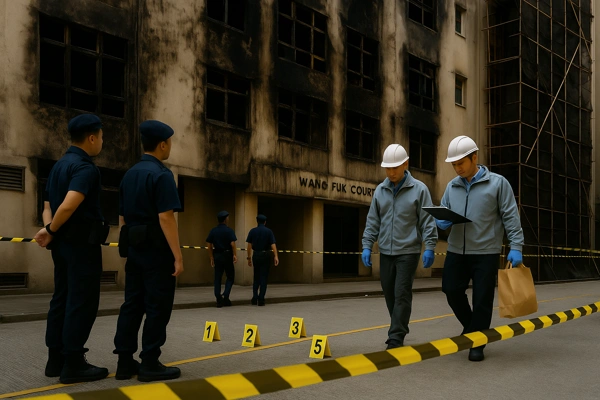
As families continue searching for missing relatives and thousands of displaced residents navigate temporary shelters, the investigation is rapidly shifting from a routine fire inquiry into a far-reaching criminal case with political, social, and regulatory implications.
Background
The 26 November fire tore through seven towers of Wang Fuk Court, a densely populated housing estate in Tai Po District. Within minutes, flames shot up bamboo scaffolding wrapped in green netting, intensified by foam insulation installed around façade repair areas. Photos and video verified by international media showed scaffolding engulfed from the ground to the upper floors, with smoke pouring from window openings.
Residents had raised concerns about the hazards of the renovation works as early as September, citing loose scaffolding components, debris, and poorly secured safety netting. Authorities now acknowledge that those warnings were not adequately addressed before the blaze. International outlets such as Reuters and the Philadelphia Inquirer have documented how quickly the fire spread and how difficult the search effort has been.
More than 4,000 residents were affected. Over 1,100 people were moved into government evacuation centres, while another 680 were placed in youth hostels. Search teams are still combing stairwells, rooftops, and burnt-out corridors — areas where many victims were trapped — and warn that the operation may take weeks due to the condition of some remains.
New Arrests as Police Expand Probe
Police say they have now detained a total of 13 people in connection with the Wang Fuk Court tragedy, all on suspicion of manslaughter. The newly arrested individuals add to earlier detentions announced when the first stage of the Hong Kong fire investigation began.
Those arrested include:
- scaffolding subcontractors who supplied and installed the green mesh around the towers;
- procurement officers responsible for approving insulation materials used on the façade;
- site supervisors accused of missing or ignoring critical safety violations;
- engineers overseeing scaffolding and façade repair inspections;
- workers suspected of concealing improper materials in hard-to-reach areas of the structure.
Authorities said tests conducted on several samples of mesh recovered at the site revealed that they failed to meet fire-retardant standards. Foam-based insulation found on multiple floors also intensified the heat and speed at which flames travelled up the buildings.
A senior police official stated during a briefing:
“Some of the victims’ remains have turned completely into ash. Given the extreme conditions inside certain stairwells and rooms, we may not be able to identify all missing persons.”
Investigators believe cheaper materials were intentionally used to reduce costs and increase profit margins. Officers are reviewing procurement contracts, delivery records, and inspection logs to determine whether corruption or document falsification occurred during the renovation process.
ICAC Probes Possible Corruption and Document Tampering
Hong Kong’s Independent Commission Against Corruption (ICAC) is conducting a parallel investigation into whether financial inducements or false certifications allowed unsafe materials to bypass quality-control procedures. Earlier, ICAC announced that eight people had been arrested in connection with the blaze, signalling that the corruption angle is not limited to front-line workers.
According to investigators, the ICAC probe is examining whether:
- inspection reports were signed without on-site verification,
- contractors substituted lower-grade materials intentionally,
- supervisors ignored staff concerns about flammability,
- government inspectors missed or downplayed critical warnings.
International coverage, including additional reporting from Reuters’ earlier dispatch on the Wang Fuk Court probe, has highlighted how the anti-graft agency’s involvement has raised expectations that any corruption uncovered will be pursued aggressively.
If wrongdoing is proven, suspects could face charges ranging from criminal negligence and conspiracy to fraud and corruption, in addition to manslaughter.
Analysis: What the Arrests Reveal
The expanding detentions expose longstanding structural weaknesses in Hong Kong’s building-safety ecosystem — particularly in renovation projects involving ageing estates and multi-layer subcontracting systems.
1. Substandard Materials Hid in Hard-to-Reach Areas
According to authorities, contractors used cheaper mesh and insulation in “non-visible” sections of the scaffolding structure to evade inspectors. This helped the fire spread vertically at astonishing speed, turning exterior scaffolding into a tunnel of flames that carried heat into multiple towers.
2. Missed Safety Warnings
Residents had complained about renovation hazards months earlier, but their concerns were dismissed or inadequately addressed. The failure of fire alarms across several towers, now under separate review, only magnified the disaster and may have delayed evacuations.
3. Deadliest Blaze Since 1948
Not since a 1948 warehouse fire that killed 176 people has Hong Kong seen a blaze of this magnitude. The historical comparison underscores the scale of oversight failure and the political pressure now facing city leaders.
4. Political Sensitivities Shape the Response
Security Chief Chris Tang criticised what he described as attempts by “malicious actors” to use the tragedy to stir political unrest, echoing Beijing’s warning against turning the disaster into a protest issue. That stance has fuelled debate about whether public anger is being managed as a security problem rather than as a call for accountability.
Hausse Retractable 2-Story Fire Escape Ladder (13 ft)
Compact retractable escape ladder supporting up to 1,000 lbs with slip-resistant steel rungs.
JJ CARE Fire Blanket – 2 Pack (40×40 in)
High-heat-resistant blankets with wall hooks — ideal for kitchens, workshops, and small flames.
FIRST ALERT BRK SC9120FF Smoke & CO Detector
Hardwired smoke and carbon monoxide alarm with battery backup and dual-sensor protection.
Disclosure: GSN may earn a small commission at no extra cost to you. This supports our independent journalism.
Public Reaction
Large crowds have gathered for vigils in Hong Kong, Tokyo, London, and Taipei to honour victims — including at least nine domestic helpers from the Philippines and Indonesia. Earlier reporting by Reuters on the role of foreign domestic workers highlighted how deeply many of the victims were embedded in Hong Kong family life.
Some residents expressed frustration that renovation-related hazards were ignored and that alarms reportedly failed to sound in several towers. Petition groups have demanded an independent inquiry into the Wang Fuk Court disaster, and at least one student activist who handed out leaflets calling for such a probe was briefly detained before being released, according to video reports from international media.
Global & Local Impact
Safety Reforms Under Review
Officials are drafting new rules to tighten oversight on:
- renovation material standards and supplier accountability,
- scaffolding safety protocols and permit systems,
- inspection verification methods, including digital audit trails,
- fire alarm maintenance requirements and redundancy checks.
International Dimensions
Labour groups in Manila and Jakarta have urged stronger protection for migrant domestic workers in high-rise housing. Meanwhile, global cities that still rely heavily on bamboo scaffolding — including Bangkok, Nairobi, and Mumbai — are reviewing safety standards in light of the tragedy, wary of similar disasters in dense, vertical neighbourhoods.
Connecting to GSN Reporting
This case echoes broader safety and regulatory failures examined in GSN coverage such as AliExpress Sex Doll Ban Prompts Global Safety Action and Volkswagen China Exports Target New Markets Beyond Europe. Weak enforcement and opaque oversight frequently set the stage for crises with far-reaching human impact.
Conclusion
The widening Hong Kong fire investigation marks a turning point in the search for accountability. As arrests increase and allegations of material substitution and missed warnings gain traction, Hong Kong faces pressure to overhaul renovation oversight and ensure that such a tragedy never occurs again. Whether this moment leads to lasting reform will depend on the transparency of the investigation and the willingness of authorities to confront systemic failures rather than treating public anger purely as a security threat.