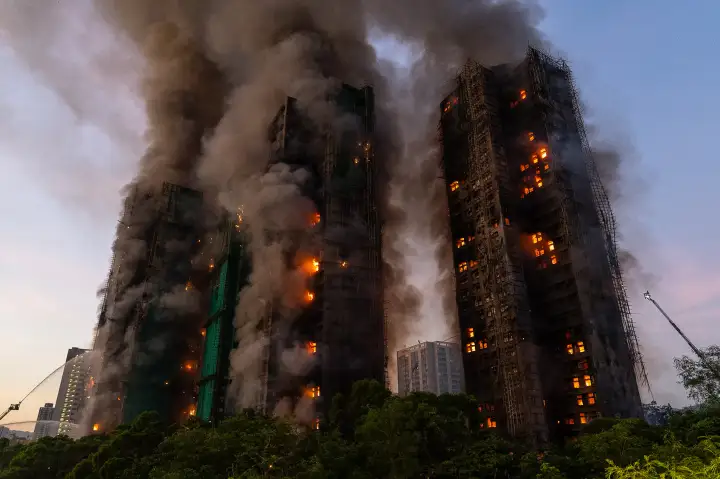
HONG KONG — A catastrophic Hong Kong high-rise fire has ripped through a cluster of residential towers in the city’s northern Tai Po district, killing 36 people and leaving hundreds still uncontactable, according to updated government figures.
The blaze erupted on Wednesday afternoon at Wang Fuk Court, a public housing estate made up of eight high-rise buildings containing nearly 2,000 apartments and home to more than 4,000 residents. As rescue teams battle extreme heat, collapsing scaffolding and dense smoke, more than 700 people have been evacuated to temporary shelters while thousands remain unable to return to their homes.
A Vulnerable Estate Before the Flames
Wang Fuk Court is one of Hong Kong’s larger public housing estates, located in the Tai Po district in the city’s New Territories. Each of its eight towers rises more than 31 storeys, with relatively narrow stairwells and small lift lobbies typical of older public housing designs.
Government-sourced data shows that Wang Fuk Court is home to a significantly older population: roughly 36% of residents are aged 65 or above. That demographic profile makes the community especially vulnerable during fast-moving emergencies, when many people rely on walking sticks, mobility aids, or slower assisted evacuation.
At the time of the incident, several of the towers were undergoing external renovation and were encased in bamboo scaffolding and green safety mesh. Bamboo scaffolding is a long-standing feature of Hong Kong’s skyline, valued for its flexibility, light weight and low cost. Yet, it has increasingly come under scrutiny, as fire-safety specialists warn, as a potential fire risk when wrapped around occupied buildings.
Only weeks earlier, another major blaze tore through a bamboo-clad high-rise in the city’s central business district. No deaths were reported in that incident, but several people were hospitalized and firefighters warned that the combination of bamboo poles and protective mesh can allow flames and heat to climb vertically with alarming speed.
How the Hong Kong High-Rise Fire Unfolded
The Wang Fuk Court blaze reportedly began shortly before 3:00 p.m. local time. Residents saw flames licking up the side of one of the towers as thick black smoke poured from windows and exterior scaffolding. Within a short period, the fire had spread across multiple buildings, with at least seven of the estate’s eight towers affected.
Inside the stairwells, visibility dropped close to zero as smoke filled corridors. Some residents attempted to run downstairs, only to retreat because of choking fumes and heat. Others sheltered in their flats, taping the edges of doors and windows and using wet towels or cloths to block smoke, following instructions issued by the Hong Kong Fire Services Department.
Emergency officials said temperatures inside the worst-affected towers reached “extremely high” levels. Collapsing ceilings, falling debris and the risk of sudden structural failure forced crews to pull back and re-enter repeatedly. Bamboo poles, safety mesh and construction materials peeled off the exterior and fell 10 to 20 storeys onto the streets below, sending sparks and fragments across nearby roads.
More than 30 people have been treated in hospital for smoke inhalation, burns and other injuries. Many of the casualties are elderly residents who struggled to navigate long stair descents or who remained trapped in upper-floor apartments.
Struggle to Reach Trapped Residents
Firefighters described one of the hardest rescue environments they have faced in recent years. The Hong Kong high-rise fire created overlapping hazards: extreme heat inside the towers, collapsing bamboo scaffolding outside, and wind-driven smoke that repeatedly cut off escape routes.
Officials urged residents who could not safely evacuate to stay inside, close doors and windows, and seal gaps with wet cloth or tape. Those trapped were told to call emergency hotlines, identify their building and flat number, and move away from corridors or lift lobbies that might fill quickly with smoke.
At various points during the evening, authorities said they remained in phone contact with some of the people stuck on higher floors. However, communications were not always stable, with power disruptions and structural damage making it difficult to confirm the status of all those missing.
Emergency shelters were quickly set up at a nearby school and park, where more than 700 evacuees gathered. Volunteers and staff handed out bottled water, blankets and boxed meals. For many residents, it was the first proper meal they had eaten in hours after fleeing with only the clothes on their backs.
Firefighter Killed in the Line of Duty
Authorities have confirmed that one firefighter died during the rescue operation. The officer, named by officials as Ho Wai-ho, sustained fatal injuries while attempting to reach residents trapped on an upper floor.
Senior civil service officials praised him for what they called gallantry and selfless devotion to duty, offering condolences and support to his family. The loss has added to the sense of grief across Hong Kong, where firefighters are widely respected for their professionalism and willingness to take risks to protect densely packed communities.
Witness Accounts and Human Stories
Among those sheltering at the emergency sites were pensioners, families with young children and long-time residents who had lived in Wang Fuk Court for decades. Many wore masks or improvised face coverings to protect themselves from smoke still drifting across the neighborhood.
One elderly man told local media that he had flown back to Hong Kong from mainland China earlier that day. While in transit, he saw images of the blaze on his phone but did not realise his own block was affected until he landed. The apartment he had spent eight months renovating in preparation for retirement was destroyed.
“I was getting ready to move in,” he said quietly. “Now it’s all burnt.”
Residents also spoke of horror as they watched scaffolding and burning materials fall from the towers and crash onto the ground, sometimes sending showers of sparks across footpaths and access roads. Others described dark stairwells crowded with neighbours trying to escape, some turning back in panic because of the intense heat.
Why the Fire Spread So Quickly
Investigators have not yet announced what ignited the Hong Kong high-rise fire, but several factors are likely to be examined closely. Safety experts point to the intersection of high-density living, renovation work and an aging population as a dangerous combination.
Bamboo scaffolding and mesh. The external bamboo poles and green mesh that wrapped much of Wang Fuk Court may have provided fuel and pathways for flames and heat to travel rapidly upwards. Open gaps between the building façade and scaffolding can act like vertical chimneys, drawing flames up the exterior of the structure. A future inquiry is expected to consider whether additional fire breaks, materials or protections are needed when work is carried out on occupied residential towers.
High-rise design and evacuation. Tall buildings concentrate many people into a small footprint. If smoke quickly fills corridors or stairwells, evacuation becomes extremely difficult, especially for residents with limited mobility. In Wang Fuk Court, a large share of tenants are elderly, meaning even a short descent can be exhausting and slow in emergency conditions.
Complex urban risk. Hong Kong’s skyline is famous worldwide for its density and height, but that density also complicates firefighting. Narrow surrounding roads restrict the positioning of ladders and vehicles. Responders must navigate a forest of power lines, construction sites, footbridges and overhead structures while working under intense time pressure.
Home Fire-Safety Essentials for Apartment Residents
Stay prepared, protect your family, and improve evacuation readiness in any high-rise or urban apartment.
Hausse Retractable 2-Story Fire Escape Ladder (13 ft)
Compact retractable escape ladder for second-floor windows, supporting up to 1,000 lbs with slip-resistant steel rungs.
JJ CARE Fire Blanket – 2 Pack (40"×40")
High-heat-resistant emergency fire blankets with wall hooks — ideal for kitchens, home safety, camping, and small flame suppression.
FIRST ALERT BRK SC9120FF Smoke & CO Detector
Hardwired smoke and carbon monoxide alarm with battery backup — reliable dual-sensor protection for bedrooms and hallways.
Disclosure: This section contains affiliate links. If you purchase through these links, Global Standard News (GSN) may earn a small commission at no extra cost to you. This helps support our independent journalism.
Reactions from Officials and the Community
Hong Kong’s leadership has promised a full investigation into the blaze and the emergency response. Officials say their immediate priority remains search and rescue, followed by structural assessments and support for displaced residents.
At the shelters, volunteers, NGOs and religious groups have joined government staff in providing food, blankets and psychological first aid. Community organisers say many evacuees are still in shock — especially elderly residents who have lost homes, possessions and neighbourhood networks in a single day.
Online, the disaster has reignited broader debates about safety in crowded cities, the use of temporary construction materials and the need for stronger oversight of high-rise maintenance. GSN has previously reported on how concerns about safety and regulation have reshaped debates in other sectors, including digital marketplaces in stories such as AliExpress Sex Doll Ban Prompts Global Safety Action, where global pressure forced platforms to remove harmful products.
Global and Local Impact
Locally, the Hong Kong high-rise fire has left thousands of residents displaced or uncertain about when they can return home. Authorities have warned that structural checks may take days or weeks, particularly in towers where scaffolding and exterior materials suffered severe damage.
Many evacuees are pensioners living on fixed incomes who will now rely heavily on public assistance, family support and community solidarity. Social workers have urged the government to prioritise long-term rehousing, counselling and medical follow-up for residents exposed to smoke, trauma and sudden displacement.
Globally, the disaster is already being studied by urban planners and fire-safety specialists as a case study in high-density risk. Cities across Asia, Europe and the Middle East have large numbers of aging residential towers under renovation. The images from Wang Fuk Court — flames racing up bamboo scaffolding, debris falling from 20 storeys, and first responders working in extreme heat — will likely influence future regulations in other regions.
Questions may also arise for investors and businesses operating in densely built markets. As GSN explored in Volkswagen China Exports Target New Markets Beyond Europe, global companies increasingly factor regulatory stability, infrastructure resilience and public-safety records into long-term decisions. Large-scale urban disasters can shape international perceptions for years.
What Investigators Will Be Looking At
A formal investigation into the Hong Kong high-rise fire is expected to focus on several key questions:
- What specifically ignited the blaze, and where did it start?
- How did bamboo scaffolding, safety mesh and renovation materials influence the fire’s spread?
- Were all fire doors, alarms and sprinkler systems operating correctly?
- Were evacuation routes properly maintained and free from obstructions?
- Did emergency communications reach residents quickly and clearly enough?
Authorities are also likely to review building codes and renovation rules for occupied high-rises, alongside guidelines for protecting elderly and disabled residents in emergencies. Independent experts have called for transparent publication of findings so that lessons can be applied not just in Hong Kong but in other dense cities worldwide.
Looking Ahead
For now, the priority remains finding the missing and supporting survivors. The confirmed death toll of 36 has already made this one of Hong Kong’s deadliest residential fires in recent memory. Officials warn that the number could still rise as search teams gain access to more floors.
As day turns to night over Tai Po, the lights of emergency vehicles continue to flash across the damaged towers of Wang Fuk Court. Behind every statistic is a family who has lost a loved one, a neighbour who no longer has a home, or a firefighter who risked everything to pull strangers from the smoke.
Global Standard News (GSN) will continue to follow developments, official investigations and recovery efforts in the days and weeks ahead as the city confronts the long aftermath of this devastating Hong Kong high-rise fire.