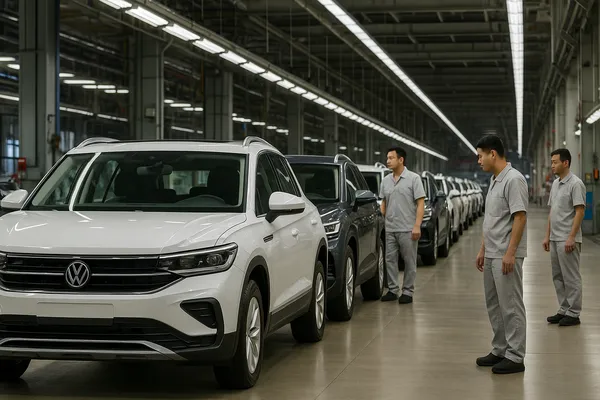
Volkswagen China exports are set for a major expansion as the German automaker prepares to ship more China-made vehicles to a wider range of overseas markets. The new push will see petrol and electric models developed and built in China sent to Asia, the Middle East and other growth regions — but notably not to Europe. The strategy was outlined by senior executives during a visit to Volkswagen’s innovation hub in Hefei, in comments first reported by Reuters.
The move is part of Volkswagen’s “in China for China” approach. It aims to leverage China’s rapid advances in vehicle software, electronics and manufacturing efficiency to stay competitive against increasingly powerful Chinese rivals at home and abroad, while avoiding political and regulatory flashpoints in Europe.
For readers following how next-generation technology platforms are reshaping global industries, this trend connects closely with our explainer AI World Models: The Next Big Leap in Intelligent Machines, and our analysis on China’s shifting industrial landscape in China Crypto Mining Surge Defies Ban in Stunning Rebound.
Volkswagen’s Changing Position in China
For decades, Volkswagen dominated China’s car market via its joint ventures with SAIC and FAW. At one point, the group controlled more than a fifth of passenger car sales, with models such as the Passat, Jetta and Lavida becoming near-generic names for sedans in major cities.
But the landscape has changed dramatically. Local manufacturers — especially electric vehicle (EV) players like BYD, Nio and XPeng — now lead on pricing, range, software, and user experience. As Chinese buyers shift away from traditional combustion engines toward smart EVs, Volkswagen has seen its relative position weaken.
In response, the company has poured billions into its Hefei hub, transforming it into a fully fledged development and production center that can design, test and approve new vehicle platforms directly in China. According to company executives, building certain EVs completely in China can cut development costs by up to 50% compared with similar projects in Germany, thanks to localised supply chains, faster validation cycles and dense supplier networks, as reported by the Financial Times.
That cost advantage helps explain why Volkswagen is increasingly using China not only as a sales market, but as an export base for selected global products.
Current Development: New Export Markets — But Not Europe
Volkswagen has already begun exporting China-made petrol limousines to the Middle East, with deliveries starting around six weeks before the latest announcement. The company is now evaluating which models could fit additional overseas markets, including:
- Southeast Asia — where price-sensitive buyers and rising urbanisation are driving demand for compact sedans and SUVs;
- Central Asia — a region seeking affordable, durable vehicles for mixed road conditions;
- Broader Asian and Middle Eastern markets — where German badges still command strong brand recognition;
- Latin America and Africa (under consideration) — where Volkswagen already has a footprint and could supplement local production with China-built vehicles.
Volkswagen’s Chinese plants can produce both internal combustion engine vehicles and EVs, giving the group flexibility to tailor exports to the infrastructure and regulatory realities of each region. In markets where EV charging networks are still emerging, traditional petrol models are likely to lead; in more advanced markets, entry-level EVs may follow.
However, executives have been clear on one point: Europe is excluded from this China export strategy. Speaking to reporters in Hefei, the company said it has no plans to export China-made cars to Europe, citing:
- Differences in electronic architecture and software between China-specific models and those engineered for European regulations and data standards;
- Regulatory and political risk tied to ongoing EU investigations and tariffs on Chinese-made vehicles;
- Brand and strategic considerations, as Volkswagen balances its European manufacturing base with its China operations.
That decision stands in contrast to some competitors that already export China-built EVs into Europe, highlighting Volkswagen’s more cautious approach to a market where trade and industrial policy are in flux.
Why Volkswagen Is Leaning on China
At the heart of the new strategy is a simple equation: China has become one of the most efficient places on earth to develop and build cars, especially EVs. Local suppliers, from battery producers to chipmakers, are clustered around major hubs, cutting logistics time and cost. Testing facilities, software labs and manufacturing lines sit under one roof, allowing companies to iterate faster.
Volkswagen says its Hefei innovation centre — which houses more than 100 advanced labs for software, hardware, batteries and powertrains — can shorten development time by roughly 30% compared with the traditional Germany-centred process. For a fiercely competitive EV market, shaving months off the development cycle can determine whether a model launches into strong demand or misses the window entirely.
At the same time, Chinese brands are pushing aggressively into overseas markets, from Southeast Asia to Europe, using attractive pricing and feature-rich EVs. By exporting from China, Volkswagen is effectively using the same cost advantages its rivals enjoy, while relying on its brand strength and dealer networks in third countries.
There is also a strategic technology angle: vehicles built on Volkswagen’s new China-developed electronic architecture are expected to be sold outside China “very soon,” according to company executives. These platforms integrate key components — from control units to chips — in ways designed around Chinese software ecosystems first, rather than retrofitting German platforms for Chinese needs, as highlighted in the original Reuters report.
Disclosure: This section contains affiliate links. If you purchase through these links, Global Standard News (GSN) may earn a small commission at no extra cost to you. This helps support our independent journalism.
How the Market Is Responding
Industry analysts see the export push as a pragmatic step. Instead of leaving unused capacity idle in China while Chinese rivals expand overseas, Volkswagen is putting its factories to work in markets where it can still grow profitably.
Some experts note that Volkswagen’s approach complements its broader efforts to streamline European operations, including cost-cutting at legacy plants, while giving the group more freedom to experiment with new platforms and price points from its Chinese base.
Investors are watching two questions in particular:
- Can China-built Volkswagens compete with new Chinese brands on price and features in third markets?
- Will regulators in developing countries eventually mirror Europe’s tougher stance on Chinese-origin vehicles?
The answers will determine whether this export strategy becomes a long-term pillar of Volkswagen’s global model, or a transitional solution while it accelerates EV and software development elsewhere.
China as an Export Powerhouse
Volkswagen’s plan underscores a much larger reality: China has become the world’s leading vehicle exporter, overtaking Japan in recent years. This shift is powered not just by state-backed Chinese brands, but also by global companies using China as their manufacturing base.
In many ways, the auto sector is now mirroring what has already happened in consumer electronics and smartphones. Companies design products for global markets, but the physical manufacturing, component sourcing and increasingly the software integration are centred in Asia — particularly China.
For governments, this raises complex policy questions. Supporting domestic industry, managing trade balances, and guarding against over-dependence on Chinese manufacturing are now core political debates in Europe, the United States and beyond. Volkswagen’s decision to keep China-built cars out of Europe reflects how sensitive these issues have become.
What This Means for Europe
Europe remains Volkswagen’s home market and a key profit centre, but it is also where the company faces tough new challenges: slowing demand, tighter emissions rules, and mounting competition from both Chinese EV makers and Tesla.
By not exporting China-built cars into Europe, Volkswagen is signalling that it still intends to defend its European manufacturing base and avoid direct political backlash at a time when the EU has raised tariffs on Chinese EV imports and launched anti-subsidy investigations.
Instead, Europe is likely to see a different type of China influence: technology and platform cooperation that flows back into European-built vehicles, rather than finished cars being shipped from Chinese ports to European showrooms.
Conclusion
Volkswagen’s expanded China export strategy marks a pivotal moment in the global auto industry. By leaning on Chinese technology, cost structures and development speed, the German automaker is trying to stay in the race against aggressive Chinese rivals without opening a new political front in Europe.
The decision to rule out Europe for China-made exports, at least for now, shows how deeply trade policy, industrial strategy and geopolitics are now intertwined with the business of building cars. As Volkswagen, Chinese automakers and other global brands vie for market share from Southeast Asia to Latin America, China’s role as the world’s automotive workshop is only set to grow.
For consumers and policymakers alike, the question is no longer whether China will shape the future of the car — but how much of that future will be designed, coded and built there.