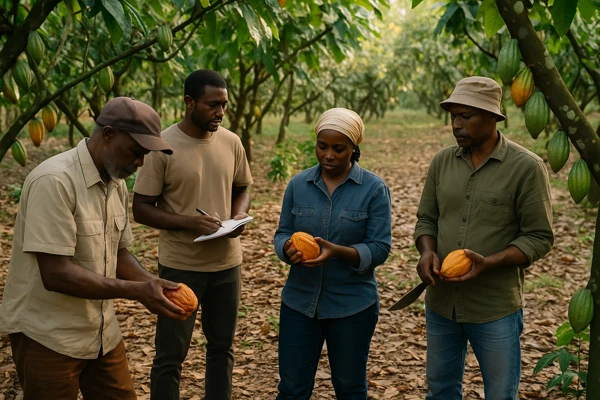
Cocoa reforms Ghana Ivory Coast have taken on renewed urgency as the European Union and its French development partners warn that both countries risk losing competitiveness in the global cocoa market if long-delayed reforms do not accelerate.
The warning was delivered during a two-day Cocoa4Future feedback workshop in Accra, where researchers presented extensive findings from a five-year EU and AFD-funded project examining the structural challenges and potential transformation pathways for the world’s two largest cocoa producers.
At the heart of the message was a clear directive: the pace of change must increase, or Ghana and Côte d’Ivoire could fall behind as global markets move decisively toward higher sustainability, traceability, and climate-resilient cocoa production.
Why the Stakes Are Rising
Ghana and Côte d’Ivoire together supply about 60% of the world’s cocoa, forming the backbone of the global chocolate industry and sustaining millions of rural households. Export earnings from cocoa remain a crucial pillar of national revenue, foreign exchange, and rural employment.
Yet the sector is under pressure from multiple directions. Farms are aging, climate patterns are shifting, and soil fertility is declining. Many producers are trapped in a cycle of low yields, low incomes, and limited capacity to invest in better practices. At the same time, international buyers and consumers are demanding more information about where their cocoa comes from and how it is produced.
Across Europe and beyond, retailers and chocolate companies are tightening standards on deforestation, labour rights and supply chain transparency. These changes mean that traditional production models can no longer guarantee market security, even for the world’s leading suppliers.
For Ghana, these pressures intersect with growing challenges in cross-border leakage and declining national output, highlighted in the Cocoa Smuggling Crisis: Ghana Loses 150,000 Tonnes in 2023–24 Season, which underscores how market instability and illegal trade further weaken farmer incomes and national revenue.
This sits alongside broader trade shifts such as the Ghana–US tariff removal deal on cocoa and key exports, signaling how competitiveness now depends not only on price, but on sustainability, traceability, and policy alignment across markets.
Findings from the Cocoa4Future Project
The research shared in Accra painted a detailed picture of sector vulnerabilities and the reforms needed to protect long-term competitiveness. Drawing on field data from both Ghana and Côte d’Ivoire, the project identified three major areas of concern: production systems, disease control, and the limitations of current certification schemes.
Low- to No-Shade Farming Dominates Production
Researchers confirmed widespread farmer reliance on low or no-shade cocoa systems. These systems can boost yields in the short term, especially when trees are young and well fertilised. For farmers working under tight financial constraints, the promise of higher short-term yields is hard to ignore.
However, the long-term consequences are serious. Low-shade systems undermine forest recovery and reduce biodiversity, leaving landscapes more exposed to heat waves, droughts and extreme rainfall. Without protective shade, soils lose moisture faster and become depleted, while beneficial insects and wildlife disappear.
With climate change intensifying across West Africa, continuing with such production models poses a serious threat to future productivity. Researchers warned that unless shade trees, agroforestry and soil restoration become central to cocoa policy, yield declines and crop failures could become more frequent in the coming decades.
CSSVD Remains a Severe and Persistent Threat
Cocoa Swollen Shoot Virus Disease (CSSVD) continues to devastate farms in both countries. The study highlighted that infections can slash yields by up to 202 kg per hectare on severely affected farms, undermining farmer incomes and national output at the same time.
Across many communities, farmer-led responses—such as cutting off infected branches, applying chemical treatments or simply ignoring early symptoms—have proven largely ineffective. In some cases, these practices can even spread the disease further across farms and districts.
To address CSSVD, the project recommends intensifying rehabilitation programmes, scaling up production and distribution of CSSVD-resistant seedlings, and expanding early-detection technical training for farmers and extension officers. Crucially, any rehabilitation effort must be paired with financial support for farmers who lose income while new trees are establishing.
Certification Helps — But Does Not Fix Structural Gaps
Fairtrade and Organic certification schemes have delivered important gains. The research found that certified farms often enjoy higher yields, better prices and more employment opportunities, particularly for youth and women engaged in cooperative activities.
However, these schemes do not automatically solve deeper structural problems. Their impact on food security and broader working conditions remains uneven, and many smallholders still lack access to the networks needed to become certified in the first place.
Researchers stressed that certification should not be viewed as a standalone solution. Instead, it must be integrated into a broader reform strategy that addresses land tenure, access to finance, extension services, and climate resilience at scale.
What the Findings Mean for Ghana and Côte d’Ivoire
Taken together, the Cocoa4Future findings amount to a strategic warning for policymakers in Accra and Abidjan. The evidence shows that the current model—high dependence on low-shade production, limited disease control and patchy certification coverage—is unsustainable in a world where buyers are increasingly demanding traceable, responsibly produced cocoa.
For governments, the message is that incremental reforms will not be enough. Unless agroforestry, farm rehabilitation and farmer support systems are treated as national priorities, Ghana and Côte d’Ivoire risk weakening the very sector that underpins their rural economies. In practical terms, that means aligning public budgets, donor funding and private investment around a long-term transformation plan.
For international partners, including the EU and France, the study also provides a roadmap for how assistance can be better targeted. Rather than funding fragmented projects, there is an opportunity to support integrated programmes that combine tree tenure reform, disease-resistant planting material, farmer training and access to credit. Stronger coordination between donors, governments and farmer organisations will be essential.
Finally, for farmers and cooperatives, the research confirms what many already experience on their farms: short-term yield gains are no longer enough to sustain a viable future. Resilient production—backed by shade trees, healthy soils and reliable markets—will require new skills, tools and partnerships.
Key Recommendations from Researchers
Across all thematic areas, governments in both countries were urged to ramp up input distribution, clarify tree tenure rights, promote hybrid cocoa varieties, incentivise agroforestry adoption, and formalise support systems for farmer livelihoods including pensions, credit access, and modern farm equipment.
Development partners stressed that these evidence-based reforms are now critical, as the global market moves rapidly toward higher standards and buyer expectations. The findings echo wider debates in policy circles and development forums across Europe, including discussions hosted by the European Commission on sustainable value chains for commodities such as cocoa, coffee and palm oil.
Risks for Ghana and Côte d’Ivoire
If reforms continue to lag, both countries risk reduced access to premium markets, loss of competitiveness, long-term productivity decline, and greater vulnerability to climate-driven production shocks. Buyers may increasingly favour origins that can demonstrate stronger environmental safeguards and more transparent supply chains.
Given their dominant role in global cocoa supply, the consequences would extend beyond trade—affecting rural livelihoods, national revenue, and sector stability. Reports from outlets like Citi Newsroom and other regional media have repeatedly highlighted how volatile cocoa prices and production challenges translate into real hardship for farming families.
For cocoa-dependent communities, a loss of competitiveness would not be an abstract policy issue; it would be felt directly in the form of reduced incomes, fewer employment opportunities and increased pressure on young people to migrate in search of alternative livelihoods.
Conclusion
The message from the Accra workshop is unambiguous: cocoa reforms Ghana Ivory Coast must accelerate, not as a reaction to external pressure, but as a strategic investment in the future of the sector. The research has identified the vulnerabilities, the solutions, and the pathway forward. What remains is implementation at scale.
For Ghana and Côte d’Ivoire, the choice is clear. By embracing agroforestry, strengthening disease control, investing in farmer support systems and aligning national policy with evolving global standards, both countries can protect their position at the heart of the chocolate industry. Failure to act would risk ceding hard-won ground to more agile competitors.
As global markets continue to evolve, the ability of Ghana and Côte d’Ivoire to translate research findings into real change on the ground will determine whether they maintain their leadership—or risk falling behind as expectations rise. For millions of cocoa farmers, the outcome of that transition will shape not only the future of cocoa, but the future of their communities for decades to come.