Why West Africa Became a Crime and Security Corridor
For more than a decade, West Africa has been identified as a critical hub for arms trafficking, vehicle crime, fraud, drug smuggling and terrorism financing. Its geography — linking the Atlantic coast to the Sahel and Central Africa — makes it attractive to organized crime groups that exploit porous borders, limited surveillance capacity and uneven law-enforcement cooperation. Vehicles stolen in Europe or North America are shipped to ports in the Gulf of Guinea, re-registered with forged customs papers and sold on regional markets, while weapons, explosives and drugs are moved inland towards conflict zones.
Criminal networks also take advantage of gaps in identity and document control. Fraudulent passports, counterfeit visas and forged driver’s licences allow suspects to move between countries with minimal scrutiny. Parallel to this, cyber-enabled crime has grown into a parallel underground economy, with West African syndicates engaged in romance scams, business-email compromise, SIM-box fraud and digital impersonation. It is within this environment that the latest West Africa Interpol Raid was launched to disrupt supply chains, dismantle networks and identify individuals with suspected links to terrorism.
Current Development: Inside Operation Screen West Africa 2025
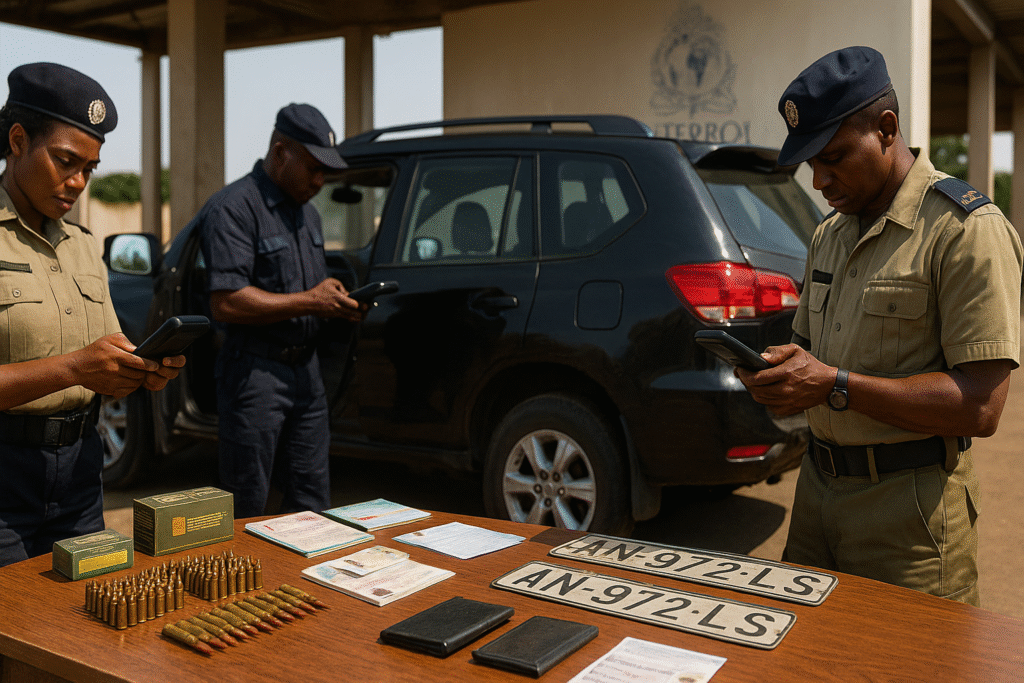
Operation Screen West Africa 2025 brought together law enforcement agencies from Benin, Burkina Faso, Cabo Verde, Côte d’Ivoire, The Gambia, Ghana, Liberia, Mauritania, Nigeria, Senegal, Sierra Leone and Togo. Border officers used INTERPOL Mobile Devices and the organisation’s I-24/7 secure police communications system to run on-the-spot checks against databases covering stolen and lost travel documents, wanted persons, stolen motor vehicles, firearms and other criminal intelligence.
In total, officers performed around 1.7 million checks during the operational window, leading to hundreds of hits on INTERPOL systems and several new investigations. The West Africa Interpol Raid focused on three main areas: suspected foreign terrorist fighters, organized crime and trafficking, and cyber-enabled financial crime.
Sixty-Two Suspects Arrested Across 12 Countries
The operation led to the arrest of 62 suspects, including individuals linked to terrorism, arms trafficking, vehicle crime, drug smuggling, counterfeit medicine distribution, human trafficking and fraud. Nine people were detained on suspicion of terrorist activities, among them three individuals arrested in Burkina Faso who were subjects of Blue Notices issued by Côte d’Ivoire in connection with a 2020 Al-Qaeda-affiliated JNIM attack that killed more than ten Ivorian security personnel. Six further suspects were arrested in Mauritania over alleged extremist links.
136 Stolen Vehicles Detected and Seized
A major focus of the West Africa Interpol Raid was the detection of stolen vehicles. Through systematic checks on INTERPOL’s Stolen Motor Vehicles (SMV) database, officers detected around 150 stolen vehicles and seized more than 75 on the spot, including 136 stolen vehicles identified as part of the wider operation. Many had been trafficked from Canada, France, Germany and the Netherlands, while others were believed to have originated in other European states and North America before being re-labelled in West African ports using forged import papers and altered chassis numbers.
Some vehicles were already being used as assets within broader criminal economies — from drug transport to money laundering and support for extremist groups. The seizures underline how stolen vehicles are not only a property crime, but also a currency used to fund other illegal activity. For ordinary citizens in the region, the recovery of these cars is a direct outcome of the West Africa Interpol Raid and a sign that cross-border cooperation can have tangible benefits.
Weapons, Explosives, Drugs and Counterfeit Medicines
Authorities also intercepted a wide range of dangerous materials. Seized items included ammunition, firearms, explosives and dynamite, as well as counterfeit medicines, fake currency and approximately 731 kg of cannabis. Investigators believe some of the explosives and ammunition were ultimately destined for conflict-affected areas in the Sahel, where armed groups rely heavily on cross-border smuggling to sustain their operations. By cutting off these supply chains, the West Africa Interpol Raid contributes directly to efforts to reduce attacks and instability.
Human Trafficking Victims Rescued
In one of the most serious findings, Ghanaian authorities, working with Nigerian partners, helped rescue 21 Ghanaian victims of human trafficking who had been held in Nigeria and exploited in fraudulent online schemes. The victims, many of them young adults, were coerced into running digital scams targeting victims abroad. Their rescue during the West Africa Interpol Raid illustrates how trafficking, cybercrime and financial fraud are now tightly interlinked — and how border-security operations can uncover hidden forms of exploitation.
Cyber and Document Fraud Uncovered
Across multiple borders, officers seized laptops, phones, routers and storage devices believed to be connected to cyber-enabled crime. Evidence pointed to romance scams, business-email compromise, phishing operations and impersonation schemes targeting individuals and companies in Europe, North America and other parts of Africa. Large volumes of fake passports, driver’s licences and customs documents were also intercepted, preventing suspects from travelling under false identities or moving goods through ports with forged paperwork.
What the West Africa Interpol Raid Reveals
Security analysts say the West Africa Interpol Raid under Operation Screen West Africa 2025 reveals several critical trends about modern organised crime in the region.
1. Transnational Networks, Not Isolated Cells
The operation confirmed that criminal groups operate across multiple borders, often coordinating car theft, drug trafficking, arms smuggling and cyber-fraud from different countries at once. A vehicle stolen in Europe might be detected in a West African port, linked to fake paperwork in another state and ultimately tied to financial scams run from a third country. This interconnected web makes coordinated operations like the West Africa Interpol Raid essential: no single country can tackle these networks alone.
2. Technology Is Both a Threat and a Tool
Organised crime groups make heavy use of encrypted messaging, spoofed IP addresses, GPS manipulation and digital identity theft. Yet the operation also showed how technology empowers law enforcement. INTERPOL Mobile Devices and I-24/7 allowed officers to run instant checks at roadside checkpoints, airports and ports, dramatically increasing the chances of detecting stolen vehicles or wanted persons in real time. This echoes the lessons from domestic crackdowns such as Ghana Passport Fraud: 379 Foreigners Arrested in Sweeping Crackdown , where improved data-sharing and document screening produced rapid results.
3. Terrorism Relies on Criminal Supply Chains
The arrests of suspects linked to JNIM and other extremist groups highlight how terrorism in the Sahel is deeply connected to smuggling routes in coastal West Africa. Ammunition, explosives, vehicles and counterfeit goods are all part of a wider ecosystem that funds and equips violent organisations. Disrupting these supply chains through operations like the West Africa Interpol Raid is therefore a central pillar of counterterrorism strategy, not just a parallel policing effort.
The West Africa Interpol Raid shows how sophisticated and cross-border modern crime has become. These carefully selected security tools can help families and small businesses improve their own protection at home.
1080p HD live view, infrared night vision, motion alerts and up to two-year battery life – ideal for monitoring doors, compounds and car parks.
View on AmazonMagnetic mount, long-lasting battery and real-time 4G LTE tracking to help locate cars, motorbikes and high-value assets if stolen.
View on AmazonFire-resistant box for passports, land documents, certificates and contracts – suitable for home or office use.
View on AmazonDisclosure: As an Amazon Associate, Global Standard News (GSN) earns from qualifying purchases. This section is for general information only and does not replace professional security, legal or financial advice.
How Officials and Observers Responded
INTERPOL’s leadership described the West Africa Interpol Raid as a powerful demonstration of what joint operations can achieve. The organisation’s Executive Director of Police Services said the arrests and seizures showed how “specialised tools and real-time data-sharing help law enforcement identify suspects, protect victims and disrupt criminal networks.” National authorities across the 12 participating countries echoed this message, stressing that continued investment in border technology and training would be crucial to sustaining the gains made.
In Ghana, police and immigration officials highlighted the rescue of the 21 trafficking victims and the role of international cooperation in bringing them home safely. Commentators noted that these outcomes complement domestic efforts, such as the Ahafo Security Operation: Over 300 Suspects Arrested in Major Joint Crackdown , which targeted local crime hotspots and illegal operations. Civil-society organisations welcomed the cross-border operation but called for transparent prosecutions, victim support and stronger safeguards against corruption in the justice chain.
International media and regional analysts also responded positively. Outlets such as Africanews and MyJoyOnline reported that the arrests and seizures demonstrate growing capacity in West African policing, while also warning that criminal networks are likely to adapt and test new routes in response.
Global and Local Impact of the West Africa Interpol Raid
For local communities, the immediate impact of the West Africa Interpol Raid is seen in fewer weapons and explosives in circulation, safer roads, and the disruption of vehicle theft and drug networks that feed everyday insecurity. The recovery of stolen vehicles means some victims in Europe and North America may eventually have their property returned, while communities in West Africa benefit from a reduction in criminal assets circulating in their neighbourhoods.
Globally, the operation reassures partner countries that stolen goods, fake medicines and terror-linked assets moving through West Africa are being actively tracked and intercepted. The raid also strengthens trust in shared policing tools such as INTERPOL’s Stolen and Lost Travel Documents database and the SMV system, which have already flagged tens of thousands of suspicious documents and vehicles worldwide.
Economically, seizing millions of dollars’ worth of illicit goods protects legitimate trade and investment. When traffickers use the same ports, highways and logistics corridors as lawful businesses, they increase risk, insurance costs and security expenses across the board. By constraining this criminal ecosystem, the West Africa Interpol Raid supports efforts to build a more predictable, rules-based trading environment in the region.
A Strong Signal, But Not the Final Battle
The West Africa Interpol Raid stands out as one of the most significant recent examples of how coordinated, intelligence-led policing can confront complex criminal networks. With 62 arrests, 136 stolen vehicles identified and seized, large quantities of weapons, explosives, drugs and counterfeit medicines taken off the market, and trafficking victims rescued, the operation delivered both symbolic and tangible results.
Yet its long-term impact will depend on what happens next: effective prosecutions, continued information-sharing, sustained investment in border technology and stronger oversight to prevent corruption. As organised crime groups adapt, regional and global law enforcement will have to stay a step ahead. For now, Operation Screen West Africa 2025 and the broader West Africa Interpol Raid send a clear signal that West African borders are no longer a low-risk playground for criminals – and that cooperation remains the most powerful tool in the fight against transnational crime.