Ghana Visa Fraud Campaign: Australia, Canada & UK Launch Joint Crackdown
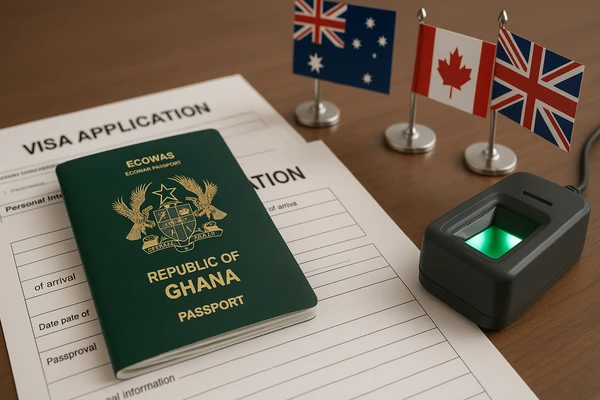
The Ghana Visa Fraud Campaign has emerged as a powerful international initiative bringing together the Australian High Commission, the High Commission of Canada, and the British High Commission in Accra. Announced during International Fraud Awareness Week, the campaign seeks to combat the surge of visa-related scams affecting Ghanaian applicants—ranging from forged documents and fake agents to misleading online advertisements promising “guaranteed visas.”
For many Ghanaians eager to travel abroad for education, work, business, or tourism, visa misinformation has become an increasingly dangerous trap. Scammers exploit financial desperation and lack of awareness, often charging large sums for fraudulent documentation that leads to visa denials or even 10-year bans. As visa fraud evolves in sophistication, the diplomatic missions of three major destination countries have decided to send a united message: only official channels and honest submissions safeguard your immigration future.
By combining their communication power, public education resources, and migration-security expertise, the embassies hope the Ghana Visa Fraud Campaign will reset public understanding of visa procedures and empower applicants to avoid costly mistakes.
Rising Visa Fraud and the Urgency for a Joint Response
Visa fraud is not new in Ghana, but its scale and complexity have escalated in recent years. Agents now operate on social media, promising “express visas” or “direct connections” to embassy officials. Some offer to create bank statements, academic transcripts, invitation letters, or employment contracts—all of which are easily detected by embassy verification systems.
The British High Commission revealed that more than 1,600 Ghanaian visa applications in 2024 contained fake or misleading documents. This represented roughly four percent of all applications submitted, a figure significant enough to trigger broader anti-fraud measures. Every fraudulent submission resulted in an automatic 10-year ban—a devastating setback for applicants and their families.
Australia and Canada face similar challenges. Fraudulent job-offer letters targeting workers heading to Canada’s rural communities have increased, with scammers reportedly charging thousands of Ghana cedis for fake Canadian LMIA (Labour Market Impact Assessment) documents. Australian authorities have detected false student admissions and manipulated financial records submitted via unauthorized “education consultants.”
The Ghana Visa Fraud Campaign was necessary not only to address individual cases but also to combat broader criminal networks forging documents across multiple countries. These networks often exploit young people seeking scholarships, health workers seeking migration opportunities, and families hoping to visit loved ones abroad.
This harmful ecosystem is further fuelled by misinformation. Many Ghanaians still believe that bank statements are “not checked,” that agents can influence visa officers, or that you can “buy a visa package” guaranteed to succeed. These myths persist despite repeated embassy warnings. The new campaign is designed to dismantle these misconceptions and explain how visa officers actually evaluate documents, financial capacity, travel history, and credibility.
Current Developments: Inside the Joint Visa Fraud Awareness Strategy
The Ghana Visa Fraud Campaign combines high-level diplomatic communication with mass public education. Its execution spans digital platforms, traditional media, educational spaces, travel agencies, and community institutions.
Official Embassy Warnings and Public Statements
Each mission has issued formal advisories stressing that no agent can influence visa approval and that all documents are thoroughly verified using international databases. The Australian High Commission has urged applicants to follow official instructions published on the Australian Department of Home Affairs website. The British High Commission has reiterated that forged documents—especially bank statements—are easily detected and permanently damage immigration histories. The Canadian High Commission has emphasized the importance of applicants submitting their own truthful information rather than relying on unauthorized intermediaries.
These coordinated statements form the backbone of the outreach and are reinforced across media interviews and embassy events, giving the Ghana Visa Fraud Campaign strong visibility and authority.
Digital Education: Social Media as the Primary Battlefield
The embassies have launched a synchronized digital campaign using the hashtag #AUSCANUKGH, targeting youth, students, freelancers, and families. Daily content on Facebook, X (Twitter), Instagram, and YouTube includes red flags for identifying fake agents, advice on checking whether a website is legitimate, and explanations of the full impact of submitting forged documents.
Posts also highlight common fraud formats, such as WhatsApp groups advertising “visa slots,” fake Canadian farm jobs, sham UK care-worker placements, and unaccredited Australian college admissions. By naming these tactics explicitly, the Ghana Visa Fraud Campaign helps applicants recognise scams earlier and encourages them to report suspicious offers.
Community Outreach: Engaging Institutions Across Ghana
The campaign’s offline component is equally important. The embassies are collaborating with the Ghana Immigration Service, the Ghana Police Service, reputable travel and tour associations, universities, and senior high schools. Guidance counsellors, student leaders, and civil-society organisations are being engaged as key multipliers of accurate information.
This approach ensures that the message reaches applicants who may not actively follow embassy social-media pages. Regional outreach to cities such as Kumasi, Tamale, Takoradi, and Sunyani is a core goal, as many fraudulent agents operate outside Accra. In these communities, the Ghana Visa Fraud Campaign is framed as both a consumer-protection and youth-protection effort.
Exposing Common Fraud Schemes
As part of the educational drive, the campaign highlights the top fraud methods affecting Ghanaian applicants: fake Canadian LMIA job offers, fake UK invitation letters, fake Australian student-admission letters, forged bank statements, fraudulent travel itineraries, and manipulated proof of accommodation. Another recurring issue is agents uploading documents without fully explaining to clients what is being submitted on their behalf.
By exposing these patterns, the Ghana Visa Fraud Campaign encourages applicants to take ownership of their applications and to ask detailed questions whenever third parties are involved.
Travel Safety Essentials for Visa Applicants
As the Ghana Visa Fraud Campaign emphasizes secure and lawful travel preparation, these carefully selected tools help protect your passport, identity, financial records, and key documents when traveling abroad. Ideal for students, workers, and frequent flyers.
Secure your passport, cards, and AirTag with this anti-theft RFID-blocking passport cover — ideal for students, tourists, and business travellers who want extra protection at airports and border checks.
View on AmazonA must-have accessory for Ghanaian travellers heading to Canada, the UK, Australia, the USA, or Europe. Keep your phone, laptop, and power bank charged safely in almost any country.
View on AmazonProtect your essential visa documents, bank statements, receipts, and certificates from fire, water, and theft at home or on the move. A practical safeguard for anyone preparing for a visa interview.
View on AmazonDisclosure: As an Amazon Associate, Global Standard News (GSN) earns from qualifying purchases at no additional cost to you.
Analysis: Why the Ghana Visa Fraud Campaign Is a Landmark Initiative
Beyond practical guidance, the Ghana Visa Fraud Campaign is part of a larger global shift toward protecting migration integrity. Interpol and the United Nations Office on Drugs and Crime (UNODC) have repeatedly warned that migration fraud networks now span multiple countries, using digital tools and forged documents to exploit people seeking opportunities abroad.
Document-verification technology has grown significantly more advanced. Embassies use a combination of artificial intelligence, biometric data, bank-statement verification systems, university enrollment portals, and employer cross-checks to detect inconsistencies. What may appear to an applicant as a “minor adjustment” or a “helpful modification” by an agent is quickly flagged by these systems as deliberate fraud.
Fraudulent submissions do not only harm individuals; they increase scrutiny for everyone. They lengthen visa-processing times, force embassy staff to devote more resources to investigations, and can lead to a general drop in approval rates if a particular country becomes associated with high levels of deception. In this sense, the Ghana Visa Fraud Campaign is also about protecting the reputation of genuine Ghanaian applicants who follow the rules.
Economically, the stakes are high. Many victims of visa fraud report losing thousands of Ghana cedis to fake agents—money often borrowed from family or financed through loans. When those applications are refused because of fraud, applicants are left with debt and no travel opportunity. By strongly discouraging fraudulent practices, the campaign protects both personal finances and Ghana’s broader economic interests.
Reactions: Diplomatic Voices, Expert Opinions and Public Sentiment
Statements From the High Commissions
Diplomats from the three missions have praised the joint approach as a necessary step in a challenging environment. The Australian High Commissioner has described fraud as something that “destroys genuine opportunities” and urged applicants to rely only on information found on official government websites. The British High Commissioner has called documented fraud levels “deeply concerning” and warned that the United Kingdom has a policy of zero tolerance for forged documents. The Canadian High Commissioner has reaffirmed that protecting the integrity of migration systems is crucial to maintaining public confidence and ensuring that honest applicants are treated fairly.
Reactions From Ghanaian Institutions and the Public
Ghanaian institutions have broadly welcomed the initiative. Officials from the Ghana Immigration Service and the Ghana Police Service’s cyber units have noted an increase in online visa scams over the last three years, many targeting people under the age of 30. Travel and tour associations have requested more joint outreach, including workshops for registered agents to ensure they fully understand embassy expectations.
On social media, early reactions from the public have been largely positive. Many prospective students and workers say the campaign gives them clearer direction on where to find trustworthy information. Parents who often pay for their children’s visa processes have also expressed relief, hoping the campaign will reduce the number of fraudulent operators in the market. Some commentators have called for stricter licensing and regulation of travel consultants to support the goals of the Ghana Visa Fraud Campaign.
Global and Local Impact: What the Campaign Means for Ghana and Beyond
At the local level, the campaign is expected to reduce the number of fraudulent applications reaching embassy desks, improve processing times for genuine applicants, and empower Ghanaians with better knowledge of official procedures. For students applying through Canada’s SDS, the UK’s points-based system, or Australia’s Genuine Student (GS) requirements, clear guidance can mean the difference between a smooth approval and a damaging refusal.
Globally, the Ghana Visa Fraud Campaign aligns with international efforts to promote safe, orderly, and regular migration. It reflects recommendations from the United Nations and the International Organization for Migration (IOM) that emphasise transparent, lawful pathways over irregular routes and fraudulent practices. Embassies in other regions—such as East Africa, South Asia, and Eastern Europe—have launched similar joint initiatives, underscoring that visa fraud is a transnational challenge.
If sustained and supported by strong local enforcement, the campaign could significantly weaken visa-fraud networks operating in and around Ghana. It could also help restore and strengthen Ghana’s reputation as a source of honest, well-prepared applicants, encouraging partner countries to maintain or expand their visa services for students, tourists, workers, and business travellers.
A Blueprint for Safer, Fairer Visa Applications
The Ghana Visa Fraud Campaign represents one of the strongest diplomatic collaborations in recent years. By uniting three major high commissions, the initiative delivers a powerful message: honesty, transparency, and direct engagement with official channels are the only safe paths to obtaining visas.
For thousands of Ghanaians dreaming of studying, working, or traveling abroad, the campaign serves as both a warning and a guide. It empowers applicants to avoid fraud, protects them from exploitation, and strengthens trust between Ghana and global migration partners. If sustained, this initiative could become a model for Africa—and a crucial step toward ensuring the integrity of global visa systems.
Further Reading & Verified Sources
Internal Links (GSN Articles):
- AirTags Black Friday Sale: Best Deals and Market Impact
- World Diabetes Day: Experts Warn of Rising Global Cases
External Links (Authoritative Sources):