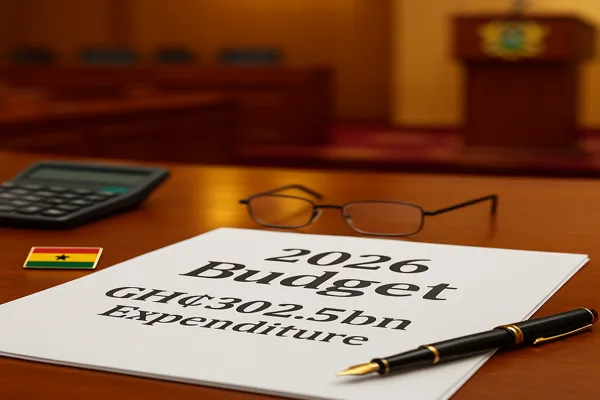
The 2026 Ghana Budget outlines a bold GH¢302.5 billion national spending plan designed to stabilise the economy, expand infrastructure, and provide relief to households still recovering from years of economic turbulence. Presented at a time of tight fiscal constraints and public concern about rising living costs, the 2026 Ghana Budget seeks to restore confidence and support growth while remaining aligned with IMF fiscal discipline requirements. The plan is ambitious, far-reaching, and politically significant ahead of a pivotal election year.
Economic Context Framing the 2026 Expenditure Plan
The 2026 Ghana Budget comes on the back of an economy still healing from severe shocks experienced between 2022 and 2024. During that period, Ghana’s fiscal position deteriorated due to high debt levels, currency depreciation, inflation spikes exceeding 40%, and disrupted global supply chains. These challenges forced Ghana into an IMF Extended Credit Facility programme, triggering debt restructuring negotiations and stringent fiscal adjustments.
By late 2025, some stability had returned: inflation had slowed, the cedi had steadied modestly, and investor confidence was gradually recovering. However, households continued to feel intense pressure from food prices, rent hikes, utility adjustments, and transport fares. In this challenging environment, the 2026 Ghana Budget aims to strike a balance between supporting growth and maintaining strict fiscal discipline.
Understanding the GH¢302.5bn Expenditure Framework
Government’s programmed expenditure for 2026 stands at GH¢302.5 billion, representing a 12.4% rise over the previous year, according to credible reporting from MyJoyOnline and Citi News.
• Compensation of Employees
Driven by new recruitment in education, security, and healthcare. Ghana’s expanding public sector wage bill continues to be one of the largest budget components.
• Interest Payments
A major expenditure item even after domestic debt restructuring, reflecting Ghana’s still-heavy debt servicing obligations.
• Capital Expenditure
One of the most significant increases, aimed at infrastructure expansion, industrial growth, agricultural modernisation, and digital transformation.
• Goods and Services
Improved allocation to strengthen public sector efficiency and service delivery.
This structure suggests a strategic attempt to maintain macro stability while pursuing targeted growth.
Infrastructure Expansion as the Anchor of Economic Transformation
A defining pillar of the 2026 Ghana Budget is its aggressive push for infrastructure development through the Big Push programme. Government intends to channel substantial resources into:
- National and regional road construction
- Urban mass transit improvements
- Affordable housing projects in major cities
- Upgrades to health facilities
- Classroom blocks and school infrastructure
- Water systems and rural electrification drives
These investments aim to reduce logistical bottlenecks, expand productive capacity, and stimulate job creation. Analysts, however, stress that value-for-money audits and timely payments to contractors are crucial to prevent delays, inflated costs, and abandoned projects.
Job Creation and Industrial Growth Targets for 2026
The 2026 Ghana Budget outlines a plan to create 800,000 jobs, a major political and economic priority. Key employment strategies include:
1. Public Sector Expansion
Hiring teachers, nurses, security personnel, and specialised health professionals.
2. Industrial Incentives
Boosting agro-processing, automobile assembly, pharmaceuticals, textiles, and light manufacturing.
3. Agricultural Modernisation
Mechanisation centres, irrigation expansion, and subsidised input distribution to improve productivity and youth participation.
4. Digital Skills and Innovation Hubs
Scaling youth tech training programmes, startup incubation centres, and digital entrepreneurship schemes.
While ambitious, the success of these initiatives depends heavily on financing availability, private sector competitiveness, and market conditions.
Social Protection Commitments for Vulnerable Communities
Acknowledging the widespread economic pressure on households, the 2026 Ghana Budget increases funding for social programmes such as:
- LEAP cash transfers
- School Feeding Programme
- NHIS service strengthening
- Free SHS infrastructure expansion
- Rural water and sanitation projects
- Community development initiatives
These policies aim to stabilise struggling families and reduce inequality during recovery.
Fiscal Consolidation and Revenue Performance Expectations
Despite its ambitious spending, the 2026 Ghana Budget emphasises fiscal restraint to meet IMF commitments and maintain macroeconomic stability. Government highlights the following measures:
- Enhanced tax compliance and enforcement
- Expansion of digital tax platforms
- Reduction of non-essential government expenditure
- Tight control of arrears accumulation
- Freeze on new non-concessional external borrowing
- Improved oversight of state-owned enterprises
Analysts warn that Ghana’s historically weak revenue performance could challenge implementation if reforms are not aggressively pursued.
Expert, Industry, and Political Reactions
Reactions to the 2026 Ghana Budget reveal a mixture of optimism, caution, and political debate.
Economists
A senior economist at ISSER observed:
“GH¢302.5 billion is ambitious for a consolidating economy. Implementation discipline will determine whether this becomes a recovery springboard or another missed opportunity.”
Private Sector
The AGI welcomed incentives for industrial expansion but demanded predictable government payments and reduced bureaucratic delays.
Labour Unions
Unions applauded improved wage and employment commitments but insisted that cost-of-living adjustments must reflect real inflation.
Opposition MPs
Opposition voices argue that revenue projections are over-stated and warn the budget may rely too heavily on optimistic assumptions.
Public Sentiment
Citizens expressed cautious hope, with many highlighting concerns over fuel prices, food inflation, taxes, and youth unemployment.
National and International Implications of the Budget
The 2026 Ghana Budget will shape both domestic well-being and global investor perceptions.
Domestic Impact
- Improvement in infrastructure may reduce transport and food distribution costs.
- Job creation initiatives could soften unemployment pressures.
- Expanded social interventions may cushion vulnerable households.
- Better service delivery in health and education may improve nationwide human capital.
International Impact
- Demonstrated fiscal discipline could strengthen Ghana’s credit ratings.
- Investors will watch revenue performance to gauge Ghana’s macro-stability.
- Successful budget execution may reopen medium-term access to international capital markets.
Failure, however, could stall economic recovery, increase investor caution, and heighten public dissatisfaction.
Conclusion
The 2026 Ghana Budget presents a forward-leaning, high-investment plan shaped by a GH¢302.5 billion expenditure framework. It promises jobs, infrastructure, social protection, and economic stabilisation. Yet, it also faces significant hurdles—revenue gaps, debt burdens, and implementation challenges. Its success will depend on disciplined execution, efficiency, transparency, and realistic revenue mobilisation. As Ghana navigates the year ahead, this budget will serve as both a test of governance and a roadmap for national recovery.
Internal Links
Military Recruitment Stampede: Six Dead, Dozens Injured at El-Wak Stadium
Ghana Passport Fraud: 379 Foreigners Arrested in Sweeping National Crackdown
Ahafo Security Operation: Over 300 Suspects Arrested in Major Joint Crackdown
External Links
MyJoyOnline Budget Report
Citi News Budget Analysis
Bank of Ghana Economic Indicators