Ghana Pay Rise Signals Relief for Workers
The recently announced Ghana Pay Rise represents a crucial intervention for thousands of public-sector employees across the country. The government and organised labour have jointly endorsed a 9 % increment in both the national minimum wage and base pay for 2026. The decision aims to relieve economic pressure on households, enhance morale among civil servants, and align wages with Ghana’s ongoing economic recovery plan under IMF supervision.
From Inflation Shocks to Stabilisation
Ghana’s wage policy has often mirrored its economic turbulence. Between 2022 and 2024, high inflation, currency depreciation, and fiscal tightening heavily eroded real wages. The Fair Wages and Salaries Commission (FWSC) and the Ministry of Finance engaged labour unions under the Trades Union Congress (TUC) to re-establish predictable annual negotiations.
By late 2025, inflation had dropped to single digits after hovering above 50 % in 2023, creating space for a moderate Ghana Pay Rise. The previous year’s 23 % adjustment had been corrective; the 9 % increase now signals a return to steady, sustainable wage growth rather than emergency relief.
The government emphasised that the latest increment aligns with its fiscal consolidation goals, ensuring worker welfare without jeopardising macroeconomic reforms agreed with international partners.
Details of the Agreement – Terms of the Ghana Pay Rise
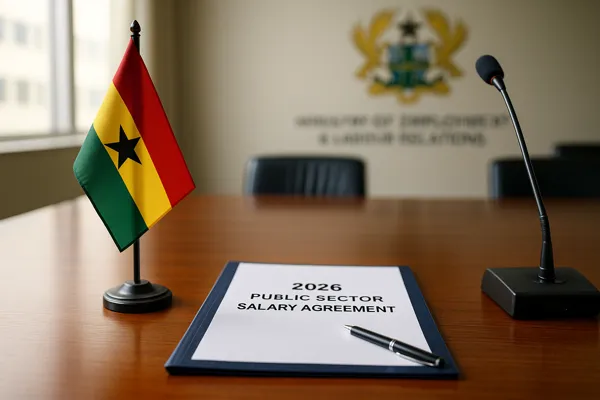
At a ceremony on November 9 2025, officials from the FWSC, the Ministry of Finance, and the Ministry of Employment and Labour Relations signed the 2026 wage memorandum with representatives of organised labour.
Key highlights of the Ghana Pay Rise include:
- Public-sector salaries under the Single Spine Salary Structure will increase by 9 %, effective January 1 2026.
- The National Daily Minimum Wage (NDMW) climbs from GH₵ 19.97 to GH₵ 21.77, also effective January 1 2026.
- The new rate will remain valid through December 31 2026, providing a full-year guarantee for workers.
- Government has pledged prompt implementation with no arrears.
The FWSC confirmed that payroll systems are being recalibrated in advance so workers experience the new rate from the first quarter of 2026. The agreement forms part of Ghana’s “social partnership framework,” which promotes annual dialogue rather than confrontation between government and labour.
Economic Interpretation – Balancing Relief and Responsibility
Policy analysts view the 9 % Ghana Pay Rise as a deliberate balance between social protection and fiscal prudence. With inflation stabilising around 8 %, the increment is expected to preserve real incomes without stoking new price pressures.
Dr Patrick Asante, a labour economist, explained that “the Ghana Pay Rise supports purchasing power while staying consistent with IMF-mandated expenditure ceilings.”
Public-sector compensation already accounts for roughly half of Ghana’s domestic revenue. Overly aggressive increases could threaten deficit-reduction targets; conversely, wage stagnation risked undermining morale and productivity. The 9 % compromise, therefore, seeks to maintain economic equilibrium while acknowledging labour’s concerns.
The increment could also stimulate modest consumer spending, particularly in retail and transport sectors, boosting short-term growth. However, economists warn that without productivity gains, such wage expansion could heighten pressure on public finances.
Stakeholder Perspectives – Reactions from Government and Labour
The announcement drew a measured welcome from both sides.
TUC Secretary-General Dr Yaw Baah commended the consultative process, stating:
“The Ghana Pay Rise demonstrates good-faith negotiation. While 9 % may not fully offset rising costs, it represents progress toward fairness and social stability.”
Benjamin Arthur, Chief Executive of the FWSC, described the agreement as “an outcome of compromise and evidence-based planning.” He added that “salaries will reflect the 9 % increment from January without delay.”
Finance Minister Dr Cassiel Ato Forson emphasised fiscal discipline:
“The Ghana Pay Rise is within our affordability threshold. It rewards workers yet preserves macroeconomic stability—our twin objective for 2026.”
Some labour groups, including teachers and nurses, called for additional incentives tied to performance and rural deployment. Civil-service associations welcomed the move but urged vigilance to ensure future increments track inflation and productivity.
Public sentiment on social media was mixed. Many praised the gesture but questioned whether 9 % was sufficient given persistent rent and food inflation.
Macroeconomic Implications – Fiscal and Social Dimensions
The Ghana Pay Rise directly affects over 700 000 public employees, influencing household consumption patterns and the broader fiscal framework.
Short-Term Impact
Increased disposable income could lift household spending and reinforce recovery momentum projected at 3.8 % GDP growth for 2026. Businesses supplying consumer goods may benefit from improved demand.
Fiscal Concerns
However, the wage bill—already near GH₵ 45 billion—will expand further, tightening fiscal space for capital expenditure. Analysts caution that unless tax collection improves, the government may need to reallocate funds from infrastructure or borrowing to meet payroll commitments.
Monetary Policy Link
The Bank of Ghana will closely watch inflation dynamics. If the Ghana Pay Rise generates excessive liquidity, monetary tightening could follow. Sustaining price stability remains vital to preserving the real value of the increment.
Comparative Perspective – Regional and Global Context
Compared to peers in West Africa, Ghana’s 9 % adjustment appears moderate yet credible. Nigeria and Côte d’Ivoire implemented wage reviews exceeding 15 %, but at significant fiscal cost. Ghana’s calibrated Ghana Pay Rise reinforces its commitment to reform discipline under IMF oversight.
International observers note that wage management is central to Ghana’s debt-restructuring success. A predictable, negotiated system fosters investor confidence and labour peace—key ingredients for macroeconomic credibility.
Globally, many emerging economies face similar trade-offs between protecting workers and maintaining fiscal health. Ghana’s model of annual social partnership could become a regional template for constructive labour relations.
Socio-Economic Outlook – Broader Benefits and Risks
The Ghana Pay Rise carries implications beyond salary figures.
- Household Well-being: Improved income security may ease household debt and enhance access to education and healthcare.
- Private Sector Benchmarking: Employers often peg pay scales to public-sector adjustments; hence, the 9 % rise may ripple into private industries.
- Labour Productivity: Sustained motivation could raise efficiency within ministries and public agencies.
- Fiscal Risk: Without matching productivity, wage growth could outpace revenue, creating future budget stress.
Experts therefore advocate complementary reforms—digital payroll management, anti-ghost-worker audits, and merit-based allowances—to ensure the Ghana Pay Rise strengthens both equity and efficiency.
Public Voices – Reactions from Citizens and Experts
Random interviews across Accra and Kumasi show cautious optimism. A teacher in Madina said, “The Ghana Pay Rise is welcome, but inflation must remain low; otherwise, we’ll lose the value quickly.”
Civil-society organisations commended the peaceful negotiation process, urging enforcement of the new GH₵ 21.77 daily minimum wage in the informal sector, where compliance remains weak.
Economist Dr Grace Mensah remarked that “predictability builds trust. Knowing the government honours agreements like the Ghana Pay Rise encourages labour peace and investment confidence.”
Ghana Pay Rise as a Test of Sustained Stability
The 2026 Ghana Pay Rise embodies the delicate balance between compassion and constraint. By agreeing to a 9 % uplift, Ghana’s leaders and workers have demonstrated maturity in social dialogue. The challenge now lies in ensuring fiscal sustainability, inflation control, and productivity improvement.
If implemented transparently and supported by sound macroeconomic management, the Ghana Pay Rise could strengthen household resilience and reinforce Ghana’s reputation as a country pursuing growth through fairness and responsibility.
Internal Links
- Germany Pledges GH¢823m to Boost Ghana’s Development Initiatives
- Europe Bird Flu Outbreak: Early Surge Sparks Fresh Public-Health and Trade Fears
External Links
- Citi Newsroom – Gov’t Increases Public Sector Salaries by 9 %
- Modern Ghana – Government Approves 9 % Salary Increase for Public Workers