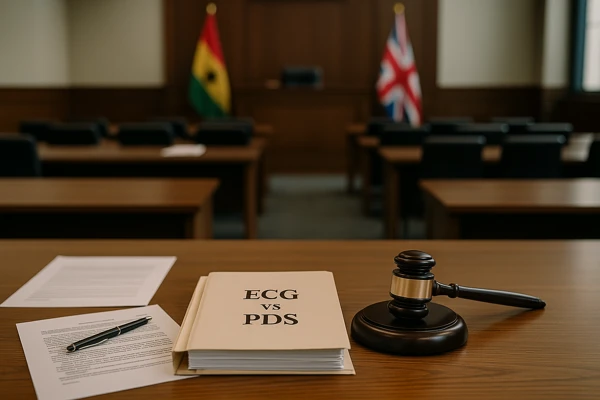
In a ruling that underscores Ghana’s regulatory credibility, a London arbitration tribunal has declared that PDS loses $390m claim against the Electricity Company of Ghana (ECG). The decision ends years of legal wrangling between the state power distributor and its former private partner, Power Distribution Services Ghana Ltd (PDS). For Accra, the verdict represents both a financial reprieve and a moral victory — reaffirming that governance, not speculation, must guide the management of critical national assets.
Historical Context — From Promise to Controversy
The origins of the dispute trace back to 2019, when PDS was awarded a 20-year concession to manage ECG under Ghana’s Millennium Challenge Corporation (MCC) Compact II. The contract, part of a $498 million U.S.-backed reform program, was meant to attract private investment and improve operational efficiency in power distribution.
However, just five months after the takeover, Ghana suspended PDS over concerns about the authenticity of its financial guarantee — a mandatory safeguard required by the MCC and the Ministry of Finance. Investigations by the government revealed irregularities in the insurance guarantee submitted by PDS, prompting the contract’s termination later that year.
PDS disputed the findings, alleging that its guarantee met all contractual requirements and that the government’s decision was politically influenced. In response, PDS initiated arbitration proceedings in London, claiming $390 million in damages for what it described as unlawful termination and reputational harm.
Tribunal Verdict — PDS Loses $390m Claim in Full
After nearly four years of legal proceedings, the London arbitration tribunal concluded that PDS loses $390m claim in its entirety. The ruling, delivered in October 2025, sided with ECG and the Government of Ghana, determining that the termination was legally justified.
According to reports from MyJoyOnline and Reuters, the tribunal found that PDS failed to meet critical financial security conditions precedent to the concession. Without these guarantees, ECG was entitled to revoke the agreement. Consequently, the tribunal dismissed all compensation demands from PDS and ordered each party to bear its own legal costs.
PDS has since acknowledged the judgment, noting that its legal team is reviewing the award before deciding on possible next steps. ECG, on the other hand, hailed the outcome as a “complete vindication” of Ghana’s energy-sector governance and due diligence.
Legal Insight — Why the Tribunal Favoured ECG
Legal analysts say the tribunal’s decision that PDS loses $390m claim highlights the centrality of compliance and authenticity in public-private partnerships. The panel reportedly emphasized that the guarantee submitted by PDS did not meet the contractual standard required under international project finance law.
Dr. Kwaku Mensah, a senior lecturer in energy law at the University of Ghana, told GSN:
“This outcome reinforces that no amount of foreign capital can replace procedural integrity. The tribunal’s decision sends a clear signal — contracts in Ghana must adhere to both domestic and international legal norms.”
The ruling is expected to shape how future energy concessions are structured, emphasizing verifiable guarantees and transparent oversight mechanisms.
Stakeholder Reactions — Mixed Emotions Across the Spectrum
Government and ECG officials celebrated the outcome. ECG’s Managing Director, Samuel Dubik Mahama, described the verdict as “a victory for accountability and for every Ghanaian taxpayer.” The Ministry of Energy echoed this sentiment, stating that the case has provided “valuable lessons for improving governance within Ghana’s power sector.”
Meanwhile, PDS officials expressed disappointment but maintained respect for the tribunal process. In a statement shared with the BBC, the company said it believed the concession was handled in good faith and was “intended to deliver sustainable improvements in Ghana’s electricity services.”
Civil-society groups, including the Africa Centre for Energy Policy (ACEP), welcomed the judgment but called for transparency. ACEP Executive Director, Benjamin Boakye, urged the government to publish the full arbitration award, noting that “public access to the findings will strengthen investor confidence and public trust.”
Economic Impact — Financial Relief and Policy Reflection
The tribunal’s decision carries significant fiscal implications. Had the case gone the other way, Ghana could have been compelled to pay nearly $390 million in damages — equivalent to 0.4% of its GDP and a potential strain on public finances. By ensuring that PDS loses $390m claim, Ghana avoids a heavy liability and preserves its macroeconomic stability amid ongoing IMF-supported recovery efforts.
According to analysts at Bloomberg Africa, the verdict enhances Ghana’s reputation as a state capable of defending its interests through lawful and transparent means. However, they caution that the decision should not mask the need for systemic reform in ECG’s operational efficiency and customer service delivery.
Economist Dr. Patrick Asare observed that the ruling “should prompt a sober reassessment of how Ghana manages privatization in essential sectors. Legal victories must translate into better governance, not complacency.”
Recommended Power & Safety Devices
Reliable backup power for home and office during outages — perfect for protecting computers, Wi-Fi routers, and essential devices.
View on AmazonProfessional-grade multimeter with non-contact voltage detection — trusted by engineers, technicians, and energy specialists.
View on AmazonHeavy-duty, ETL-listed surge protector designed for computers, home appliances, and sensitive electrical equipment.
View on AmazonGovernance Perspective — Lessons for Future Partnerships
For policymakers, the fact that PDS loses $390m claim underscores a broader governance message: oversight, documentation, and compliance are indispensable. The Energy Commission and Public Utilities Regulatory Commission (PURC) are expected to tighten licensing and concession frameworks to prevent similar disputes.
Future power agreements may now feature more stringent “proof-of-security” clauses, independent audits, and arbitration contingency protocols. This approach aligns with global standards and safeguards national interests in cross-border energy deals.
The Ministry of Finance has already indicated plans to work with the Attorney General’s Department to design a new model concession framework that ensures both investor protection and state accountability.
Regional and Global Implications — A Case Study in Legal Credibility
The outcome that PDS loses $390m claim has reverberated beyond Ghana’s borders. Across Africa, governments and investors are studying the case as a precedent for dispute resolution within the energy sector. It demonstrates that arbitration, when fairly conducted, can uphold justice and balance between sovereign authority and private-sector ambition.
For Ghana, the victory enhances its image in international circles as a jurisdiction that honors contracts but will defend its integrity when breached. It also sets an example for other states — such as Nigeria, Kenya, and Zambia — where energy-privatization models have faced similar challenges.
Globally, the ruling reinforces confidence in the London Court of International Arbitration’s neutrality and strengthens investor awareness of the risks of entering complex state contracts without airtight guarantees.
Public Sentiment — Relief and Renewed Confidence
On social media, Ghanaians have largely welcomed the tribunal’s outcome. Many view it as an affirmation of national sovereignty and responsible governance. The phrase PDS loses $390m claim quickly trended on X (formerly Twitter), with commentators highlighting the need for continued vigilance in the management of public assets.
Energy consumers, advocacy groups, and legal experts agree that the ruling marks a turning point in Ghana’s push toward more transparent public-private cooperation. Some users also called for ECG to channel the momentum into better service delivery, improved billing systems, and expanded access to rural electrification.
A Legal Win and a Governance Wake-Up Call
The confirmation that PDS loses $390m claim represents more than a legal victory; it is a governance milestone for Ghana’s energy landscape. It validates due diligence, contractual integrity, and regulatory vigilance.
As ECG looks ahead, the task now is to transform this moral and legal triumph into tangible operational gains. For PDS, the case serves as a reminder that even high-stakes privatization ventures must be grounded in transparency and compliance.
In the end, Ghana’s win is not just about avoiding a $390 million payout — it is about reaffirming the principle that truth and accountability remain the country’s most powerful assets in global business.
Internal Links (GSN)
- Ford Recall Hits Nearly 80,000 Vehicles Over Door and Lightbar Defects
- Chinese Illegal Miners Arrested in Mankranso: Weapons Seizure Shocks Ghana