Mounting Tensions After Disputed Vote
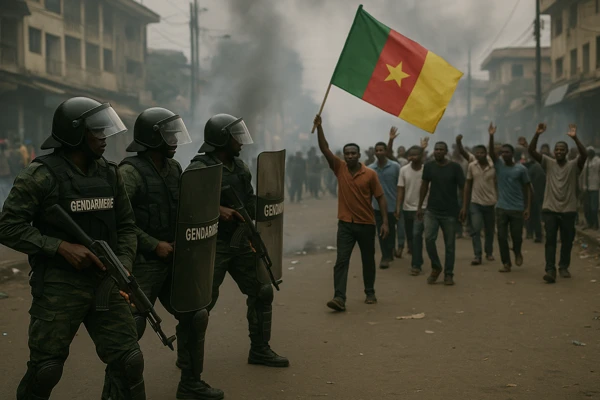
The Cameroon Election Protests have escalated into one of the country’s bloodiest political crises in decades, with United Nations sources confirming 48 civilians killed as security forces used live ammunition to disperse demonstrators.
The violence erupted after President Paul Biya, in power since 1982, was declared winner of the October 12, 2025 election with 53.66 percent of the vote — extending his 43-year rule and igniting public outrage over alleged electoral fraud.
Decades of Political Stagnation
Cameroon’s fragile democracy has long revolved around Biya’s centralized rule and the dominance of the Cameroon People’s Democratic Movement (CPDM). Once celebrated for stability, the nation has slid into a cycle of repression and disillusionment, particularly among the youth who see little prospect for change.
Since taking office in 1982, Biya has survived multiple legitimacy crises — from the Anglophone separatist conflict to allegations of rigged polls. The Cameroon Election Protests are not merely a reaction to a single vote, but rather a manifestation of decades of pent-up frustration.
Opposition leader Issa Tchiroma Bakary, who declared himself the “people’s president,” accused the electoral body ELECAM of “industrial-scale fraud.” His claims triggered demonstrations in major cities including Douala, Yaoundé, and Garoua, where thousands defied security bans to demand a recount.
UN Reports 48 Deaths Nationwide
A Reuters investigation quoting two senior UN officials revealed that at least 48 civilians were killed between October 13 and 21, as troops opened fire on protesters in Douala and Garoua. The UN Human Rights Office confirmed that most victims died from gunshot wounds, while others succumbed to injuries inflicted by batons and rifle butts.
“The use of live ammunition against unarmed civilians is unacceptable,” said a UN official familiar with the report. “These incidents reflect a clear pattern of excessive force.”
Witnesses in Douala described chaotic scenes as armored vehicles rolled through neighborhoods and security agents fired into crowds. Hospitals reported being overwhelmed by casualties, with dozens of injured protesters treated for bullet wounds.
Despite mounting evidence, the Cameroon government has not issued an official death toll, nor has it acknowledged responsibility for the fatalities linked to the Cameroon Election Protests.
Official Response: Denials and Deflections
Government spokesperson René Sadi dismissed the UN findings as “foreign exaggerations,” claiming the state’s security forces acted within legal limits to “protect lives and property.”
He accused international media of “colluding with opposition elements to tarnish Cameroon’s image” — a familiar refrain used during past crises, including the 2018 Anglophone uprising.
Yet, human-rights groups maintain that the government’s rhetoric contrasts sharply with realities on the ground. The Cameroon Renaissance Movement (CRM) stated that it has verified 36 civilian deaths independently and estimates over 500 arrests nationwide.
The CRM called for international mediation, urging the African Union (AU) to establish a fact-finding mission to prevent the country from sliding into further violence.
In-Depth Analysis: Erosion of Political Legitimacy
Analysts view the Cameroon Election Protests as a symptom of deeper institutional decay. The state’s security-heavy governance model, long justified by the fight against Boko Haram and separatists, is now being turned inward on its citizens.
Political analyst Dr. Edmond Tchinda told GSN that Cameroon’s political fabric is “unraveling under the weight of repression.”
“When a government rules through fear for four decades, even peaceful demands for change are treated as rebellion,” he said. “The protests are a desperate cry for renewal.”
Observers argue that the 2025 election represented a generational tipping point. Over 65 percent of Cameroonians are under 30 — most have never known another leader. The absence of political transition has fueled mistrust in state institutions and widened the divide between the ruling elite and an increasingly restless youth population.
The Cameroon Election Protests have thus become both a political and moral reckoning — challenging whether the country’s institutions can reform without collapsing.
Reactions Across the Globe: Condemnation and Concern
The international community has reacted with growing alarm.
The United Nations Office for the Coordination of Humanitarian Affairs (OCHA) condemned the killings and called for restraint, emphasizing that “Cameroon’s use of lethal force against protesters must be thoroughly investigated.”
The African Union Commission Chairperson, Moussa Faki Mahamat, urged all parties to pursue “peaceful dialogue and electoral transparency.”
The European Union said it was “deeply concerned about reports of civilian deaths” and has initiated talks with Cameroonian authorities regarding human-rights obligations under the Cotonou Agreement.
The United States Embassy in Yaoundé issued a stern statement:
“We condemn the disproportionate use of force against peaceful demonstrators. Accountability is essential to preserving Cameroon’s democratic credibility.”
Meanwhile, Amnesty International and Human Rights Watch have urged an independent investigation, warning that continued impunity could embolden future abuses.
On social media, the diaspora has amplified the movement, circulating videos of the protests under the hashtag #JusticeForCameroon, making the Cameroon Election Protests a global trending issue.
Socioeconomic Implications: Instability and Uncertainty
Beyond the immediate loss of life, the Cameroon Election Protests threaten to derail the country’s fragile economy. Douala — the nation’s commercial heartbeat — has experienced widespread shutdowns, affecting port operations, logistics, and retail sectors.
The International Monetary Fund (IMF) recently projected 4 percent GDP growth for 2025, but economists now warn of potential downgrades if unrest persists. Investors fear that ongoing instability could delay infrastructure projects and disrupt exports of cocoa, oil, and timber — key pillars of Cameroon’s revenue.
In the humanitarian sphere, the protests have compounded existing crises. The country already hosts over 1 million internally displaced persons (IDPs), mainly from conflict zones in the Anglophone regions and the Far North. Aid agencies now warn of a “converging emergency” if violence spreads further.
Regional and Global Impact: The Central Africa Ripple Effect
Cameroon’s turmoil resonates across Central Africa, where political transitions remain rare and aging incumbents hold power through fragile coalitions. Analysts fear that if Cameroon fails to stabilize, cross-border insecurity could intensify, especially along porous frontiers with Nigeria and Chad.
Regional blocs such as the Economic and Monetary Community of Central Africa (CEMAC) face pressure to intervene diplomatically to avoid a spillover that could destabilize the entire subregion.
At the global level, the crisis reignites debate about Western engagement in African governance. Critics say long-standing partnerships with Biya’s regime — including counterterrorism and trade cooperation — have indirectly emboldened authoritarian practices.
Diplomatic observers suggest that international partners now face a moral choice between strategic stability and democratic accountability.
Public Sentiment: Anger, Fear, and Fatigue
In neighborhoods across Douala and Yaoundé, grief has turned into quiet defiance. Families of victims recount harrowing stories of loss while activists risk arrest to demand justice.
One bereaved mother told GSN’s local correspondent:
“My son went out to protest because he wanted a better future. He came back in a coffin.”
Citizens are calling for truth commissions, early elections, and police reform, but fear remains pervasive. Many protesters have gone into hiding as police conduct house-to-house searches.
The Cameroon Election Protests have awakened long-suppressed calls for reform — but whether the regime listens remains uncertain.
Conclusion: A Nation at the Crossroads
The Cameroon Election Protests have revealed the depth of Cameroon’s political wounds. With 48 civilians confirmed dead, the crisis poses a stark question: can one of Africa’s oldest regimes reform itself before it collapses under its own weight?
If dialogue and accountability are not prioritized, analysts warn that the current unrest could evolve into a prolonged national emergency. The coming weeks will determine whether Cameroon steps toward reconciliation and democratic renewal, or slides deeper into repression and unrest.
Internal Links
- Californium Production: Inside the $27 Million Element That Can’t Be Found in Nature
- Congo Ex-Justice Minister Convicted of $19M Embezzlement in Prison Project