A Presidential Threat Ignites Global Tension
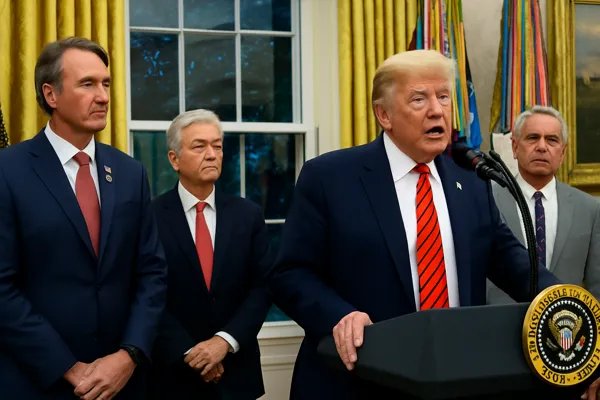
Trump Threatens Nigeria — a phrase that has quickly dominated international headlines after the former U.S. president warned of possible military action over alleged killings of Christians in Africa’s most populous nation. In a statement shared on November 1, 2025, through his Truth Social account, Donald Trump declared he had instructed the “Department of War” to prepare a military response against “Islamic terrorists” purportedly responsible for widespread atrocities in Nigeria.
The post triggered immediate diplomatic backlash, with the Nigerian government dismissing the claim as “false, reckless, and capable of inciting religious tension.” Analysts say Trump’s remarks mark one of the sharpest rhetorical escalations between Washington and Abuja in recent memory.
Historical Context: Nigeria’s Long Battle With Faith and Violence
Nigeria’s security challenges pre-date the Trump controversy. The nation’s north and central belts have been plagued by insurgencies and communal conflicts for decades, often entangled with religion, ethnicity, and resource competition.
Militant groups such as Boko Haram and the Islamic State West Africa Province (ISWAP) have targeted villages, churches, and mosques alike, leaving devastation across states like Borno, Plateau, and Benue. The Armed Conflict Location & Event Data Project (ACLED) estimates that more than 60,000 people have died in violence linked to extremist or sectarian motives since 2009.
Successive Nigerian governments have balanced counter-terrorism with delicate religious diplomacy. While Christians constitute roughly 49 percent of the population and Muslims 51 percent, leaders have consistently argued that Nigeria’s conflict is driven more by economic deprivation, land disputes, and criminal banditry than by theology.
Against this backdrop, the phrase Trump Threatens Nigeria lands in a sensitive national discourse — one where identity and insecurity already intertwine dangerously.
Escalating Rhetoric: Trump’s Post and Its Explosive Message
On November 1, Trump’s Truth Social post read:
“If the Nigerian government continues to allow the killing of Christians, the United States will immediately stop all aid and assistance to Nigeria — and may very well go into that now disgraced country, guns-a-blazing, to completely wipe out the Islamic Terrorists committing these atrocities.”
He further announced the re-designation of Nigeria as a “Country of Particular Concern” under the U.S. International Religious Freedom Act, arguing that “Christianity faces an existential threat” there.
The Nigerian Ministry of Foreign Affairs swiftly responded, calling Trump’s assertions “misguided and deeply offensive.” Foreign Minister Yusuf Tuggar stated:
“Nigeria remains a secular republic that protects every citizen’s right to worship. To depict us as a nation persecuting Christians is both inaccurate and unhelpful.”
Abuja summoned the U.S. ambassador for clarification and warned that “foreign figures must avoid statements capable of inflaming fragile communal relations.”
While the Biden administration sought to distance itself, saying Trump’s comments “do not represent the official position of the U.S. Government,” the episode has reignited old tensions about Western perceptions of African governance and faith relations.
Political Underpinnings: U.S. Domestic Motives and Evangelical Optics
Political analysts believe the Trump Threatens Nigeria narrative cannot be separated from U.S. domestic calculations. Evangelical voters — a cornerstone of Trump’s electoral base — have long advocated stronger American action against perceived persecution of Christians abroad.
“Trump’s message plays directly to evangelical anxieties about global Christianity,” explains Dr. Sarah Levine of the Brookings Institution. “It’s both a foreign-policy statement and a campaign signal as he eyes another term.”
By framing Nigeria’s conflict primarily as a religious war, Trump revives his 2018 and 2020 rhetoric, when he warned of “Christian genocide” in parts of Africa. But critics argue that such framing oversimplifies Nigeria’s complex violence — and risks empowering extremist propaganda that portrays Western nations as anti-Islamic.
Furthermore, U.S. foreign-policy officials warn that unilateral threats could destabilize long-standing partnerships in West Africa, particularly on intelligence sharing, counter-terrorism, and humanitarian operations.
Diplomatic Fallout: Abuja’s Pushback and Regional Reactions
Nigeria’s response to the Trump Threatens Nigeria controversy has been swift and multifaceted.
President Bola Ahmed Tinubu convened a high-level National Security Council meeting, reiterating that “no foreign actor will dictate how Nigeria manages its internal affairs.”
In Lagos, the Christian Association of Nigeria (CAN) welcomed international concern but cautioned against militarization:
“We appreciate voices that highlight the plight of Christian communities, yet war rhetoric is counter-productive. What Nigeria needs is support for justice and peace, not invasion,” said CAN President Most Rev. Daniel Okoh.
Conversely, the Supreme Council for Islamic Affairs (NSCIA) condemned Trump’s statement as “reckless and Islamophobic,” adding that it “endangers lives by validating extremist narratives.”
Across West Africa, leaders including Ghana’s President John Mahama and Senegal’s Macky Sall called for restraint. The ECOWAS Commission urged dialogue, noting that inflammatory global rhetoric could complicate ongoing counter-terrorism operations across the Sahel.
In Washington, the State Department emphasized continued collaboration with Abuja on regional security and counter-insurgency efforts, indirectly calming fears that aid suspension was imminent.
Expert Perspectives: Legal and Strategic Ramifications
International-law scholars caution that if ever enacted, Trump’s threat would violate both the U.N. Charter and U.S. constitutional limits on the use of force.
“Military intervention without Security Council authorization or host-nation consent would be unlawful,” says Prof. Kwame Mensah, a Ghanaian expert on international security law.
Strategically, analysts doubt such an operation’s feasibility. Nigeria possesses one of Africa’s largest militaries and is a critical U.S. partner in the Gulf of Guinea. Any confrontation could sever vital energy and trade ties, disrupt ECOWAS cohesion, and embolden anti-Western sentiment across Africa.
Some observers also question intelligence sources behind Trump’s claim. Reports from NGOs like Human Rights Watch and Amnesty International acknowledge Christian victims but stress that Muslims constitute the majority of those killed by extremist violence — undermining the idea of a one-sided religious war.
Public Reactions: Polarization Across Borders
The phrase Trump Threatens Nigeria became one of the most trending hashtags on X (formerly Twitter) within hours of the post. In the U.S., evangelical commentators praised Trump for “speaking truth to global persecution,” while progressive groups denounced “irresponsible diplomacy.”
In Nigeria, reactions were largely defensive. Youth activists under the #HandsOffNigeria campaign staged peaceful marches in Abuja and Port Harcourt, carrying placards reading “Faith Is Not a Battlefield.”
Local journalists also criticized Western media framing. “Our conflicts are complex — not a simple Christian-versus-Muslim narrative,” wrote columnist Aisha Bello in The Guardian Nigeria. “Trump’s words erase decades of coexistence.”
Online, misinformation flourished. Fake images of U.S. troops supposedly deployed to West Africa went viral before fact-checkers debunked them.
Regional Implications: Security and Economic Stakes for West Africa
The Trump Threatens Nigeria episode carries potential consequences far beyond Nigeria’s borders.
Economically, the U.S. remains one of Nigeria’s top trading partners, with bilateral trade exceeding $10 billion in 2024. An aid freeze or sanctions could disrupt investment confidence, particularly in energy, agriculture, and fintech sectors.
Security-wise, Nigeria’s cooperation under the Trans-Sahara Counter-Terrorism Partnership (TSCTP) and the Global Fragility Act initiatives forms the backbone of regional intelligence coordination. Analysts warn that abrupt U.S. policy shifts could create gaps exploited by insurgent networks in the Sahel.
For Ghana and Côte d’Ivoire, both reliant on Nigerian imports and migrant labour, economic tremors could ripple quickly. “If Washington and Abuja clash, the shockwaves will reach every ECOWAS border,” notes economist Dr. Felix Aboagye of Accra’s University of Professional Studies.
At a geopolitical level, China and Russia could exploit the rift by offering military or economic alternatives to Nigeria — reshaping the West African balance of power.
Humanitarian Dimension: Christians, Muslims, and the Shared Burden of Violence
While the Trump Threatens Nigeria statement frames the issue through a religious lens, field data tell a more nuanced story.
The International Crisis Group reports that in Nigeria’s Middle Belt, over 45 percent of attack victims in 2024 were Muslims, primarily in herder–farmer clashes. Meanwhile, church burnings and kidnappings for ransom continue to devastate Christian communities.
This complex reality underscores that both faith groups endure the consequences of weak governance, poverty, and arms proliferation. Analysts warn that foreign rhetoric simplifying these dynamics could inflame tensions rather than resolve them.
Faith leaders across Nigeria are instead calling for “national repentance, reconciliation, and reform” rather than external military threats.
Comparative Analysis: Lessons From Past U.S. Interventions
Observers draw parallels between the Trump Threatens Nigeria saga and previous American interventions framed around moral imperatives — such as Iraq (2003) or Libya (2011). Both began with humanitarian justifications but ended in protracted instability.
African Union peace and security experts stress that any intervention must respect sovereignty and support local peacebuilding mechanisms. “What we need is engagement, not escalation,” says AU Commissioner for Peace Bankole Adeoye.
In the broader context, Trump’s remarks could complicate future U.S. diplomatic efforts, as African states may interpret them as indicative of a return to unilateralism.
Diplomacy or Division Ahead
The controversy surrounding Trump Threatens Nigeria epitomizes the delicate intersection of religion, politics, and international power. Though rooted in legitimate concerns over violence, Trump’s blunt rhetoric risks alienating a key African ally and reigniting dormant religious tensions.
Nigeria’s challenge remains formidable: ending insurgency while protecting freedom of worship for all citizens. The United States, meanwhile, faces a choice — whether to lead through partnership and respect or through punitive posturing.
As both nations navigate this uneasy moment, the world watches for signals of either reconciliation or rupture. What follows could redefine U.S.–Africa relations for years to come.
Internal Links
- Africa Single Currency: Zuma Calls for Economic Independence
- Republican Party Power Surge: 10 Turning Points Defining Trump’s Control
Reuters – Trump threatens U.S. military action in Nigeria over treatment of Christians
AP News – Trump escalates claim of Christian persecution in Nigeria