The sprawling Rio Police Raids in Brazil’s northern favelas have left at least 132 people dead, marking the most lethal law enforcement operation in the country’s modern history. Conducted on October 28 2025, the coordinated crackdown targeted alleged members of the Comando Vermelho (Red Command), a notorious drug syndicate operating across Rio de Janeiro. As bodies filled the streets of Complexo da Penha and Complexo do Alemão, outrage erupted nationwide and abroad, reigniting debate over the militarization of policing in Latin America’s largest democracy.
A Cycle of Urban Warfare
To understand the scale of the Rio Police Raids, one must revisit Brazil’s decades-long struggle with organized crime. Rio’s favelas—densely populated informal neighborhoods perched on steep hillsides—have long functioned as both community hubs and conflict zones. Since the 1980s, drug gangs such as Comando Vermelho and Amigos dos Amigos have turned these areas into fortified enclaves, often outgunning local police.
In response, successive state administrations have authorized aggressive interventions known as “mega-operations.” These incursions, while intended to restore order, have consistently drawn criticism for civilian casualties and extrajudicial killings. The infamous 2021 Jacarezinho raid, which killed 28 people, prompted a Supreme Court ruling restricting police actions in poor communities during the pandemic. Yet little has changed.
The 2025 Rio Police Raids thus continue a tragic pattern—one where state firepower meets entrenched criminal control, leaving residents caught in the crossfire.
Inside the Operation: Timeline and Execution
At dawn on October 28, nearly 2,500 officers from elite tactical units launched simultaneous assaults on the favelas of Complexo do Alemão and Complexo da Penha. Backed by helicopters, drones, and armored vehicles, the raids sought to capture or eliminate high-ranking members of the Comando Vermelho.
Governor Cláudio Castro framed the action as a “strategic offensive against narcoterrorism,” emphasizing that the gangs had been using drones equipped with explosives and blocking major roads with hijacked buses. Authorities claimed the operation dismantled several command posts and seized large quantities of firearms, ammunition, and drugs.
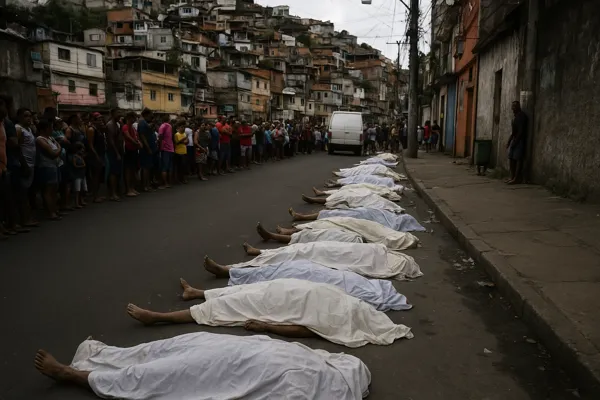
However, eyewitnesses told a different story. Residents reported hearing continuous gunfire from evening until midday, describing scenes of terror as police swept through narrow alleys. By nightfall, over 70 bodies lay along Penha’s main street, retrieved by locals who feared authorities would dispose of them. Photos verified by Reuters and The Guardian showed dozens of corpses stacked outside makeshift morgues, prompting international outcry.
The state public defender’s office confirmed 132 fatalities—128 civilians and four officers—making this the deadliest single police action in Brazilian history.
Professional Analysis: Systemic Failures and Security Myths
Security experts argue that the raids epitomize a flawed approach rooted in the “war-on-drugs” mentality rather than sustainable law-enforcement reform. Brazil has one of the world’s highest homicide rates, and public frustration over crime remains intense. Yet, according to sociologist Silvia Ramos of the Center for Security and Citizenship Studies, “each new mega-operation reinforces a cycle of revenge, fear, and impunity.”
Ramos noted that while raids may produce impressive seizure statistics, they seldom dismantle criminal economies. “When the state enters with helicopters and assault rifles, it leaves behind resentment, not governance,” she said.
Comparatively, Rio’s policing model contrasts sharply with Medellín’s post-cartel transformation, which combined social investment with targeted policing. Analysts contend that until Brazil balances enforcement with community trust and socioeconomic programs, its favelas will remain battlegrounds.
The professional consensus is that the Rio Police Raids, though tactically effective in short-term disruption, strategically failed to address the underlying poverty, unemployment, and inequality that sustain criminal networks.
Official Responses and Public Reactions
The aftermath of the Rio Police Raids has ignited a storm of political, legal, and social responses.
President Luiz Inácio Lula da Silva expressed “deep concern” over the unprecedented death toll, revealing that the federal government had not been notified in advance. His administration has since requested a full briefing from the Rio state governor and pledged federal oversight in subsequent investigations.
The United Nations Human Rights Office called the raid “a grave violation of international human-rights norms” and urged Brazil to ensure accountability. Amnesty International echoed those concerns, labeling the event “a slaughter disguised as security policy.”
In Rio itself, families of the deceased gathered outside the Forensic Institute demanding access to bodies and information. Religious leaders organized vigils in Penha’s central square, while civil-society organizations launched petitions calling for independent forensic audits.
Governor Castro, however, defended his administration, stating: “We will not surrender Rio to criminals. This was a necessary act to restore peace.” The remarks deepened divisions between law-and-order advocates and human-rights defenders.
Humanitarian Dimension: Communities in Trauma
Beyond political rhetoric, the Rio Police Raids have left a profound humanitarian scar. Schools, clinics, and markets in the affected neighborhoods remain closed, while hundreds of families have fled temporarily to safer zones. Psychologists working with local NGOs report widespread trauma, particularly among children who witnessed gunfights or lost relatives.
Community organizer Mariana Sousa described the aftermath as “a war zone where silence replaced laughter.” She added, “We are not criminals—we are citizens trapped between bullets and bureaucracy.”
Local hospitals, already stretched thin, received dozens of wounded residents with gunshot injuries. Reports from emergency workers suggest that paramedics were initially barred from entering combat areas—a claim authorities deny but which human-rights monitors are investigating.
This social devastation underscores a recurring paradox: the state’s effort to enforce law and order often erodes the very communities it seeks to protect.
Global Implications: Brazil Under the International Lens
The global reaction to the Rio Police Raids has been swift and severe. The European Union, Organization of American States (OAS), and numerous foreign ministries have requested transparent investigations. The raid’s timing—just days before Rio hosted the C40 Climate Summit and the Earthshot Prize ceremony—sparked questions about the government’s priorities and sensitivity to global scrutiny.
International media coverage has portrayed the event as symptomatic of broader Latin American policing failures. Comparisons have emerged with operations in Mexico’s Sinaloa state and Colombia’s Buenaventura district, where militarized crackdowns yielded temporary security but long-term instability.
Human-rights advocates warn that continued impunity could affect Brazil’s trade and diplomatic relations, particularly with partners emphasizing governance and rule of law. Economically, tourism experts caution that the imagery of corpses lining Rio’s streets could tarnish the city’s global brand at a critical moment for post-pandemic recovery.
Legal and Investigative Outlook
In response to public pressure, Brazil’s Federal Prosecutor’s Office has opened an investigation into potential abuses during the raids. Justice Minister Ricardo Lewandowski announced coordination with state prosecutors to ensure “truthful, transparent, and swift” accountability.
Human-rights groups are pushing for independent forensic analysis, witness protection programs, and federal oversight of state policing. Analysts suggest this case may set a legal precedent determining whether Brazil can curb excessive force within its security institutions.
If substantiated, allegations of extrajudicial executions could lead to prosecutions under both domestic law and international conventions. However, given Brazil’s record—where fewer than 3 percent of police killings result in convictions—activists remain skeptical.
Socio-Political Consequences and Path Forward
The Raids have deepened Brazil’s political polarization. Supporters of hardline security policies argue that the operation demonstrates state resolve against criminal empires that terrorize ordinary citizens. Opponents insist that such raids amount to collective punishment and racialized violence, disproportionately targeting Afro-Brazilian and low-income communities.
Political analysts believe this incident could influence upcoming municipal elections. Candidates aligned with Governor Castro may frame the operation as proof of strong leadership, while progressive contenders will likely use it to advocate for reform and oversight.
Beyond politics, the tragedy reignites national discourse on the need for comprehensive police reform, improved training, and socioeconomic investment in marginalized neighborhoods. Scholars argue that without structural change, Brazil risks perpetuating an endless loop of violence that erodes both democracy and trust in state institutions.
Conclusion
The Rio Police Raids represent more than a tragic episode in Brazil’s fight against organized crime—they reveal a nation at a crossroads between authoritarian reflex and democratic accountability. With 132 lives lost and countless others scarred, the operation’s legacy will depend on whether Brazil confronts its systemic failures or continues to equate justice with firepower.
As the world watches, the favelas of Rio de Janeiro stand as a stark reminder that true security cannot be achieved through violence alone—it demands transparency, equity, and humanity.
Internal Links
- Grokipedia Launch Redefines How the World Consumes Knowledge
- World’s Oldest President Re-Elected in Disputed Cameroon Election