Arrests Deepen Cameroon’s Political Crisis
The phrase Cameroon Detains Opposition Figures has taken center stage as the government cracks down on dissent ahead of the country’s tense presidential results. The arrests of several opposition leaders and activists have fueled growing domestic and international alarm about democratic backsliding in Central Africa’s once-stable nation. Analysts warn that the detentions could trigger wider unrest and further erode public confidence in state institutions.
A Country at a Democratic Crossroads
The current turmoil stems from Cameroon’s October 12, 2025 presidential election — a vote that was meant to demonstrate political maturity but has instead exposed deep divisions. The nation’s 92-year-old incumbent, President Paul Biya, is Africa’s second-longest-serving leader, having ruled since 1982. His continued leadership has often sparked frustration among younger generations seeking renewal.
His main challenger, Issa Tchiroma Bakary, campaigned on promises of reform and transparency through his Union for Change alliance. Preliminary tallies released by independent monitors suggested strong performance for Bakary in several urban centers. However, before official results were announced, reports emerged that Cameroon Detains Opposition Figures aligned with his campaign, signaling a crackdown on dissent.
Observers note that the move mirrors earlier electoral cycles where security forces detained critics and restricted media access. Internet disruptions and the banning of rallies further suggest a narrowing civic space at a time when Cameroonians yearn for credible governance.
Crackdown Intensifies as Results Loom
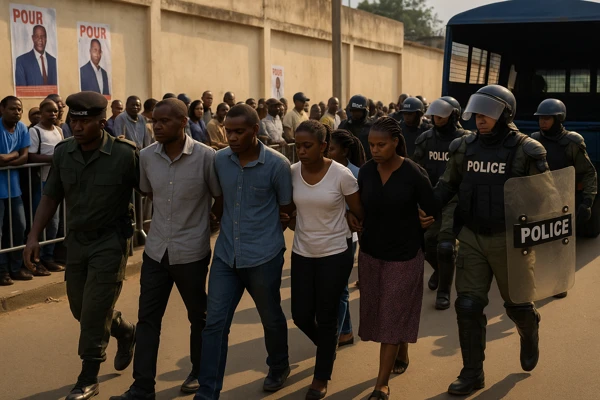
As the Constitutional Council prepares to announce the official outcome, the government has detained at least thirty opposition members, including high-profile activists Anicet Ekane of MANIDEM and Djeukam Tchameni of the Union for Change. These arrests under the headline Cameroon Detains Opposition Figures have sparked widespread condemnation across political and civil society circles.
Government spokesman René Sadi justified the detentions, citing a “credible threat of insurrection.” Authorities accuse the opposition of planning mass demonstrations intended to “undermine state stability.” However, local human-rights organizations dismiss those claims, calling the operation politically motivated and unconstitutional.
In major cities like Yaoundé, Douala, and Bamenda, security has been visibly tightened. Armored vehicles patrol intersections, while heavily armed officers man checkpoints. Eyewitnesses told GSN that residents face curfews and random searches, creating an atmosphere of fear. The state has also restricted internet access, a tactic it previously used during periods of political tension.
Reports verified by Reuters and The Guardian confirm that at least two protesters were killed and dozens arrestedafter clashes with police. Journalists attempting to cover the protests were briefly detained, prompting sharp criticism from international press watchdogs.
As the phrase Cameroon Detains Opposition Figures continues trending on regional media, it has become symbolic of the broader struggle for democratic accountability and civil rights within the country.
The Erosion of Democratic Norms
The unfolding events highlight how fragile Cameroon’s democratic structures remain after more than four decades of centralized power. Political scientists interviewed by Global Standard News argue that Cameroon Detains Opposition Figures reflects not merely a pre-election security operation, but a deeper crisis of governance.
Analyst Dr. Henry Mbassa notes that the repeated use of force to silence dissent “undermines the legitimacy of state institutions and discourages civic participation.”
The Cameroon Detains Opposition Figures narrative also sends a chilling message to emerging political movements, signaling that dissent could invite imprisonment.
Economically, this tension could carry serious consequences. Cameroon’s financial markets have already shown signs of instability, while trade through Douala Port—a regional logistics hub—has slowed amid fears of extended unrest. The International Crisis Group warns that sustained turmoil could discourage foreign investment and weaken the Central African region’s economic integration.
Politically, Cameroon’s crisis mirrors a wider continental pattern. From Uganda to Chad and Congo-Brazzaville, entrenched leaders continue to resist political transition, citing “security concerns” while curbing fundamental freedoms. The ongoing episode demonstrates the limits of controlled democracy under aging leaderships reluctant to relinquish power.
Reactions: Domestic Outcry and International Pressure
Opposition leader Issa Tchiroma Bakary, addressing supporters via a social-media broadcast, denounced the arrests as “a premeditated attempt to nullify the will of the people.” His coalition insists it won the election “based on authentic results” collected from polling stations nationwide. The arrests under the banner Cameroon Detains Opposition Figuresare, in his words, “a coup against the people’s choice.”
Government officials, however, have doubled down on their narrative. Spokespersons from the ruling Cameroon People’s Democratic Movement (CPDM) accuse Bakary of “spreading false victory claims” and plotting to destabilize the country.
Diplomatic reactions have been swift.
- The European Union Delegation in Yaoundé expressed “deep concern” and called for the immediate release of detainees.
- The U.S. Embassy urged authorities to uphold due process and ensure peaceful resolution.
- Human Rights Watch described the arrests as “preventive repression,” while Amnesty International labeled them “a grave violation of political rights.”
Locally, the Council of Protestant Churches of Cameroon and the Catholic Bishops Conference appealed for calm, calling on both sides to respect democratic norms. Market women and students in Douala told GSN reporters they fear further escalation and want “peace, not politics.”
Social media, despite restrictions, remains a battleground for information. The hashtag #FreeCameroonVoices trends across encrypted messaging channels, amplifying public frustration and drawing solidarity from activists across Africa.
Domestic Strain and Regional Repercussions
The repercussions of the Cameroon Detains Opposition Figures episode are likely to extend far beyond the election period. Cameroon serves as a key security partner in counter-terrorism efforts against Boko Haram in the Lake Chad Basin. A prolonged political standoff could weaken these regional operations and embolden extremist groups in border areas.
Humanitarian agencies are also on alert. The United Nations Office for the Coordination of Humanitarian Affairs (OCHA) warns that renewed unrest could worsen displacement in the North-West and South-West regions, where separatist conflicts have already displaced more than 800,000 people.
With 3.2 million Cameroonians requiring humanitarian assistance, any disruption to aid convoys or logistics chains would deepen the crisis.
International financial institutions such as the IMF and World Bank have previously tied support to governance reforms. Political instability may jeopardize disbursement schedules or trigger investor pullbacks. Regional blocs like the African Union and ECOWAS—which recently imposed sanctions on unconstitutional regimes—are expected to deliberate Cameroon’s situation if violence escalates.
For ordinary citizens, daily survival remains the priority. Traders interviewed by GSN in Yaoundé’s Mvog-Ada market said they are “tired of politics that bring soldiers to the streets instead of customers to the stalls.” Their voices echo a national exhaustion with decades of contested leadership and economic stagnation.
The Road Ahead for Cameroon’s Democracy
The unfolding story that Cameroon Detains Opposition Figures encapsulates more than a moment of political turmoil—it represents a crossroads for the nation’s democratic journey. As the Constitutional Council prepares to announce final results, the government faces a defining choice: either embrace transparency and dialogue or double down on repression.
If detainees are released and civic freedoms restored, Cameroon could yet salvage credibility before its citizens and the world. But continued arrests and censorship risk isolating the country diplomatically and igniting wider unrest. For now, the world watches as Cameroon’s leaders decide whether the future belongs to reform—or to the past.
Internal Links
- Nigeria, Kenya Go the Ghana Way: Building Gold Reserves to Strengthen Naira and Shilling
- Nigeria Fuel Tanker Explosion: Dozens Killed in Niger State Inferno
External Links
- Reuters – Cameroon Detains Opposition Figures Ahead of Presidential Results
- The Guardian – Deaths and Arrests Amid Cameroon Election Crackdown