A Mounting Threat to Ghana’s Health Sector
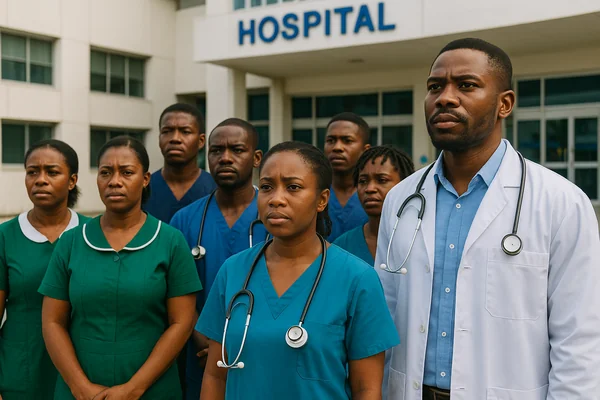
Accra, Ghana — Ghana’s health system is teetering on the edge of a major employment and fiscal crisis. Health Minister Kwabena Mintah Akandoh has warned that the Ghana Health Workforce Crisis could see more than 180,000 trained health professionals unemployed by 2028 if urgent measures are not implemented.
According to the Minister, the government needs at least GHS6 billion to recruit over 74,000 unemployed health workers who have completed their training but remain unposted. His remarks highlight deep-rooted structural problems in Ghana’s healthcare labor system and expose the mounting tension between training output and employment absorption.
Context: Decades of Unbalanced Health Workforce Planning
For years, Ghana has expanded its health training infrastructure, approving new nursing, midwifery, and medical schools to meet population needs. While this growth has increased the number of qualified professionals, the rate of employment into public service has failed to keep pace, worsening the Ghana Health Workforce Crisis.
Between 2016 and 2024, the number of graduates from health institutions nearly doubled, but recruitment authorizations from the Ministry of Finance remained erratic. Fiscal ceilings imposed under the International Monetary Fund (IMF) program further restricted the wage bill, making large-scale recruitment difficult.
This long-standing imbalance between health education and employment is now the central feature of the Ghana Health Workforce Crisis. Periodic clearance exercises have provided temporary relief but not a sustainable solution. As a result, thousands of nurses, midwives, and laboratory technicians spend years waiting for government postings, leading to frustration and underutilized talent.
Current Situation: Akandoh’s Fiscal Warning and Recruitment Dilemma
In an interview with Channel One TV on October 15, 2025, Minister Kwabena Mintah Akandoh issued a stark warning: without immediate intervention, the Ghana Health Workforce Crisis will escalate into a national emergency.
“If we don’t act now, we could have about 180,000 trained health professionals sitting at home by 2028,” Akandoh cautioned.
— (GhanaWeb)
He explained that GHS6 billion is required to recruit the 74,000 currently unemployed professionals, a process that would otherwise stretch over several fiscal years due to budget limitations.
“It’s simply not true that we can employ everyone by 2026. The resource envelope is limited. If we had GHS6 billion today, we could clear the backlog immediately,” the Minister emphasized.
— (MyJoyOnline)
Akandoh also revealed that the Ministry of Health is pursuing phased recruitment and bilateral partnerships such as the Ghana–UK Nursing Programme to relieve domestic unemployment pressure and manage the Ghana Health Workforce Crisis more sustainably.
In-Depth Analysis: Structural Roots of the Ghana Health Workforce Crisis
Experts argue that the Ghana Health Workforce Crisis is rooted in weak coordination between educational expansion and health employment policy. Health training institutions have multiplied faster than hospitals and clinics can absorb graduates. Meanwhile, IMF-imposed fiscal restrictions limit new hires even when medical facilities remain understaffed.
Public health economist Dr. Esther Addo describes the system as “a cycle of overproduction and underemployment.”
“We are producing thousands of skilled nurses, doctors, and laboratory scientists annually, but the state cannot employ them. It’s an economic and social time bomb,” she told GSN.
The situation also intensifies the brain drain, as Ghanaian nurses and doctors migrate to the UK, Canada, and the Gulf States in search of better pay and stability. Paradoxically, while Ghana faces a surplus of unemployed professionals, rural hospitals still struggle to fill vacancies — a dual symptom of the Ghana Health Workforce Crisis.
Economic and Policy Implications
Economists warn that the financial implications of the Ghana Health Workforce Crisis extend far beyond healthcare. The cost of training thousands of health workers without employment represents a massive inefficiency in public investment.
Development analyst Dr. Emmanuel Quartey notes that each unemployed nurse or doctor reflects “wasted public funds and lost potential tax revenue.” He recommends establishing a Health Workforce Stabilization Fund to ensure consistent recruitment rather than irregular clearance cycles.
“Ghana’s fiscal strategy must evolve to view healthcare employment as both a human investment and an economic driver,” he emphasized.
Stakeholder Responses: Demand for Systemic Reforms
The Ghana Registered Nurses and Midwives Association (GRNMA) has welcomed Akandoh’s transparency but insists that action must replace rhetoric. In a statement, GRNMA described the situation as “a crisis of confidence” in national workforce planning and demanded a public recruitment timetable.
Civil society groups like the Africa Centre for Health Policy Research propose three reforms:
- Incentivize rural postings to balance workforce distribution.
- Establish digital systems linking graduates to district-level vacancies.
- Integrate private and mission hospitals into the employment framework.
Meanwhile, officials at the Finance Ministry have indicated that partial recruitment could feature in the 2026 Budget, with emphasis on essential roles — but warned that overall employment expansion depends on IMF flexibility and revenue growth.
Global Perspective: A Crisis Beyond Borders
The Ghana Health Workforce Crisis mirrors patterns across Africa, where nations produce skilled personnel but lack fiscal capacity for absorption. According to the World Health Organization (WHO), the world faces a projected shortfall of 10 million health workers by 2030, yet many African countries are dealing with local unemployment instead.
For Ghana, this creates a paradox: while global demand for healthcare talent rises, local professionals remain idle. Without a coordinated solution, the Ghana Health Workforce Crisis risks undermining both national healthcare delivery and global workforce supply chains.
Strategic Outlook: Building a Sustainable Path Forward
Experts recommend a multi-sectoral national strategy to mitigate the Ghana Health Workforce Crisis:
- Fiscal Innovation – Create a dedicated Health Workforce Fund backed by both state and donor support.
- Policy Synchronization – Align health education output with national employment needs.
- Private Sector Engagement – Encourage private hospitals to absorb graduates through tax incentives.
- International Cooperation – Expand ethical recruitment deals that benefit both Ghana and host nations.
These measures could transform the Ghana Health Workforce Crisis from a looming disaster into an opportunity for modernization, sustainability, and equitable growth.
Conclusion: Turning Crisis into Opportunity
The Ghana Health Workforce Crisis remains one of the country’s most urgent challenges. With 74,000 unemployed professionals today and projections reaching 180,000 by 2028, the time for incremental measures is over.
Mobilizing GHS6 billion to employ these workers would not only strengthen healthcare delivery but also stimulate the broader economy. If addressed decisively, this crisis could become the catalyst for Ghana’s next major public-sector reform — a chance to realign fiscal policy with national development priorities and restore trust in the nation’s healthcare system.