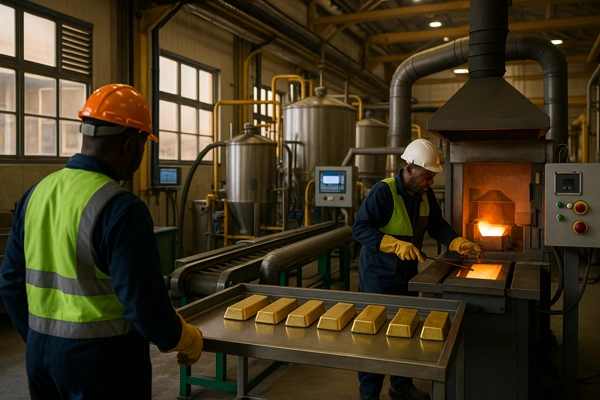
Ghana’s Record-Breaking Gold Surge
Small-scale gold exports in Ghana have surged to over US $8.06 billion between January and 15 October 2025, marking a historic leap in the nation’s artisanal and small-scale mining (ASM) sector. The achievement highlights the impact of comprehensive regulatory reforms, improved traceability systems, and a focus on retaining foreign exchange earnings within the country.
From Informal Mining to Structured Export Economy
For decades, Ghana has ranked among Africa’s leading gold producers, combining industrial operations with a thriving artisanal segment. In 2024, total gold exports reached US $11.64 billion, with small-scale miners contributing roughly US $5 billion, underscoring the sector’s economic importance.
Early in 2025, Parliament approved the establishment of the Ghana Gold Board (GoldBod) to oversee purchasing, assaying, selling, and exporting gold from licensed ASM operators. The reform replaced fragmented systems with centralized oversight . Concurrently, a law effective 1 May 2025 barred foreigners from trading artisanal gold to reduce smuggling and currency leakages
These changes target the decades-old challenge of illegal mining (galamsey), which had drained government revenues and polluted rivers across the Ashanti, Western, and Eastern Regions .
Market Performance: Record Exports and Revenue Momentum
According to data from GoldBod and the Precious Minerals Marketing Company (PMMC), licensed small-scale miners exported 81,719.23 kilograms of gold between January and 15 October 2025. This translated into foreign-exchange earnings of about US $8.06 billion, nearly doubling the previous year’s total.
Year-on-Year Comparative Growth
- 2023: ≈ US $2.19 billion
- 2024: ≈ US $4.61 billion
- 2025 (YTD): ≈ US $8.06 billion
This fourfold increase in small-scale gold exports demonstrates both volume growth and enhanced formalization.
Quarterly Breakdown Shows Robust Compliance
Performance peaked in the second quarter of 2025: April (~ US $897 million), May (~ US $1.17 billion), and June (~ US $958 million). Industry analysts attribute this surge to the widespread adoption of new GoldBod procedures and a global rally in bullion prices .
Institutional Reforms Reshaping the Mining Landscape
Centralization under GoldBod has transformed oversight of small-scale gold exports. By integrating licensing, export authorization, and assaying under one institution, the government closed loopholes that previously enabled unrecorded sales.
The ban on foreign participation in artisanal gold trade ensures that value stays within regulated Ghanaian channels and prevents currency losses through underground networks .
Furthermore, the creation of a dedicated Task Force on Gold Traceability in July 2025 introduced blockchain-based tracking of exports, significantly reducing smuggling attempts and increasing repatriated earnings.
Macroeconomic Significance and Fiscal Resilience
The rise in small-scale gold exports has helped replenish Ghana’s foreign reserves, now covering 4.5 months of import needs, according to the Bank of Ghana. Improved reserves stabilize the cedi, reduce reliance on short-term borrowing, and improve sovereign credit ratings.
Beyond macro stability, the gold sector contributes significantly to tax revenue and royalties earmarked for infrastructure and social projects. Experts say small-scale gold exports could soon account for over 40 percent of total national gold earnings.
Environmental Governance and Sector Challenges
Despite these gains, the industry faces persistent environmental and social challenges. An estimated 70 percent of artisanal sites still operate without full licenses, causing river siltation and farmland degradation.
In response, GoldBod has begun a nationwide audit to certify environmental compliance and suspend non-conforming operations. Civil society groups continue to urge balance between economic growth and sustainability.
Without consistent enforcement and eco-friendly technologies, the gains from small-scale gold exports could be short-lived. Experts recommend investing in mercury-free processing plants and reclamation funds to protect river ecosystems.
Voices from the Field: Policy Leaders and Industry Experts
Government officials say the export surge proves that formalization works. A Ministry of Lands and Natural Resources representative told GSN that “transparent data collection under GoldBod is restoring confidence in the mining value chain.”
Meanwhile, economists cite strong international gold prices – peaking at US $3,500 per ounce in April 2025 – as a secondary driver of export growth. Forecasts suggest artisanal output may reach 1.9 million ounces by year-end, up from 1.5 million in 2024 .
Still, community leaders warn that environmental costs must not be overlooked. Recent protests in cocoa growing areas highlight the need for stricter site monitoring and water protection laws.
Economic and Regional Implications
Strengthening Domestic Economy
Rising small-scale gold exports have enhanced Ghana’s capacity to fund budgetary programs without relying solely on external debt. The sector’s contributions are also bolstering local employment in mining towns and stimulating micro-enterprise activity in processing and logistics.
Shaping Regional and Global Trends
Internationally, Ghana’s reform success is influencing policy debates across West Africa. Neighboring countries such as Burkina Faso and Sierra Leone are adapting elements of the GoldBod model to strengthen their artisanal mining oversight.
At the global level, commodity markets view Ghana as a stabilizing force in African gold supply chains, particularly as investors seek secure sources amid geopolitical volatility.
A Defining Moment for Responsible Growth
The achievement of over US $8 billion in small-scale gold exports by October 2025 is a milestone that extends beyond revenue. It symbolizes policy discipline, institutional innovation, and the collective effort to transform Ghana’s artisanal mining into a globally recognized, responsible industry.
Maintaining this momentum requires sustained transparency, investment in eco-safe practices, and continued empowerment of licensed miners. If these foundations hold, Ghana’s small-scale gold exports could solidify the country’s status as a benchmark for inclusive and sustainable resource management in Africa.
Internal Links
- IMF Ghana Growth Forecast 2025: 4% Expansion Amid Inflation Pressures
- Gold Hits $4,000/oz: Record-Breaking Rally Shakes Global Markets
- OpenAI’s $500B Valuation Redefines the Future of Artificial Intelligence