A Day of Mourning Turns Chaotic
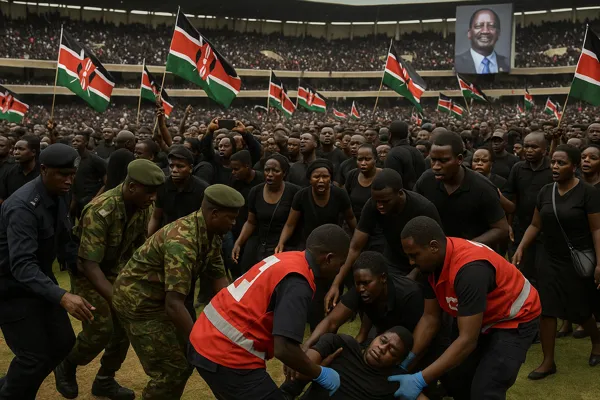
The Odinga Funeral Stampede has cast a somber shadow over Kenya’s final farewell to one of its most influential political figures. On October 17, 2025, at Nyayo National Stadium in Nairobi, grief turned to panic as thousands of mourners surged forward to view the body of former Prime Minister Raila Amolo Odinga, resulting in at least 17 injuries.
Witnesses recounted emotional and chaotic scenes — supporters scaling barriers, fainting in the heat, and security officers struggling to maintain order amid an overwhelming outpouring of national grief.
Legacy Remembered: The Life and Impact of Raila Odinga
Raila Odinga, the 80-year-old statesman and five-time presidential contender, passed away earlier this month after a prolonged illness. His death marks the end of an era in Kenyan politics.
A veteran of the struggle for multi-party democracy, Odinga was imprisoned during the Moi regime in the 1980s and later became a leading voice for reform. His efforts culminated in the 2010 Constitution, which decentralized power and expanded civil liberties across Kenya.
To millions, Odinga was not merely a politician but a symbol of resilience, defiance, and hope — traits that earned him the affectionate title “Baba,” meaning father of the nation.
The government declared three days of national mourning, flying flags at half-mast and organizing a state funeralattended by regional heads of state, diplomats, and tens of thousands of citizens. What was meant to be a solemn moment of unity, however, descended into tragedy.
How the Odinga Funeral Stampede Unfolded
According to Reuters, the Odinga Funeral Stampede erupted mid-morning as Odinga’s body arrived for public viewing. Large crowds that had camped overnight outside the Nyayo National Stadium rushed through the gates once they opened.
Eyewitnesses reported that metal barricades gave way, sending waves of mourners tumbling forward. Some were trampled underfoot as others pushed through to catch a glimpse of the casket.
Paramedics and emergency volunteers from the Kenya Red Cross and St. John Ambulance worked frantically to rescue victims amid scenes of confusion.
“We had to evacuate several unconscious people while pleading with the crowd to move back,” said a Red Cross responder at the scene. “The emotional intensity was beyond control.”
Medical staff at Kenyatta National Hospital later confirmed that 17 people were hospitalized with injuries ranging from broken limbs to breathing difficulties caused by suffocation in the crowd.
Police officers and military personnel eventually regained control, cordoning off key sections of the stadium and allowing the ceremony to continue under heightened security.
Operational Failures: Crowd Management and Event Oversight
The Odinga Funeral Stampede highlights the challenges of organizing large-scale public gatherings in emotionally charged environments. Analysts have long warned that most of Kenya’s major venues — including Nyayo and Kasarani stadiums — lack modern crowd-flow systems, controlled access points, and adequate medical response stations.
Dr. Samuel Mwangi, a public safety consultant, noted that emergency preparedness was likely insufficient given the magnitude of the event.
“This was not just a funeral; it was a historical moment,” Mwangi explained. “Organizers underestimated the turnout and failed to create multiple viewing zones or timed entry systems to manage crowd pressure.”
Similar crowd-related tragedies have occurred in Ghana, Nigeria, and South Africa in recent years, underscoring a continental problem of poor safety planning at major events.
The incident also came just one day after a violent confrontation during another public viewing in Kisumu, Odinga’s home region. Police reportedly fired tear gas and live bullets at mourners trying to breach barriers, killing two people.
Interior Ministry officials said an internal review will be conducted to assess police preparedness, security coordination, and public communication protocols surrounding the funeral.
Socio-Political Significance: Why Odinga’s Death Resonates Deeply
For decades, Raila Odinga embodied Kenya’s political conscience. His leadership of the Orange Democratic Movement (ODM) and his repeated calls for electoral justice turned him into both a polarizing figure and a moral compass.
The Odinga Funeral Stampede therefore symbolizes not just the logistical failure of crowd control but also the emotional depth of Kenya’s collective grief.
Political analyst Ruth Ochieng describes the tragedy as an “unintended reflection of Odinga’s influence.”
“People weren’t just attending a funeral,” she said. “They were saying goodbye to a living chapter of their identity.”
Odinga’s death also reopens national debate about succession politics. Many Kenyans are now asking whether his departure will create a leadership vacuum in opposition ranks or pave the way for new reform-minded voices to emerge.
Public Response: Grief, Unity, and Calls for Accountability
Across Kenya, citizens continue to express sorrow and frustration. Thousands lit candles outside ODM offices in Nairobi and Kisumu, chanting liberation songs and reciting Odinga’s famous rallying cry: “No retreat, no surrender.”
President William Ruto sent condolences to the Odinga family and urged calm:
“We honor Raila Odinga’s lifelong commitment to Kenya’s democracy. His farewell must remind us that unity is our greatest strength.”
Opposition leaders, however, have demanded a formal investigation into the Odinga Funeral Stampede. ODM Secretary-General Edwin Sifuna accused authorities of failing to implement safety measures despite prior warnings of crowd pressure.
Neighboring countries also joined Kenya in mourning. Tanzania’s President Samia Suluhu Hassan and Uganda’s President Yoweri Museveni described Odinga as “a fearless champion of democracy and East African unity.”
Lessons from Similar Tragedies
The Odinga Funeral Stampede bears resemblance to other large-crowd disasters in recent African and global history.
In 2021, at least 45 people died during a religious festival in Israel, and in 2022, 125 were killed in a football stadium stampede in Indonesia.
In all these cases, investigations pointed to limited exits, poor coordination, and delayed emergency response. Experts argue that Kenya — and Africa at large — must adopt international standards for crowd safety management.
Public health officials also emphasize that such tragedies expose how collective trauma and emotional mobilization can overwhelm infrastructure not designed for mass mourning events.
To prevent recurrence, Kenya’s National Disaster Management Authority (NDMA) has proposed establishing a National Crowd Safety Framework to govern entry, movement, and emergency procedures at all state-sponsored gatherings.
Continental and Global Reverberations
The Odinga Funeral Stampede has sparked widespread reflection across Africa on how to balance public participation and safety during moments of national mourning.
International news outlets, including Reuters, AP, and The Guardian, have highlighted both Odinga’s enduring democratic legacy and the dangers of inadequate event planning.
Globally, Odinga is remembered as a unifying figure who influenced movements for reform in countries such as Zambia, Tanzania, and South Africa. His participation in pan-African dialogues on governance and electoral transparency made him a respected voice far beyond Kenya’s borders.
Locally, his death has reignited debate about security reform, public space management, and citizen engagement in state events. For many Kenyans, the tragedy illustrates the need to modernize how the nation commemorates its heroes — with dignity, safety, and foresight.
Mourning, Memory, and Reform
As Kenya continues to process the shock of the Odinga Funeral Stampede, both government and civil society are calling for systemic change.
Plans are underway to digitize crowd-control logistics through pre-registration for high-attendance national events, a reform backed by the Interior Ministry and ICT Authority.
Meanwhile, humanitarian agencies like the Kenya Red Cross are training additional emergency volunteers to ensure faster medical response in future incidents.
In the words of sociologist Dr. Mary Njoroge:
“If Raila Odinga’s death teaches us anything, it’s that a nation’s love for its leaders must be matched by its preparedness to honor them safely.”
Kenya’s grief runs deep — but so does its resilience. The Odinga Funeral Stampede may mark a tragic chapter in its history, yet it also presents an opportunity to strengthen unity and reform.
Internal Links
- Newborn Baby Buried Alive in India Fights for Her Life
- Kenyan Officer Killed in Bow-and-Arrow Attack: State House Security Under Scrutiny
- US Government Brain Drain: 154,000 Workers Quit in 1 Week