A Deadly Breach at the Heart of Kenya’s Power
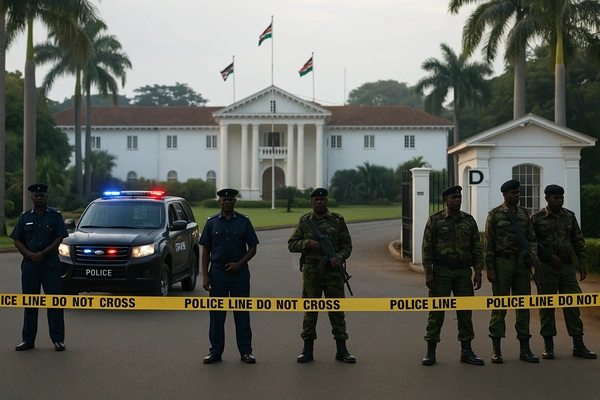
Kenyan officer killed in a shocking security breach outside President William Ruto’s residence in Nairobi has sparked national outrage and deep concern. The early-morning bow-and-arrow attack at Gate D of State House—one of the nation’s most protected compounds—has triggered grief, disbelief, and urgent debate over how such a primitive weapon penetrated Kenya’s most secure perimeter.
State House Nairobi: Symbol of Power and Site of Tragedy
State House Nairobi stands as the ultimate symbol of presidential authority, protected round-the-clock by the elite General Service Unit (GSU). The complex is layered with checkpoints, armed patrols, and 24-hour surveillance systems.
Yet despite these defenses, Police Constable Ramadhan Khamisi Matanka, a GSU officer on duty at Gate D, was fatally struck on October 13, 2025, by an assailant wielding a traditional bow and arrow. Eyewitnesses say the attacker emerged from nearby vegetation and fired a single arrow into the officer’s chest before being subdued by colleagues.
Matanka was rushed to Kenyatta National Hospital, but doctors pronounced him dead shortly after arrival. The attacker—now in custody—was reportedly incoherent and offered no clear motive at the scene. The death of a Kenyan officer killed while defending the nation’s highest office has since reverberated across the country.
Police Investigation and Government Response
The National Police Service confirmed the attack within hours, describing it as “a grave and unprecedented assault on state security.” Initial reports suggest the suspect approached from a rarely monitored section of the perimeter, possibly exploiting a blind spot during a shift change.
Security Agencies Mobilize
Teams from the Directorate of Criminal Investigations (DCI) and Internal Affairs Unit (IAU) have begun forensic analysis of CCTV recordings and access logs. The National Intelligence Service (NIS) has joined the inquiry to determine whether the event was an isolated act or part of a larger extremist plot.
Interior Cabinet Secretary Kithure Kindiki called the incident a “wake-up call” and ordered an immediate review of all security protocols. “No sacred cows will be spared,” he vowed, promising accountability at every level of command.
Attacker’s Motive and Mental Evaluation
Sources told The Star Kenya that the suspect, believed to be in his thirties, claimed he was “sent by Satan.” Mental-health experts at Mathari National Hospital are now assessing him for acute psychosis. Preliminary evaluations suggest the attack was likely driven by severe mental instability rather than organized extremism.
Still, the fact that a Kenyan officer was killed in such a manner raises questions about gaps in early detection systems for individuals showing signs of violent delusion.
What the Attack Reveals About Kenya’s Security Gaps
The killing of a Kenyan officer killed with a primitive weapon has shaken public faith in Kenya’s security institutions. Analysts say it underscores a persistent “human factor” — the vulnerabilities that even advanced surveillance systems cannot fully eliminate.
“Technology cannot replace vigilance,” said Dr. Mutuma Ruteere, former UN Special Rapporteur on Counter-Terrorism. “This incident proves how one lapse can turn a symbol of power into a target.”
Experts add that Kenya must pair its technological upgrades with psychological screening and officer welfare programs to prevent future tragedies. The National Security Council (NSC) had already approved a ₵2 billion modernization plan for AI-based monitoring systems, now expected to be accelerated.
Lone-Actor Attacks and Regional Security Risks
Kenya has long been on the frontlines of regional counter-terrorism, facing threats from al-Shabaab and radical lone actors. Yet the Kenyan officer killed in this case highlights a subtler danger — individuals acting out of delusion or despair rather than ideology.
Similar low-tech intrusions have been reported in Kampala and Addis Ababa, showing a regional pattern that challenges conventional counter-terror frameworks.
Public Reaction and National Mourning
News of the attack spread rapidly online, with #StateHouseAttack trending nationwide. Many Kenyans expressed sorrow for the slain officer’s family while criticizing lapses in government security.
“If someone can reach State House with a bow and arrow, what about ordinary Kenyans?” — @WanjikuK on X.
President William Ruto praised Matanka as “a patriotic officer who died protecting the Republic.” He directed Inspector-General Douglas Kanja to lead the investigation personally and ensure the family receives full state support.
Human-rights organizations urged compassion for the suspect, stressing the need to expand Kenya’s mental-health services. “Punishment alone won’t stop future attacks,” said Dr. Alice Munene, a clinical psychologist. “Prevention begins with treatment.”
Restoring Public Confidence and Institutional Accountability
The death of a Kenyan officer killed within the nation’s most secure location has deepened public anxiety. The Interior Ministry is now reassessing officer rotations, stress management, and welfare protocols within the GSU.
Security reform advocates are pushing for independent audits of guard routines and technology systems. Civil-society leaders, including Faith Odhiambo of the Law Society of Kenya, argue that transparency, not secrecy, will rebuild trust.
“Acknowledging weaknesses is not weakness—it’s leadership,” she noted.
Global Implications and Diplomatic Response
The attack drew international attention. Embassies in Nairobi offered condolences and technical support, while intelligence liaisons from the U.S., U.K., and Israel expressed interest in assisting Kenya’s internal review.
Security observers compared the breach to past incidents at Buckingham Palace and the White House, where individuals with mental instability infiltrated secure areas.
The Kenyan officer killed has become a global talking point about evolving threats in the age of lone-actor violence and mental distress.
Reinforcing Defenses: Immediate Security Upgrades
In response, authorities have implemented new measures:
- Strengthened State House access points with upgraded sensors
- 24-hour aerial patrol drones covering blind zones
- Mandatory mental-health screening for all officers in sensitive units
- Enhanced coordination among NIS, DCI, and GSU
The Interior Ministry expects full restoration of operational security within two weeks. A national memorial service for Matanka will be held at GSU Headquarters, Ruaraka.
A Nation Reflects: Lessons in Vigilance and Humanity
The Kenyan officer killed in the State House attack is now a symbol of both sacrifice and systemic vulnerability. His death has reignited urgent dialogue about Kenya’s mental-health crisis, officer welfare, and national preparedness.
As investigations continue, one truth stands clear: no amount of technology can replace constant vigilance, empathy, and human responsibility. Kenya’s task now is not just to fortify walls—but to heal the invisible fractures that allowed this tragedy to occur.
Internal GSN Links
- Mali Burkina Faso Niger Exit ICC in Historic Move
- M23 Congo Massacre: Shocking 140–319 Civilians Killed