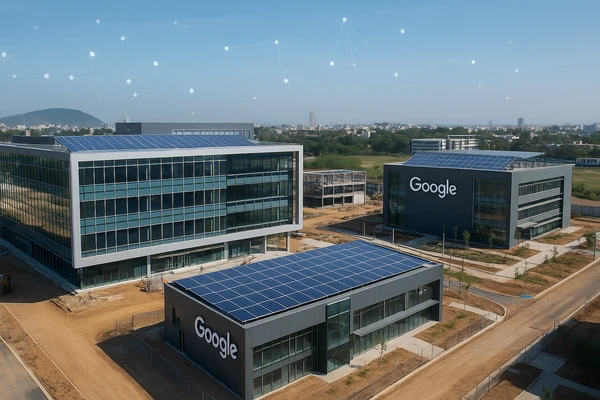
A Record-Breaking Commitment to India’s Digital Future
The Google AI Investment India initiative has entered a historic new phase with the company announcing a $15 billion AI data-centre complex in southern India. This multi-year commitment—the largest single investment ever made by Google in the country—cements India’s status as a rising global powerhouse in artificial intelligence, cloud computing, and next-generation digital services. The project aims to supercharge AI capacity across Asia, generate thousands of high-skilled jobs, and deepen partnerships with Indian technology leaders such as Airtel and Adani.
India’s Digital Ambition: Building the Foundation for AI Leadership
Over the past five years, India’s strategic ambition to become a world leader in artificial intelligence has accelerated dramatically. Following the launch of the National AI Strategy 2018, New Delhi has encouraged adoption of AI applications in governance, agriculture, healthcare, and education.
In that period, Google has been a central collaborator. Its “Google for India Digitization Fund”—announced in 2020—committed $10 billion to drive digital literacy, small-business growth, and local-language innovation. Yet the new Google AI Investment India far surpasses those earlier pledges. It signifies a decisive shift from supporting software ecosystems to building the physical and computational backbone of India’s AI economy.
This expansion comes at a pivotal time. As nations compete to secure computational sovereignty, India offers a unique balance: a skilled workforce, democratic stability, and abundant renewable energy potential. These factors position it as an ideal base for data-intensive industries seeking long-term growth in Asia.
Inside the $15 Billion Plan: The Visakhapatnam AI Data-Centre Campus
Unveiled in October 2025, the Google AI Investment India blueprint centres on constructing a state-of-the-art AI data-centre campus in Visakhapatnam, Andhra Pradesh. The initial phase will deploy 1 gigawatt (GW) of compute and storage capacity—enough to support advanced training of large-language models, cloud computing for enterprises, and regional AI applications for millions of users.
According to Alphabet Inc., the development will unfold over five years and create 8,000 direct and indirect jobsannually across construction, energy, logistics, and digital-services sectors.
Strategic Collaboration Network
- Bharti Airtel – tasked with providing terrestrial and subsea fibre connectivity to integrate India’s east coast with Google’s global data network.
- Adani Group – through Adani Green Energy Ltd, will deliver renewable solar and wind power, aligning operations with India’s clean-energy roadmap.
- DeepMind London – Google’s AI subsidiary will spearhead joint research projects with Indian universities, creating an academic-industry pipeline for AI talent.
Sustainability and Environmental Design
Google confirmed that the campus will operate on 90 % renewable energy, in line with its 2030 net-zero commitment. Cooling systems will rely on recycled water, while all buildings will be LEED-certified to reduce carbon footprint. The design exemplifies the company’s broader push toward “green AI infrastructure”—proof that sustainability and technological advancement can progress together.
Strategic Timing: Why Google Chose India in 2025
Analysts agree that the timing of the Google AI Investment India is no coincidence. India’s digital economy is projected to surpass $1 trillion by 2030, powered by more than 900 million internet users and skyrocketing data consumption.
Crucially, India’s forthcoming Personal Data Protection Act (PDPA) establishes clear guidelines for data storage and processing. Hosting data locally allows companies such as Google to improve speed, reliability, and regulatory compliance for services like Gmail, YouTube, and its new AI assistant platforms.
A Geopolitical and Economic Win
From a geopolitical standpoint, this initiative strengthens ties between the United States and India while reducing reliance on East Asian infrastructure dominated by Chinese supply chains. By anchoring a vast AI hub in the world’s largest democracy, Google aligns efficiency with geopolitical resilience.
Economically, the investment ensures that AI innovation—and the enormous capital behind it—flows into South Asia, not just Silicon Valley.
Comparative Scale
For perspective, Google’s 2023 Singapore data-centre cost approximately $850 million—less than one-fifteenth of this new Indian expansion. The difference underscores how India has evolved from a consumer market into a core infrastructure engine in Alphabet’s global operations.
National Response: Leaders Welcome a New Tech Epoch
India’s Prime Minister Narendra Modi hailed the Google AI Investment India as “a defining moment in our quest for technological self-reliance.” He noted that it dovetails with the Digital India Vision 2030, which seeks to turn India into a $1 trillion digital economy.
Sundar Pichai, CEO of Google and Alphabet, emphasized the country’s unique assets:
“India’s scale, talent, and openness to innovation make it the natural home for our next generation of AI infrastructure. This investment is about building the foundation for the AI economy of the future.”
Airtel Chairman Sunil Mittal added that the collaboration “positions India as the neural centre of the world’s digital brain.”
Industry watchers believe this announcement will ignite a regional AI infrastructure race among competitors such as Amazon Web Services, Microsoft Azure, and Reliance Jio, all seeking to capture a share of India’s rapidly expanding cloud-computing demand.
Economic and Social Upsides: Transforming Local Communities
Beyond the macroeconomics, the Google AI Investment India will directly influence local communities.
Regional Development and Employment
The Visakhapatnam project is expected to inject nearly ₹1.2 lakh crore into the economy over five years. Employment opportunities will span construction engineers, electrical specialists, logistics providers, and AI developers.
Talent Development
Collaborations with IIT Hyderabad, Andhra University, and IIIT Bangalore will yield new certification programs in data engineering, machine learning, and cloud security. By 2028, the initiative aims to train over 50,000 AI professionals, strengthening India’s position as the world’s largest pool of digital talent.
Startup Ecosystem Boost
Startups in healthcare analytics, fintech, and robotics will receive Google Cloud credits and access to AI co-innovation labs, lowering entry barriers for young innovators. Such ecosystem development ensures the benefits of the investment cascade across India’s broader tech landscape.
International Significance: India as the Global South’s AI Anchor
On the global stage, the Google AI Investment India is a defining symbol of AI democratization. As the facility comes online, developing nations across Africa, Latin America, and Southeast Asia will gain access to affordable compute resources hosted in India.
This represents a paradigm shift—moving the AI centre of gravity away from the West toward a more balanced, multipolar digital order. International development agencies have praised the model for empowering nations that historically lacked high-performance computing capacity.
Environmental organizations also applauded the commitment to renewables, contrasting Google’s sustainable design with the heavy-carbon footprints of data-centre clusters in Europe and North America. The project is already being described as a blueprint for sustainable AI growth in emerging economies.
Future Outlook: The Next Chapter in India’s AI Story
Experts believe that once operational, the Google AI Investment India campus could attract additional foreign direct investment (FDI) worth $30 billion from related sectors—telecoms, semiconductors, and logistics. The government is considering tax incentives for green data-centre clusters, which could create an AI corridor along India’s east coast.
Moreover, the project complements Google’s ongoing Project Taara (wireless optical internet) and Jio-Google smartphone initiative, both of which aim to expand access to digital infrastructure nationwide.
In the coming years, the synergy between policy, private investment, and innovation could position India as Asia’s most advanced AI infrastructure hub—a rival to established centres in the U.S. and Europe.
Conclusion: India’s AI Era Takes Shape
The Google AI Investment India represents far more than capital expenditure; it marks a strategic realignment of global AI geography. With a $15 billion commitment anchored in Visakhapatnam, Google has placed India at the intersection of innovation, sustainability, and inclusive growth.
As the first phase breaks ground in 2026, the nation’s transformation from a digital consumer into an AI infrastructure powerhouse begins in earnest. The project’s success could define how developing economies harness technology—not merely as users, but as architects of the intelligent future.
Internal Links
- OpenAI’s Sora App Breaks Records with 1 Million Downloads in Days
- Ghana Cyber Crime Hits GH₵15m Losses in 2025