Political Upheaval in Cameroon’s Presidential Race
Cameroon Election Tchiroma Victory has taken center stage in the nation’s 2025 presidential contest after opposition candidate Issa Tchiroma Bakary declared himself the winner of Sunday’s vote, urging President Paul Biya to concede defeat. The announcement, made on October 14, 2025, quickly spread across social media and major news outlets, igniting intense political debate and uncertainty across the Central African nation. Authorities have since warned that only the Constitutional Council can legally announce results, underscoring the fragile calm that now grips the country.
Observers say the Cameroon Election Tchiroma Victory has become one of the most consequential challenges to Paul Biya’s decades-long rule, raising questions about whether Cameroon is entering a new era of political transition.
A Nation Under Long Rule: The Biya Era and Growing Frustration
For more than four decades, Paul Biya, now 92 years old, has ruled Cameroon with an iron hand. Since assuming power in 1982, Biya has outlasted seven French presidents and seen multiple African leaders come and go. His rule, though credited with maintaining relative stability, has been marred by corruption allegations, restricted political freedoms, and violent suppression of dissent — especially in the Anglophone regions seeking autonomy.
The 2025 election was widely seen as a referendum on Biya’s legacy. Many young voters — most of whom have known no other leader — expressed frustration over rising unemployment, insecurity, and lack of democratic accountability. Tchiroma, a former minister in Biya’s own cabinet, capitalized on this fatigue. Leading the National Alliance for Democracy and Progress (ANDP), he promised sweeping reforms: devolved governance, a crackdown on graft, and peace talks to resolve the Anglophone crisis.
Tchiroma’s Bold Declaration of Victory
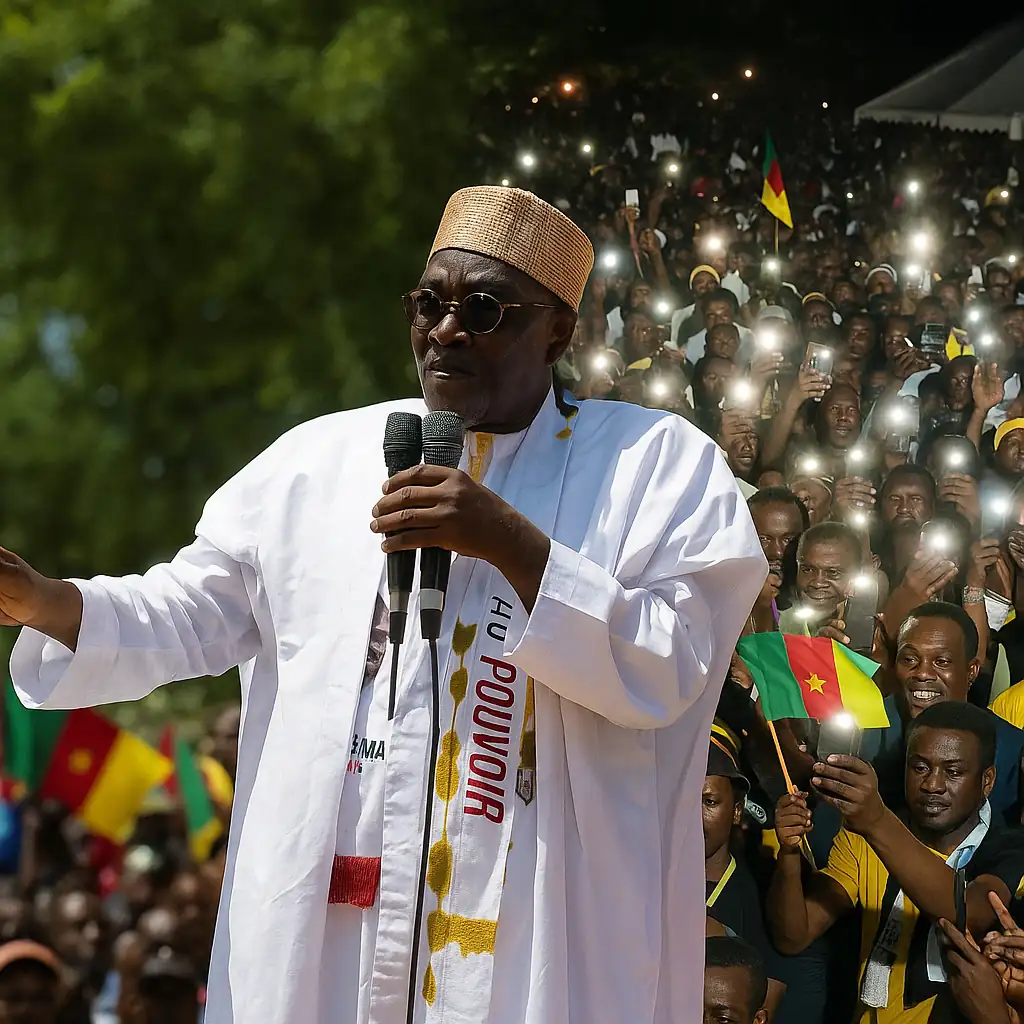
In a carefully choreographed address from Garoua, his northern hometown, Tchiroma proclaimed what he termed a “people’s victory.”
“The Cameroonian people have spoken. We have won this election. I call on President Biya to honor their will and step aside peacefully,”
he declared in a video later broadcast across Facebook and regional television networks.
According to Reuters and AP, the opposition candidate claimed access to preliminary polling data showing him ahead in key provinces. He praised voters for “resisting intimidation” and said he would publish detailed tallies to support his claim.
However, the government swiftly pushed back. Paul Atanga Nji, Minister of Territorial Administration, called the announcement “irresponsible and illegal,” warning that releasing unofficial results could amount to high treason.
The Electoral Commission (ELECAM) has not yet disclosed official figures, and the Constitutional Council — the only body empowered to validate results — has until October 26 to announce the final outcome. Amid mounting uncertainty, security forces increased patrols in Yaoundé and Douala, with reports of temporary internet disruptions — an oft-repeated tactic during previous elections to stifle unrest.
Decoding the Cameroon Election Tchiroma Victory: Turning Point or Political Gambit?
The Cameroon Election Tchiroma Victory declaration is more than a political stunt — it signals deepening cracks within Cameroon’s power structure. Analysts view Tchiroma’s move as both an act of defiance and a calculated gamble to shape post-election narratives.
Political scientist Dr. Fabrice Nguemeni told Le Monde Afrique:
“This declaration may not immediately change the outcome, but it forces the conversation. For the first time, Biya faces a coordinated opposition narrative challenging the state’s monopoly over results.”
Indeed, the symbolic weight of the Cameroon Election Tchiroma Victory claim is magnified by generational and regional frustrations. Cameroon’s youth — over 60 percent of registered voters — have grown increasingly disillusioned with entrenched elites. Yet risks abound. Analysts caution that declaring victory before official confirmation could backfire, provoking state crackdowns or validating government accusations of “attempted insurrection.” Still, for many citizens, Tchiroma’s boldness represents a rare moment of political courage in a system long criticized for silence and compliance.
Official and Opposition Reactions
Government position: The Ministry of Communication dismissed the declaration as “dangerous propaganda.” Pro-government newspapers accused the ANDP of attempting to destabilize the country, while state TV CRTV continued to air pro-Biya programming emphasizing the need for patience.
Opposition solidarity: Tchiroma’s statement drew backing from other opposition figures. Maurice Kamto, leader of the Cameroon Renaissance Movement (CRM) — who made a similar self-declaration after the disputed 2018 election — expressed solidarity on X (formerly Twitter):
“We salute Mr. Tchiroma’s courage. Cameroonians deserve truth and transparency. Let no one steal their voice again.”
The government’s rejection of the Cameroon Election Tchiroma Victory declaration has further deepened divisions among citizens and fueled concerns about possible unrest if the official results contradict the opposition’s claims.
International reactions: The European Union Election Observation Mission voiced concern over “isolated irregularities” and urged all stakeholders to await official certification peacefully. Meanwhile, the African Union (AU)and United Nations Office for Central Africa (UNOCA) issued joint statements calling for calm, dialogue, and adherence to constitutional order.
Civil society response: Groups such as Transparency International and the Cameroon Bar Association demanded publication of polling-station results to ensure transparency. Human-rights activists warned that arbitrary arrests could follow if tensions escalate.
Wider Impact of the Cameroon Election Tchiroma Victory Dispute
The Cameroon Election Tchiroma Victory crisis reverberates far beyond national borders. Cameroon remains a strategic partner to France and the United States in counter-terrorism efforts against Boko Haram and jihadist cells in the Lake Chad Basin. Any prolonged instability could weaken those alliances and disrupt regional trade routes linking Nigeria, Chad, and Gabon.
Economically, uncertainty now clouds the Central African Economic and Monetary Community (CEMAC), where Cameroon is a key player. The BEAC (Central Bank) projected 3.5 percent GDP growth for 2025 — an outlook now threatened by political unrest. Business leaders in Douala, home to Cameroon’s main port, fear strikes or demonstrations that could disrupt exports and fuel inflation.
International analysts argue that the Cameroon Election Tchiroma Victory could redefine Africa’s political transitions and serve as a blueprint for opposition movements across the continent.
Globally, observers say the Cameroon Election Tchiroma Victory episode rekindles debate over Africa’s “old-guard” politics — leaders clinging to power despite public demand for reform.
Public Sentiment and Diplomatic Outlook
Across major cities, emotions run high. Supporters of Tchiroma celebrated in Garoua and Ngaoundéré, waving flags and chanting, “Le peuple a gagné!” (“The people have won!”). Biya loyalists in Yaoundé gathered near the Unity Palace, vowing to defend what they call “the legitimate leader of the nation.”
Internationally, neighboring countries such as Nigeria and Chad monitor the Cameroon Election Tchiroma Victorysituation closely, mindful of spill-over risks to their own borders. France’s Foreign Ministry urged “respect for constitutional order,” while U.S. Secretary of State Antony Blinken stressed “peaceful resolution and transparency.”
Conclusion
As the Constitutional Council prepares its verdict, the Cameroon Election Tchiroma Victory remains both a symbol of defiance and a test of democracy. Whatever the official outcome, the Cameroon Election Tchiroma Victory will endure as a defining moment in the nation’s political evolution. Whether Tchiroma’s self-proclaimed win stands or falls, it has reignited civic engagement, challenged entrenched power, and forced the world to re-examine Cameroon’s path toward genuine change.
Internal Links:
- Madagascar President Flees as Youth Rise Up
- Mali Visa Bond U.S. $10,000 Policy Redefines Global Travel Reciprocity
External Links: