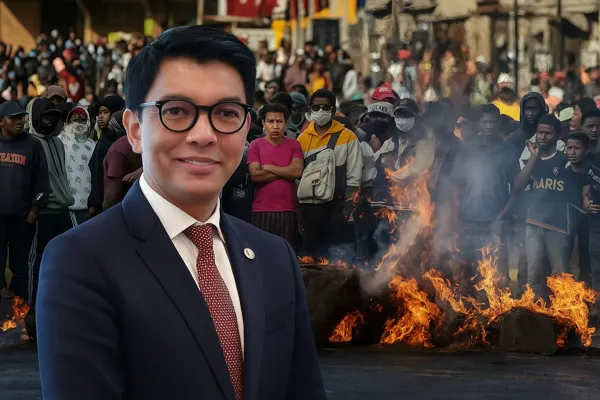
The Madagascar President Flees crisis has plunged the island nation into uncertainty after days of massive Gen Z-led protests demanding reform, transparency, and relief from deep economic hardship. President Andry Rajoelina, long seen as a shrewd political survivor, reportedly fled the country after soldiers defected to join demonstrators calling for his resignation. The sudden power vacuum now raises pressing questions about governance, stability, and the new face of civic resistance across Africa.
Youth Frustration Reaches Boiling Point
Madagascar, a nation of nearly 30 million people, has struggled for decades with political volatility, infrastructure decay, and economic inequality. Electricity outages, water shortages, and rising youth unemployment have intensified public anger.
The recent wave of demonstrations—tagged online as #GenZMadagascar—began in late September 2025 when students in Antananarivo protested extended power cuts and tuition hikes. Within days, the movement morphed into a nationwide campaign against corruption, state mismanagement, and the widening wealth gap between elites and the struggling majority.
For many young protesters, this moment echoes earlier African youth uprisings, from Nigeria’s #EndSARS to Senegal’s #FreeSenegal. Their demands go beyond material needs: they seek accountability, dignity, and generational inclusion in politics long dominated by aging elites.
President Rajoelina Reportedly Leaves Country
By early October, tensions had escalated sharply. Security forces used tear gas and live rounds to disperse crowds in the capital, while protesters regrouped through decentralized social-media calls.
On October 11, a pivotal development reshaped the crisis: the elite CAPSAT unit—responsible for logistics and administration in the military—defected, pledging allegiance to the “people’s cause.” The unit’s commander announced on national radio that the army could “no longer stand against its own citizens.”
Shortly afterward, opposition legislators claimed that President Rajoelina had left Madagascar, allegedly aboard a French military aircraft. Although unconfirmed, multiple diplomatic sources told Reuters and The Guardian that he might be in Dubai under temporary asylum.
In his last televised address, Rajoelina accused “foreign interference and extremist manipulation” of the protests but offered no concrete evidence. Meanwhile, the military appointed General Demosthène Pikulas as acting head of defense operations, declaring that the armed forces would “ensure stability and protect the constitution.”
The Madagascar President Flees reports have since dominated national discourse, fueling speculation that Rajoelina’s 14-year political reign—marked by coups, comebacks, and contested elections—may have reached its end.
A Youthquake Reshaping African Politics
The Madagascar President Flees episode illustrates how Africa’s youngest generation is rewriting the rules of political engagement. Unlike past uprisings fueled by party politics, this movement is decentralized, digitally coordinated, and emotionally charged by shared economic despair.
Political analysts say Madagascar’s Gen Z activists represent a new civic class born in the era of smartphones and mass unemployment. They organize without traditional hierarchies—using encrypted platforms to mobilize flash protests that outmaneuver security forces.
Dr. Salim Abdou, a political sociologist at the University of Mauritius, told Global Standard News:
“This isn’t merely about Rajoelina—it’s about a generation asserting agency. What we’re witnessing is a structural rejection of the old guard that governs through fear, not performance.”
Regionally, the crisis aligns with a broader youth awakening sweeping Africa—from Kenya’s cost-of-living protests to Nigeria’s recurring police-reform demands. These movements challenge governance systems that have failed to deliver opportunity or transparency to their majoritarian youth populations.
Shock, Diplomacy, and Cautious Optimism
International responses were swift yet measured.
- The African Union called for “restraint, dialogue, and constitutional continuity,” dispatching a mediation envoy to Antananarivo.
- The United Nations urged respect for human rights, warning against “military overreach or extrajudicial power transfers.”
- In Paris, the French Foreign Ministry denied any involvement in Rajoelina’s reported evacuation but said it was “monitoring developments closely.”
Within Madagascar, opposition leaders celebrated what they termed a “citizen revolution.”
“The youth have spoken louder than bullets,” said Lalatiana Rakotondrazafy, an MP and longtime critic of Rajoelina’s government.
Civil-society groups, however, urged protesters to remain peaceful, fearing that looting and factional clashes could delegitimize the movement. Human-rights monitors documented at least 18 deaths and hundreds of injuries since demonstrations began.
Global and Local Impact: Beyond Madagascar’s Borders
The Madagascar President Flees crisis has rippled across Africa and beyond. Observers warn that it could embolden youth movements in other nations grappling with similar frustrations—where median ages hover around 19 years and unemployment remains high.
Economically, uncertainty threatens Madagascar’s fragile tourism and mining sectors. The World Bank projects growth could drop below 2% if political instability persists. Foreign investors have paused contracts in nickel and cobalt projects vital to the global electric-vehicle supply chain.
Diplomatically, Madagascar’s turmoil poses a challenge for the Southern African Development Community (SADC), which must balance non-interference with regional stability. Analysts also note growing concern in Beijing, which has major infrastructure investments on the island, including port and road projects under the Belt and Road Initiative.
For the local population, immediate concerns remain access to fuel, food, and healthcare as supply chains falter amid curfews. Banks and schools in Antananarivo have operated intermittently, while social-media platforms face sporadic throttling.
Comparative Insight: A Pattern of Presidential Flight
The Madagascar President Flees scenario evokes parallels with other African leaders who fled amid uprisings—such as Tunisia’s Ben Ali in 2011 or Burkina Faso’s Compaoré in 2014. In each case, the spark was youth disillusionment amplified by social media.
However, analysts caution against romanticizing revolts. Sustainable change requires institutional reform, not just leadership change. Without an inclusive roadmap, Madagascar risks sliding into another cycle of coups and fragile transitions.
The Road Ahead
As the Madagascar President Flees saga unfolds, the nation stands at a crossroads. The military’s next steps—whether toward dialogue or dominance—will determine whether this becomes a democratic turning point or another lost opportunity.
For now, Madagascar’s Gen Z activists have achieved what few thought possible: forcing an entrenched leader from power through grassroots mobilization. The world watches to see whether this energy can translate into lasting reform, stability, and hope
Internal Links
- Interpol Online Scam Arrests: 68 Ghanaians Among 260 in Africa Crackdown
- Talc Cancer Case: Johnson & Johnson Hit with $966M Verdict
External Links
- Reuters: Madagascar president flees after army unit defects
- The Guardian: Madagascar president leaves country after losing army support