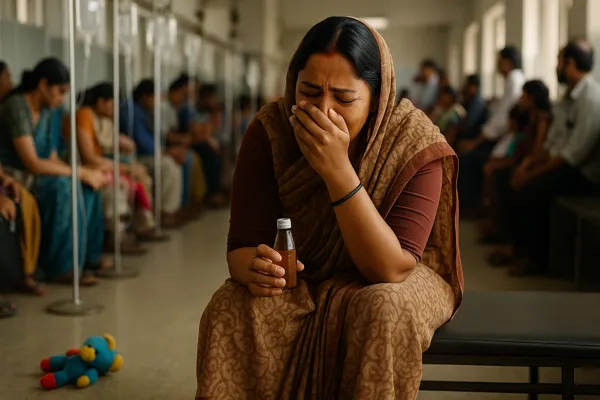
A Tragedy Unfolds
The Deadly Dose India Cough Syrup disaster in Madhya Pradesh is more than a clinical failure — it is a deeply human tragedy that has shattered communities. In October 2025, health authorities confirmed that three brands of cough syrup widely sold across the state contained diethylene glycol (DEG), a toxic chemical more commonly used in brake fluid and antifreeze than in children’s medicine.
Parents described harrowing scenes: children who went to bed with nothing more than a cough or fever woke up vomiting, listless, and struggling to breathe. Symptoms advanced with terrifying speed — nausea, abdominal pain, lethargy, followed by kidney failure and respiratory collapse. Within days, 17 children had died, and dozens more were in critical condition.
Local hospitals were overwhelmed. Pediatricians admitted they had rarely seen such rapid-onset kidney failure. “These were preventable deaths,” one doctor told reporters, his voice breaking. “We were not treating illness — we were treating poisoning.”
The grief was overwhelming. Processions of small coffins moved through the streets of Ujjain as families demanded justice. Pharmacies were vandalized by furious relatives, while communities shunned bottles of syrup that once symbolized healing. For many, trust in the medical system has been permanently broken.
For India, this is more than a local scandal. Once celebrated as the “pharmacy of the world” for producing affordable medicines for over 200 countries, India’s pharmaceutical industry is now tarnished by repeated negligence and oversight failures. The trust that once boosted its exports is now being replaced by global suspicion tied to the Deadly Dose India Cough Syrup tragedy.
The Cultural Reliance on Syrups
Cough syrups hold a special place in India’s healthcare landscape. Affordable, available on every pharmacy shelf, and aggressively marketed for decades, they have become the go-to remedy for children’s coughs, fevers, and colds. In many rural and semi-urban households, a bottle of syrup is seen as the first line of defense, often replacing a doctor’s visit altogether.
This reliance is driven by multiple factors: affordability, accessibility, ease of use, and cultural familiarity. But overdependence has proven dangerous. Families rarely question safety if medicines are openly sold, assuming rigorous checks exist.
History offers chilling reminders:
- 1970s, Delhi: Dozens of children died from DEG-laced syrup.
- 1998, Haryana: Nearly 30 child deaths exposed weak oversight.
- The Gambia, 2022: Over 70 child deaths triggered a WHO global alert against Indian syrups.
- Uzbekistan, 2022–23: At least 20 more deaths again revealed systemic flaws.
Each case reflects a tragic irony: the very medicine meant to heal children became the poison that killed them. Yet, after every outcry, reliance resumes — until the next Deadly Dose India Cough Syrup scandal resurfaces.
Madhya Pradesh: The 2025 Catastrophe
The epicenter of the crisis was Ujjain, Madhya Pradesh, where doctors first suspected a seasonal infection before realizing they faced poisoning on a massive scale.
Alarming Findings
Investigations uncovered chilling details:
- Coldrif syrup contained 48.6% DEG, nearly 500 times above safety limits.
- Respifresh TR and ReLife syrups also tested positive for DEG.
- Multiple batches were toxic, proving it wasn’t an isolated case.
Families were horrified: what they purchased in good faith to ease children’s suffering became the poison responsible for their deaths.
Emergency Response
- The Health Ministry ordered immediate recalls and banned further sales.
- S. Ranganathan, the manufacturer, was arrested for culpable homicide.
- Hospitals in Ujjain and Bhopal created special wards for DEG poisoning, though survival rates remained low.
Doctors admitted that DEG poisoning is notoriously hard to treat. No antidote exists, and by the time kidney failure sets in, survival chances are minimal.
A System Exposed
Investigators found the company relied solely on supplier certificates without independent testing. This shortcut, common in India’s smaller pharmaceutical firms, allowed toxic industrial-grade chemicals into children’s medicines.
With over 10,000 small and medium firms operating, the case exposed deep systemic weaknesses. It wasn’t just negligence — it was structural failure feeding the Deadly Dose India Cough Syrup cycle.
Understanding the Poison
Diethylene glycol (DEG) is a cheap, colorless liquid used in antifreeze and brake fluids. It mimics propylene glycol but turns deadly inside the human body.
Its effects are catastrophic: kidney failure, liver damage, neurological collapse, and death. Children are especially vulnerable — even small doses can be fatal. The invisibility of DEG makes it a perfect but deadly adulterant.
A Recurring Pattern of Neglect
The Madhya Pradesh case is only the latest in a grim history:
- The Gambia (2022): Over 70 child deaths linked to Indian syrups.
- Uzbekistan (2022): 20 children died after consuming DEG-contaminated syrups.
- Cameroon (1995): Dozens died from contaminated paracetamol syrups.
- India (since the 1970s): Multiple domestic tragedies show a persistent problem.
Despite recalls and promises of reform, systemic changes have been slow. The Deadly Dose India Cough Syrup pattern repeats: tragedy, outrage, pledges — then silence.
Systemic Weaknesses
Why does this keep happening? Experts cite:
- Cost pressures leading to corner-cutting.
- Fragmented oversight between state and central regulators.
- Weak supply chain monitoring with blind trust in supplier certificates.
- Reactive enforcement only after deaths occur.
“India has laws on paper but weak enforcement. Reliance on self-certification is a recipe for disaster,” one analyst warned.
High-Stakes Consequences
The Deadly Dose India Cough Syrup scandal carries consequences far beyond Madhya Pradesh:
- Exports: India supplies 20% of global generics. Its credibility is shaken.
- Public health: African, Asian, and Latin American nations reliant on Indian medicines face trust issues.
- Global standing: WHO continues to issue warnings, while importers reassess procurement.
Responses and Fallout
- Government: Pledged “zero tolerance,” though skeptics recall broken promises.
- WHO: Urged stricter regulation and global cooperation.
- Families: Demand life sentences for those responsible. “They sold poison as medicine,” one father said.
- Trading Partners: Some African nations are reviewing contracts with Indian firms.
Inside India, trust in syrups has collapsed. Abroad, diplomatic tensions rise, while rivals like China stand ready to take India’s market share.
Reform or Repeat?
Experts insist reforms are the only way forward:
- Mandatory independent raw material testing.
- Stronger central oversight.
- Global partnerships for safety checks.
- Public awareness to reduce blind reliance on syrups.
- Severe penalties for offenders.
Without these, more Deadly Dose India Cough Syrup disasters loom.
Lessons for the Future
The deaths in Madhya Pradesh expose systemic flaws — fragmented regulation, unchecked cost-cutting, and misplaced trust.
One contaminated bottle ended a child’s life. One regulatory gap left families grieving. India must not only punish offenders but rebuild its entire pharmaceutical safety system.
If it hopes to remain the “pharmacy of the world,” it must eliminate the Deadly Dose India Cough Syrup scourge once and for all.
Internal Links
- Measles Resurgence in U.S. Southwest
- WHO Issues New Mosquito Guidelines to Tackle Dengue, Zika & Yellow Fever
External Links
- Reuters: India declares three cough syrups toxic after deaths in Madhya Pradesh
(Trusted global news agency confirming government action on toxic syrups.) - World Health Organization: Medical product alert on contaminated syrups
(WHO’s global alert on Indian syrups — authoritative, credible, and highly relevant.)