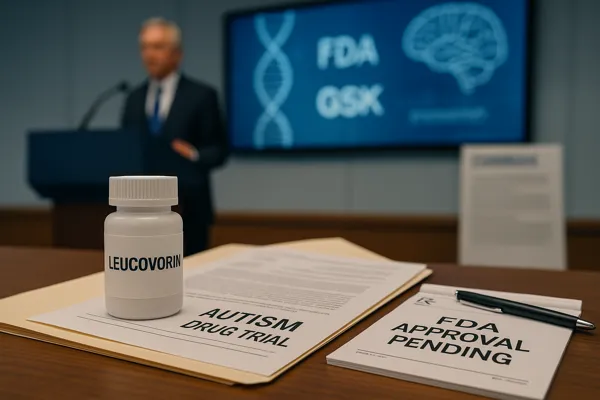
Kennedy and GSK Push Autism Drug Into Spotlight
The U.S. health debate took an unexpected turn this week as Health Secretary Robert F. Kennedy Jr. confirmed that his office, in partnership with GlaxoSmithKline (GSK), is driving a fast-track approval for an autism drug. The U.S. Food and Drug Administration (FDA) has agreed to reopen the dormant approval file for leucovorin, an older medication once used in chemotherapy. This unusual regulatory step could make leucovorin the first officially recognized drug tied to cerebral folate deficiency, a condition affecting a subset of children on the autism spectrum.
A Long History of Autism Drug Development Challenges
Autism spectrum disorder affects millions worldwide, but effective drugs have remained elusive. For decades, treatment has largely focused on behavioral therapy, speech programs, and counseling. While some psychiatric medications—such as antipsychotics—are prescribed to manage related symptoms, no drug has directly targeted the underlying biological mechanisms of the condition.
Leucovorin, now being positioned as a potential autism drug, was originally marketed by GSK under the name Wellcovorin to reduce chemotherapy toxicity. Its connection to autism emerged in the early 2000s when researchers noticed that some autistic children suffered from cerebral folate deficiency, a brain folate transport issue. Small studies suggested that leucovorin could improve communication, social engagement, and flexibility—sparking interest in its role as an autism drug candidate.
Still, research was fragmented. Most studies included fewer than 100 children, with limited replication. Regulatory authorities declined to list leucovorin as an official autism drug, leaving parents to seek it off-label at significant personal expense.
FDA Revives Autism Drug Pathway With GSK Support
Kennedy’s announcement marks the first serious federal move to establish leucovorin as a recognized autism drug. Instead of requiring large, costly Phase III trials, the FDA has invited GSK to file a supplemental application updating leucovorin’s label to include cerebral folate deficiency. Once approved, the updated indication would require all generic manufacturers to align, transforming leucovorin into a formally acknowledged drug.
This shift is remarkable. The FDA rarely reopens old files to accelerate new approvals, but Kennedy has framed it as a public health necessity. He called the initiative “a necessary correction to decades of neglect,” insisting that a proven autism drug is long overdue.
Families could soon see the benefits. With insurance coverage guaranteed once the label changes, parents may no longer need to pay out of pocket for what could become the first widely accessible drug.
Alongside this, Kennedy announced that the FDA will investigate prenatal acetaminophen use as a possible risk factor for autism. Though controversial, he linked this to the same principle of urgently addressing potential biomedical drivers of autism and supporting pathways for future drug development.
Experts Divided Over the Autism Drug Strategy
The move has divided medical experts.
Supporters argue that a recognized drug is a long-overdue milestone. “This is the first time regulators are formally addressing a biological pathway linked to autism,” said Dr. Daniel Ross, pediatric neurologist. “Even if this drug benefits only a subgroup, it represents a major shift toward biomedical solutions.”
Skeptics, however, fear the science is being stretched. “The trials supporting leucovorin as an autism drug involve very small cohorts,” warned Dr. Alice Wong of Johns Hopkins University. “Families deserve hope, but not at the cost of bypassing rigorous safety and efficacy trials.”
Policy analysts worry about precedent. If companies can repurpose old drugs with limited new data, other “fast-tracked” drugs or neurological therapies could follow, weakening regulatory safeguards.
Mixed Reactions From Officials, Doctors, and Families
The announcement triggered mixed reactions:
- Robert F. Kennedy Jr.: “Families have been told there is no biomedical treatment for autism. Today we recognize the first true autism drug pathway.”
- GSK spokesperson: “We are cooperating with the FDA to ensure Wellcovorin’s label reflects the science and its potential as an autism drug.”
- National Autism Coalition: “A new drug option is welcome, but science must remain the guiding principle.”
- Parents: Online forums lit up. Some parents praised leucovorin as the only drug that improved their children’s speech, while others worried the approval was politically motivated rather than science-led.
Ripple Effects Across the U.S. and Worldwide
If the FDA endorses leucovorin as an official drug, ripple effects will spread far beyond the U.S. Global regulators often mirror FDA decisions. Countries in Europe, Africa, and Asia may come under pressure to adopt similar approvals.
For low- and middle-income nations, including Ghana, the introduction of a drug could reduce stigma and encourage families to seek medical care. However, access will remain a challenge due to infrastructure limits and medication costs.
In the U.S., insurance coverage would immediately change. Medicaid formularies and private insurers would be required to cover the drug, shifting the financial burden away from families. The pharmaceutical industry, including generic producers, is already preparing for heightened demand.
This policy also signals a wider trend. By tying autism drug development to broader biomedical and prenatal health reviews, Kennedy has made autism policy a central pillar of his health agenda.
Hope, Skepticism, and the Road Ahead
The recognition of leucovorin as a potential drug is both a bold political step and a medical gamble. For families, the hope of having a covered, official drug offers relief. For scientists, the lack of large-scale trials raises questions about safety, expectations, and long-term credibility.
As the FDA works with GSK on this application, the world is watching. Whether leucovorin becomes the first validated drug, or remains a cautionary tale of politics overtaking science, will define the next chapter in autism health policy.