Why Nurses Are On The Streets Today
After months of waiting, Ghana’s frontline caregivers say enough is enough. The unpaid nurses protest erupted in Accra on October 2, 2025, as members of the Coalition of Unpaid Nurses and Midwives demanded immediate payment of salary arrears they say stretch 9–10 months. Organizers estimate close to 7,000 affected staff across the country, arguing they have exhausted quiet negotiations. Marchers converged at Efua Sutherland Children’s Park before heading to the Finance and Health ministries to submit petitions. CitiNewsroom.com
How We Got Here: The Road to Arrears
Ghana’s public-sector payroll has long faced bottlenecks—particularly at the juncture of financial clearance, posting, and onboarding. Nurses and midwives say many of them were financially cleared and posted, yet remained off-payroll for months, forcing them to borrow, fall behind on rent, and juggle transport to shifts without income. The unpaid nurses protest follows multiple warnings by union leaders that morale is eroding and patient care could suffer if salaries remain delayed. Historic flashpoints—strikes over arrears, risk allowances, and working conditions—underline a pattern: temporary fixes without structural reform leave arrears to recur with new cohorts. Media monitors and union accounts in recent months documented rising frustration, including threats of service withdrawal if payroll issues persisted. GHScientific
What Happened in Accra: March, Route, Demands
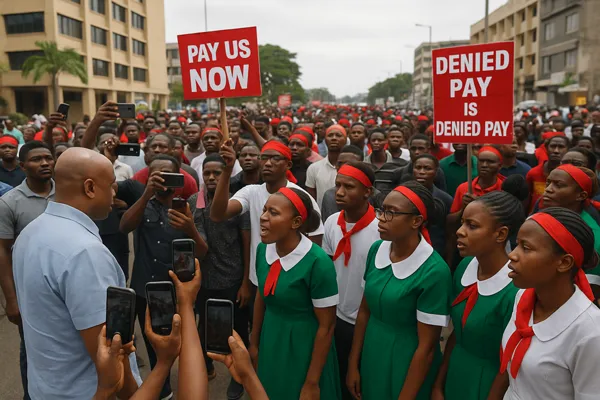
On October 2, demonstrators gathered in the morning at Efua Sutherland Children’s Park, holding placards—“Pay Us Now,” “We Heal the Sick, Yet We Are Starving.” From there, the unpaid nurses protest moved in a coordinated march toward the Ministry of Finance and the Ministry of Health, where leaders presented petitions. The coalition says arrears date back as far as December/January, leaving many newly posted staff working without pay for 9–10 months. Several outlets reported that the action could continue into October 3 if there were no concrete commitments. Adomonline.com
Participants interviewed on camera described stark realities: borrowing to commute, difficulty buying food after night shifts, and evictions over rent arrears. One young nurse said she had survived “by the kindness of colleagues,” but could no longer cope. Coverage across major outlets and social channels amplified their stories in real time, with videos from the march and outside the Finance Ministry trending nationwide. The unpaid nurses protest drew solidarity from civil society actors and former health professionals who warned that demoralizing caregivers can paralyze hospital services. GhanaWeb
By afternoon, officials acknowledged the demonstrations. Reporting by Citi News indicated a key development: government signaled that the salary arrears would be captured in the next budget, a step protesters welcomed in principle but said must be backed by timelines and disbursement. Protest leaders stressed that while dialogue remains open, arrears must be cleared and the onboarding/payroll pipeline fixed to prevent future crises. CitiNewsroom.com
What This Means for Ghana’s Health System
The unpaid nurses protest spotlights an operational risk at the heart of healthcare delivery. When newly posted nurses and midwives aren’t paid, hospitals still rely on them—creating a hidden subsidy borne by workers who can least afford it. Prolonged arrears sap morale, accelerate burnout, and can trigger an exodus to private facilities or overseas systems with more reliable pay. If even a fraction of affected staff reduce shifts or stage further actions, clinics will see longer wait times, fewer staffed beds, and possible postponement of routine services.
Beyond service delivery, persistent arrears dent Ghana’s fiscal credibility. Budget partners and health donors look for discipline in wage management; arrears suggest weak coordination among Health, Finance, and Employment ministries. While a budget provision for arrears is a start, the fix must include process controls: automated onboarding to payroll upon posting, clear service-level timelines between clearance and first pay, and transparent dashboards for unions and facilities to monitor progress. Without that, the unpaid nurses protest could recur with every new intake. CitiNewsroom.com
Voices From the Frontline and Officials
At the Accra march, frontline workers’ testimonies carried the day. “We take care of the sick, yet cannot feed ourselves,” one nurse said, echoing a refrain heard across multiple interviews. Coalition spokespeople framed the unpaid nurses protest as a plea for dignity, not confrontation: “We want to serve—but we need to live.” Live clips from the route and outside the ministries showed orderly crowds, chants demanding payment, and petition handovers. CitiNewsroom.com
Media previews ahead of the event had already flagged the scale: posts estimated ~7,000 affected, with marches slated for October 2–3 in Accra starting from Efua Sutherland Children’s Park. The route and numbers were later reflected in same-day reports and reels from broadcasters and citizen journalists on the ground. On policy, a Citi News update said authorities intend to capture the arrears in the next budget—a signal of movement, though unions insist on binding timelines. Metro TV Online
The Stakes for Patients—and Ghana’s Reputation
Locally, the health impact is immediate. If arrears persist, facilities could face staffing gaps as affected workers cut overtime or seek alternative income. Maternal care, emergency triage, and chronic disease clinics are especially vulnerable. The unpaid nurses protest also risks feeding a brain-drain loop: underpaid or unpaid early-career staff look abroad, deepening domestic shortages and raising training costs.
Internationally, a reform-minded fix would reassure partners that Ghana can post and pay its workforce on time. A credible plan—budgetary allocation plus process modernization—would restore confidence, contain the risk of repeat arrears, and help retain talent. Conversely, if arrears linger, watchdogs will question payroll governance just as Ghana courts investment and support for health initiatives. For a country that has positioned itself as a regional health hub, resolving the unpaid nurses protest swiftly and transparently is mission-critical.
What Happens Next
Momentum is now with the workers—and the government response will define the next chapter. If the budget commitment materializes quickly, arrears can be cleared and confidence rebuilt. Protest leaders, however, are ready to escalate if timelines slip. The unpaid nurses protest has turned a payroll glitch into a national priority; fixing it—for good—means pairing immediate payments with pipeline reforms so no new cohort ever works months without pay. CitiNewsroom.com
Internal Links
Ghana Debt Restructuring: $256M UK Deal Unlocks 5 Projects
HIV Protection Jab Deal Cuts Price to $40/Year for 120 Countries