A Landmark Moment for OpenAI
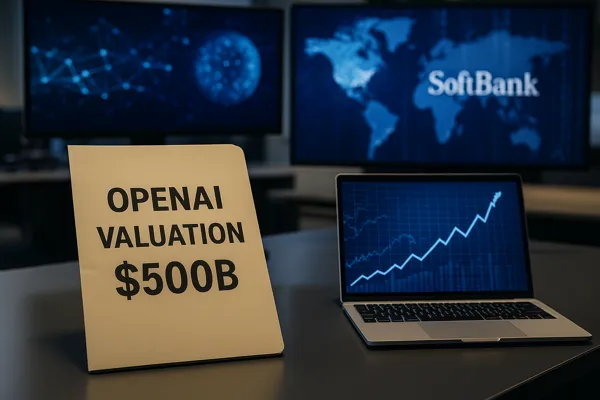
OpenAI has crossed a historic threshold, with the OpenAI valuation hitting $500 billion that places it among the most valuable companies in the world. The figure follows a massive secondary share sale led by SoftBank and other top investors, sending shockwaves across the global technology sector. For many, this valuation cements OpenAI’s role as the driving force in artificial intelligence, but it also triggers questions about whether the AI market is overheating.
From Non-Profit Roots to AI Powerhouse
When OpenAI was founded in 2015, it began as a non-profit research lab with a mission to develop artificial intelligence safely and transparently. Early backers included tech visionaries such as Elon Musk and Sam Altman, who believed AI should serve humanity rather than corporate monopolies.
However, as AI research grew more expensive, OpenAI transitioned to a capped-profit model, allowing it to raise billions while pledging to keep its mission-oriented ethos. Partnerships with Microsoft accelerated this shift—most notably a $13 billion deal in 2023 that gave Microsoft access to OpenAI’s powerful language models.
The launch of ChatGPT in late 2022 propelled the company into the global spotlight. Businesses, governments, and individuals rushed to adopt the tool, which quickly became the face of the AI revolution. By 2024, OpenAI was earning billions annually and was already valued at more than $300 billion. This massive OpenAI valuation was built on years of strategic growth and partnerships.
SoftBank Leads $6.6B Share Sale
The latest leap to a $500 billion OpenAI valuation comes from a landmark $6.6 billion secondary share sale. Instead of raising new funds, this deal allowed insiders and employees to cash out shares while attracting heavyweight investors such as SoftBank, Thrive Capital, Dragoneer, Abu Dhabi’s MGX, and T. Rowe Price.
SoftBank’s involvement carries symbolic weight. Known for betting on disruptive technologies, SoftBank sees OpenAI as a cornerstone of the new AI economy. According to financial reports, OpenAI generated $4.3 billion in revenue in just the first half of 2025—already surpassing its total for all of 2024.
This financial performance explains why investors are comfortable valuing OpenAI at half a trillion dollars, rivaling long-established giants like Meta and Alphabet. For context, SpaceX, another mega-startup, was recently valued at $200 billion, making OpenAI’s rise even more remarkable.
Experts Warn of AI Bubble Risks
Not everyone is convinced the OpenAI valuation reflects reality. Analysts warn that the speed and scale of growth resemble past bubbles, including the dot-com era of the late 1990s.
“Valuations of this size often signal speculative excess,” said one London-based technology strategist in comments to The Guardian. “Yes, OpenAI is transforming the world, but $500 billion is an extraordinary figure for a company less than a decade old.”
Some experts argue the valuation is justified by OpenAI’s rapid revenue growth and dominance of the generative AI market. Others caution that AI development faces risks: mounting regulatory scrutiny, ethical debates, and potential competition from rivals like Anthropic, Google DeepMind, and Meta AI. Critics note that the valuation may mirror the overconfidence of past bubbles.
Mixed Responses from Investors and Public
Reaction to the record OpenAI valuation has been divided. A source close to the deal told Reuters: “This valuation highlights the central role OpenAI now plays in the global technology ecosystem. Investors are betting not just on a company, but on the AI economy itself.”
Social media was flooded with contrasting views. Tech optimists hailed the news as proof that AI is the new oil, while skeptics worried about market overhype. A U.S. financial analyst posted on X: “$500B valuation in less than a decade—AI is rewriting business history. But we all know how bubbles end.”
Meanwhile, policymakers across Europe and Asia have called for tighter regulation. The European Union, already pushing its AI Act, suggested that valuations like this show why the industry needs strict oversight.
AI Boom Reshaping Global Economies
The implications of the OpenAI valuation stretch far beyond Silicon Valley. Globally, AI adoption is accelerating in healthcare, education, finance, defense, and creative industries. Governments are investing billions to avoid falling behind in what is increasingly called the AI arms race.
Emerging markets such as Ghana and Nigeria see opportunities to build AI-driven economies, leveraging cloud infrastructure and digital skills. However, the dominance of U.S.-based firms like OpenAI risks widening the digital divide. Without strong local policies, many nations could become consumers rather than creators in the AI economy. For these countries, the soaring valuation signals both opportunity and caution.
In the United States, the valuation strengthens calls for AI regulation. Lawmakers worry that unchecked growth could lead to monopolies and misuse of technology, particularly in areas like surveillance, misinformation, and job automation.
What Comes Next for OpenAI
The OpenAI valuation milestone marks a turning point in the history of artificial intelligence. With $500 billion on the table, the company has become both a symbol of innovation and a lightning rod for scrutiny. Whether the OpenAI valuation proves sustainable will depend on how the company navigates competition, regulation, and public trust in the years ahead.
Whether OpenAI continues to climb or faces a market correction will depend on how it navigates regulation, competition, and public trust. For now, one thing is certain: the world is watching closely as OpenAI leads the AI revolution.
Internal Links:
- Inside the OpenAI Video App Copyright Clash Rocking Global Media
- Cybercrime Fight: Police Use Open-Source Tools as Mahama Warns Scammers
External Links: