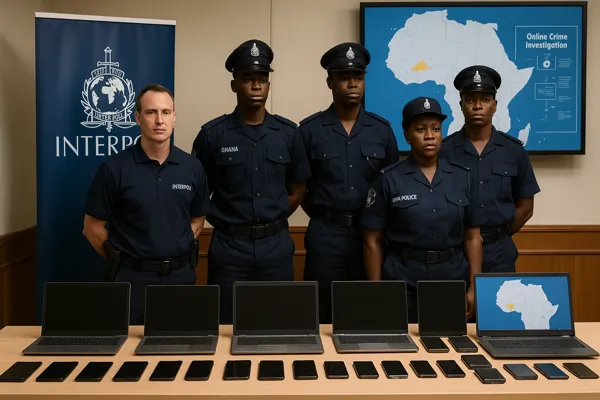
Interpol online scam arrests have uncovered one of the largest cybercrime crackdowns in Africa’s history. The coordinated operation, conducted across 14 countries, led to 260 suspects being detained, including 68 Ghanaians accused of involvement in online scams.
The crackdown targeted organized networks behind romance fraud, sextortion, impersonation, and money laundering. Interpol said the arrests expose the growing sophistication of internet-enabled scams that erode trust in digital systems while costing victims millions.
Africa’s Growing Cybercrime Problem
Cybercrime has surged across Africa in the past decade. The expansion of mobile money platforms, social media, and greater internet access has created both new opportunities for economic growth and vulnerabilities that fraudsters exploit.
Ghana, Nigeria, and South Africa have consistently ranked as major hubs for cyber fraud. In Ghana, the phenomenon has been linked with the notorious “sakawa” culture—a blend of internet scams and ritualistic practices sometimes glorified in popular music and films. This cultural framing has drawn both fascination and condemnation, with critics warning it undermines the nation’s global image.
Interpol has been targeting West African criminal syndicates for years through its Operation Jackal initiative. Jackal I (2022) and Jackal II (2023) dismantled fraud networks that laundered millions and exploited thousands of victims. The Interpol online scam arrests of 2025 mark the most ambitious crackdown yet, showing how cybercrime has become a transnational law enforcement priority.
Interpol Online Scam Arrests: 260 Suspects, 68 Ghanaians Implicated
Interpol reported striking numbers from the operation:
- 260 suspects arrested across 14 African countries
- 1,235 devices seized, including laptops, smartphones, and hard drives
- 81 cyber infrastructures dismantled
- 1,463 victims identified worldwide
- USD 2.8 million in losses uncovered
In Ghana, law enforcement detained 68 suspects, seized 835 devices, identified 108 victims, and documented USD 450,000 in fraud losses, of which USD 70,000 was recovered.
The scams took many forms: fake identities on dating apps, fraudulent courier services demanding invented “customs fees,” and sextortion rings that secretly recorded victims during intimate calls. Investigators found links between Ghana-based scammers and global networks, with funds routed through cryptocurrency exchanges, mobile money accounts, and international bank transfers.
Ghana’s Battle With Cybercrime
This is not the first time Ghana has been spotlighted in global fraud cases. Over the last 20 years, internet scams—initially called “419 fraud” in Nigeria and later evolving into “sakawa” in Ghana—have affected thousands of victims abroad.
Past operations revealed how scammers often relied on stolen photos, fake military or diplomatic identities, and elaborate storylines to win the trust of targets. Despite high-profile arrests, weak enforcement and limited resources meant many cases went unprosecuted.
The Interpol online scam arrests are therefore seen as a turning point—demonstrating Ghana’s willingness to collaborate internationally and confront the cybercrime challenge head-on.
How the Crackdown Was Executed
Interpol credited the success of the operation to close cross-border intelligence sharing and modern digital forensics. Investigators analyzed seized devices, uncovering databases of stolen identities, scam scripts, and financial ledgers.
Banks and telecom companies assisted in tracking suspicious transactions. In some cases, money moved from Ghana through Nigeria and then into accounts in Asia or Europe. This global flow highlighted the complexity of cybercrime syndicates, which often operate like multinational corporations with recruiters, trainers, and money mules.
By dismantling cyber infrastructures rather than targeting individuals alone, law enforcement disrupted entire fraud ecosystems.
Interpol Online Scam Arrests Spark Warnings from Experts
While the arrests mark progress, experts caution that Africa’s cybercrime landscape is deeply entrenched.
Dr. Isaac Mensah, a cybersecurity analyst in Accra, told GSN:
“The arrests are a wake-up call. They reveal not only how strong these networks have become but also how urgently Ghana needs reforms—from digital education to stricter sentencing”.
The United Nations Office on Drugs and Crime (UNODC) has similarly warned that cyber fraud is increasingly linked to money laundering and even human trafficking. Europol noted that romance scams inflict not only financial losses but also long-term psychological harm on victims.
Experts say cybercrime damages Ghana’s reputation abroad, deters foreign investment, and undermines the credibility of its fast-growing fintech sector.
Interpol Online Scam Arrests and Ghana Police Response
Interpol Secretary General Jürgen Stock praised the coordinated effort:
“These arrests send a strong message: cybercriminals cannot hide behind screens. Interpol and its partners are committed to protecting victims and dismantling these networks.”
The Ghana Police Service echoed the message:
“This outcome reflects Ghana’s commitment to working with international partners. We will continue to strengthen our digital security framework and bring offenders to justice.”
The Cybersecurity Authority of Ghana also issued new advisories, urging citizens to verify requests for money, avoid sharing sensitive material online, and report suspicious behavior.
On social media, public reactions were mixed. Some Ghanaians celebrated the arrests, while others worried about the country’s growing reputation as a cybercrime hotspot. Commentators emphasized the need to tackle unemployment and poverty, which drive many young people into online fraud.
Challenges in Prosecution and Enforcement
Despite the arrests, experts highlight that prosecuting cybercrime remains difficult. Gathering admissible digital evidence, tracing funds across multiple jurisdictions, and securing victim testimony from abroad all complicate legal processes.
In Ghana, limited capacity in cybercrime courts often slows down cases. Critics argue that without faster prosecution and stiffer penalties, many arrested suspects could return to scams once released.
This raises the importance of legal reforms and stronger collaboration between Ghanaian prosecutors and international partners.
Global Impact of Interpol Online Scam Arrests
The crackdown brought relief to over 1,400 victims worldwide, many of whom lost life savings to scammers. The estimated USD 2.8 million in losses is only a fraction of global online fraud, but the arrests send a clear deterrent message.
For Ghana, the operation is a double-edged sword: it shows progress in enforcement but also highlights how embedded cybercrime has become. Economists warn that Ghana must improve job opportunities and digital literacy to curb fraud’s appeal.
Diplomatically, Ghana’s active cooperation with Interpol strengthens trust with partners in Europe, North America, and Asia. This may help rebuild investor confidence if reforms continue.
The Road Ahead in Fighting Cybercrime
The Interpol online scam arrests are a milestone, but experts insist that long-term solutions are essential. Ghana and its African partners must prioritize:
- Stronger laws and courts to ensure swift prosecutions
- Public awareness campaigns to protect citizens from scams
- Job creation initiatives to reduce youth vulnerability
- Enhanced cross-border cooperation to dismantle networks at their roots
If followed through, these measures could transform this crackdown from a temporary success into a lasting shift in Africa’s cybercrime battle.
Internal links:
External links: