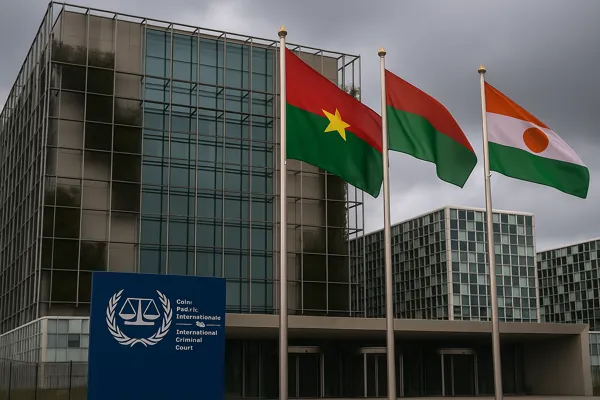
A Shockwave Through International Justice
The decision by Mali, Burkina Faso, and Niger to exit the International Criminal Court (ICC) has sent shockwaves through international law and diplomacy. Announced on October 17, 2025, the coordinated withdrawal marks one of the most consequential realignments in Africa’s postcolonial history. For the three Sahel nations—each under military leadership—the move signifies a deliberate shift toward self-determination and away from institutions seen as instruments of Western dominance.
The Mali Burkina Faso Niger Exit ICC episode is not just an act of rebellion; it represents a deep philosophical challenge to the very foundations of global justice.
The ICC’s Contested Legacy in Africa
Established in 2002, the ICC was envisioned as a permanent tribunal to prosecute crimes of genocide, war crimes, and crimes against humanity. However, two decades later, the Court faces a credibility crisis—especially across Africa.
Out of 31 indictments since inception, more than 20 have targeted African leaders, including Sudan’s Omar al-Bashir, Kenya’s William Ruto, and Ivory Coast’s Laurent Gbagbo. While some victims’ groups hailed these prosecutions as milestones for justice, others saw a troubling pattern of selective enforcement. Western powers—responsible for alleged atrocities in Iraq, Afghanistan, and Palestine—remain untouched.
For many Africans, the Mali Burkina Faso Niger Exit ICC decision is the culmination of decades of resentment toward what they view as a two-tier system: justice for the weak, impunity for the powerful.
Current Development: The Mali Burkina Faso Niger Exit ICC Announcement
In a joint declaration from Bamako, the governments of Mali, Burkina Faso, and Niger accused the ICC of “weaponizing justice” and “undermining African sovereignty.” They asserted that the Court has become a tool of Western interventionism, selectively targeting African leaders while ignoring Western transgressions.
Under Article 127 of the Rome Statute, the formal withdrawal process takes one year after notification to the UN Secretary-General. However, the ICC will retain jurisdiction over any alleged crimes committed before the effective withdrawal date—meaning ongoing cases involving Mali will not be terminated.
The Sahelian trio stated they would instead pursue a continental alternative framework for justice, inspired by “African values and traditions.” The Exit ICC moment thus symbolizes a dramatic repositioning of Africa’s legal and diplomatic priorities.
Sovereignty Versus Accountability
The Exit debate underscores a long-standing tension between national sovereignty and international accountability. Supporters of the move argue it is a rightful assertion of independence against institutions that have long dictated Africa’s political fate. They point out that major powers like the United States, Russia, and China have either refused ICC jurisdiction or undermined its authority, yet expect smaller nations to comply.
Critics, however, warn that this withdrawal could erode protections for victims of war crimes and human rights violations. The three Sahel states face serious allegations of civilian massacres, torture, and extrajudicial killings linked to counterterrorism operations. Without ICC oversight, human rights advocates fear military leaders could evade accountability under the guise of sovereignty.
In short, while the Mali Burkina Faso Niger Exit ICC move may be politically empowering, it also risks dismantling one of the few international mechanisms for justice in conflict-torn regions.
Global Condemnation Meets Regional Pride
The global response has been swift—and polarized.
- Human Rights Watch condemned the move as “a betrayal of victims and a retreat from justice.”
- Amnesty International warned it “signals open impunity for those in power.”
- The European Union and France called the decision “deeply concerning,” fearing it could isolate the Sahel further.
- Conversely, Russia and China welcomed the withdrawals, framing them as “legitimate exercises of national sovereignty.”
- Across Africa, prominent commentators praised it as a symbolic break from neocolonial dependency, with some labeling it the “Sahel Declaration of Judicial Independence.”
This divide captures the essence of the Mali Burkina Faso Niger Exit ICC phenomenon: a tug-of-war between sovereignty and globalism, independence and accountability, justice and politics.
Conflict, Instability, and Political Transformation
The backdrop to this decision is a region engulfed in instability.
- Mali has faced jihadist insurgencies linked to al-Qaeda and ISIS for over a decade.
- Burkina Faso endures almost daily militant attacks, displacing millions.
- Niger continues to grapple with terrorism, post-coup sanctions, and border insecurity.
All three nations have cut ties with France, expelled Western troops, and cultivated partnerships with Russia’s Africa Corps. Their joint exit from the ICC fits this anti-Western geopolitical realignment, echoing the formation of the Alliance of Sahel States (AES).
For many, the Mali Burkina Faso Niger Exit ICC decision completes this pivot—transforming the Sahel into a bloc determined to chart its own course in global affairs.
The Rise of the Alliance of Sahel States (AES)
Formed in 2024 after leaving ECOWAS, the AES now stands as the institutional backbone of Sahel cooperation. By rejecting ICC jurisdiction, the alliance asserts its commitment to regional autonomy and mutual defense.
AES leaders have proposed establishing a Sahel Regional Tribunal to address war crimes and corruption internally. While this could mark a step toward African judicial empowerment, analysts warn that such a system might lack the transparency, independence, and enforcement capacity of international courts.
If more African nations follow suit, the Mali Burkina Faso Niger Exit ICC could accelerate the fragmentation of international law, ushering in an era where regional justice mechanisms replace global ones—for better or worse.
Global and Legal Impact
The ripple effects of this decision stretch from The Hague to Addis Ababa:
- ICC Legitimacy Under Fire – With multiple African exits, the ICC’s moral and political authority is weakened.
- Possible Copycat Exits – Other nations frustrated by ICC bias, such as Chad or Uganda, may reconsider their memberships.
- Justice Vacuum for Victims – Civilians harmed by war crimes may lose avenues for international redress.
- Geopolitical Shifts – The Sahel’s growing alliance with Russia and China could redefine African diplomacy.
- Legal Precedent – The Mali Burkina Faso Niger Exit ICC creates a roadmap for lawful withdrawal under the Rome Statute.
Experts warn that unless the ICC reforms its structural inequities, more developing nations could abandon it—potentially triggering a crisis of legitimacy for global justice itself.
Global and Local Relevance
For Africa, this moment is deeply symbolic: a declaration of self-governance and a demand for equality on the world stage. For the international community, it is a wake-up call.
The Mali Burkina Faso Niger Exit ICC underscores the erosion of faith in global institutions perceived as Western-dominated. It also highlights the urgent need for a reimagined justice architecture—one that upholds fairness, inclusivity, and accountability across all continents.
Still, civil society groups in the three nations urge caution. They warn that rejecting the ICC must not mean rejecting justice itself, calling for domestic reforms and cooperation with the African Union’s human rights mechanisms to prevent impunity.
Conclusion: A Defining Moment for Africa’s Legal Future
The Mali Burkina Faso Niger Exit ICC represents more than a legal maneuver—it is a statement of identity, power, and autonomy.
It may empower Africa to create fairer, homegrown systems of justice, or it may embolden authoritarian regimes to act without consequence. As the world debates this bold step, one fact is certain: the Sahel has forced the world to reconsider who defines justice—and for whom.
Internal Links
- Ecuador Cocoa Grower to Overtake Ghana as World’s No. 2 Producer
- India H-1B Visa Hike Sparks Panic as Trump Imposes $100K Fee
- Newborn Baby Buried Alive in India Fights for Her Life