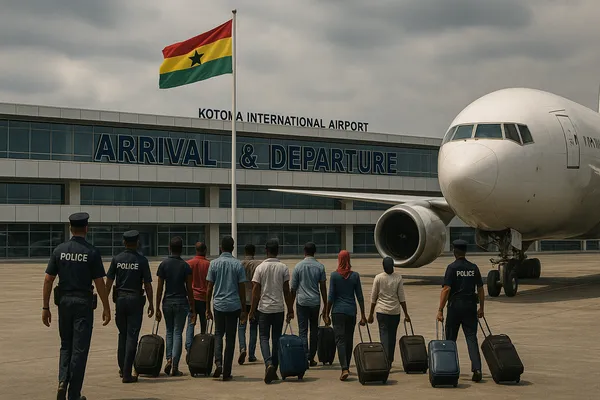
A Diplomatic and Humanitarian Dilemma
The case in which Ghana Deports 11 West Africans has sparked a legal and moral storm across Africa, the United States, and international human rights circles.
On September 23, 2025, the Accra High Court struck out a lawsuit filed on behalf of eleven West Africans deported by the U.S. and temporarily held in Ghana.
What began as a straightforward immigration transfer has evolved into a defining test of international law, asylum protection, and Ghana’s global image as a democratic and humanitarian nation.
The Chain of Deportations from the U.S.
The eleven deportees—four Nigerians, three Togolese, two Malians, one Gambian, and one Liberian—were part of a fourteen-member group expelled from the United States earlier in September 2025. According to court filings by their lawyer, Oliver Barker-Vormawor, several of them had pending asylum or protection claims under U.S. immigration law, though this detail has not been independently verified by U.S. authorities or international agencies.
When Justice Came Too Late
The legal battle over the Ghana Deports 11 West Africans case reached the Accra High Court in mid-September.
Barker-Vormawor petitioned for an injunction to delay deportation until the court could review the case’s full merits.
However, by the time the matter was heard, reports revealed that some deportees had already been removed from Ghana to their home countries.
The presiding judge ruled that the matter had been “overtaken by events” and struck out the case.
Legal analysts emphasized that this ruling did not disprove the human rights claims, but rather signaled that the court could no longer intervene once deportations had begun.
The incident has renewed calls for Ghana’s judiciary to develop rapid response systems for urgent human rights or refugee-related cases, where timing determines the fate of individuals.
Mystery Surrounds the Deportees’ Fate
Following the ruling, confusion deepened over the exact status of the deportees.
Reuters confirmed that eleven of the fourteen individuals were included in the court application, while the Associated Press reported inconsistencies regarding where the others were sent.
Some advocacy groups claim a few deportees remain in custody in Ghana, though the Ghana Immigration Service (GIS) has refused to confirm or deny these assertions.
This lack of transparency has drawn criticism from rights organizations and international observers.
While the Ministry of Interior has remained silent, critics argue that the government’s opacity undermines Ghana’s credibility and leaves it open to allegations of complicity in unlawful transfers.
Cooperation or Complicity?
Ghana’s role in facilitating the process has drawn intense scrutiny.
Officials insist that none of the deportees were Ghanaian nationals and that Ghana merely acted under a bilateral transfer agreement with the United States.
However, analysts argue that such arrangements blur the line between legal cooperation and ethical responsibility.
Without clear documentation or public disclosure, Ghana risks being viewed as complicit in potential violations of refugee and asylum law.
Civil society groups contend that this opacity contradicts Ghana’s long-standing reputation as a beacon of democracy and rule of law in West Africa.
Some activists have called for a parliamentary review of all international agreements related to deportation and migration management.
The Principle of Non-Refoulement
At the center of the Ghana Deports 11 West Africans debate lies the principle of non-refoulement—a fundamental rule of international law established under the 1951 UN Refugee Convention and the 1967 Protocol.
This principle prohibits any state from transferring an individual to a country where they face serious risk of persecution, torture, or cruel treatment.
Human rights groups, including Amnesty International Ghana, argue that Ghana violated this principle by failing to assess the risks before allowing deportations.
In a statement, the organization noted:
“Returning individuals with pending asylum claims without due process undermines international refugee law and puts lives in danger.”
Legal experts also point out that Ghana’s Refugee Act (2000) domestically enshrines the non-refoulement principle—obliging Ghanaian authorities to conduct independent assessments, even under foreign cooperation agreements.
U.S. Policy: The Strategy of Externalized Borders
The United States has also come under scrutiny for orchestrating the transfers that led to the Ghana Deports 11 West Africans controversy.
Immigration advocates accuse Washington of “externalizing borders”—a strategy that shifts deportation responsibilities to partner countries to bypass domestic legal challenges.
Reports suggest that the deportation flight landed in Ghana because several deportees lacked valid travel documents.
Ghana was asked to temporarily process and host them while their onward deportations were arranged.
However, U.S. officials have declined to clarify how asylum-seekers ended up aboard the same flight, prompting outrage among human rights lawyers.
A U.S. federal judge recently criticized the policy as “outsourcing justice” but admitted she lacked jurisdiction once deportees left American soil.
The episode highlights growing concerns over how major powers manage migration through proxy agreements that often escape international oversight.
ECOWAS and Legal Ramifications
Across West Africa, the Ghana Deports 11 West Africans case has triggered alarm among migration and human rights experts.
Lawyers in Nigeria, Togo, and Mali have hinted at filing complaints before the ECOWAS Court of Justice, which oversees cross-border human rights violations.
Analysts caution that this situation could set a troubling precedent where asylum seekers are denied fair hearings if powerful nations coordinate deportations via third countries.
Such practices could erode the human rights architecture of ECOWAS, which requires its members to protect refugees and uphold judicial independence.
If the case proceeds to the ECOWAS Court, it may force West African states to redefine the limits of cooperation with Western partners on deportation and security.
Ghana’s Balancing Act in Global Migration Politics
Legal scholars at the University of Ghana observe that the case highlights a growing imbalance in global migration policy, where powerful nations increasingly shift deportation responsibilities onto developing partners like Ghana—forcing the country to navigate a delicate balance between diplomatic cooperation and its human rights obligations.
Advocacy, Legal Pressure, and Political Scrutiny
Local human rights organizations such as the Ghana Refugee Board Watch and the Legal Resource Centre have condemned the court’s handling of the case.
They argue that the judiciary should have granted an interim injunction to protect the deportees while the legal process unfolded.
Some opposition members and civil-society advocates have urged Parliament to examine the bilateral deportation arrangement with the United States to ensure it aligns with Ghana’s constitutional and human-rights obligations.
Public Reaction: Divided Views on National Interest vs. Humanity
Public sentiment remains deeply split.
While some citizens believe Ghana acted within its rights and fulfilled its international commitments, others see the Ghana Deports 11 West Africans case as a betrayal of the nation’s Pan-African ideals.
Social media platforms were flooded with hashtags such as #RefugeeRights and #GhanaDeportations, as citizens debated whether Ghana had become an instrument of Western migration control.
Implications and Outlook: Testing Ghana’s Commitment to Justice
The Ghana Deports 11 West Africans saga serves as a cautionary tale for nations balancing state sovereignty and humanitarian duty.
Analysts say Ghana now faces diplomatic pressure to clarify its stance on asylum law, transparency, and cooperation with foreign partners.
The episode may also inspire policy reform, ensuring that future deportation cases undergo rapid judicial review before irreversible actions occur.
Observers emphasize that Ghana’s ability to manage such crises will determine whether it remains a regional model for justice and human rights.
Conclusion: A Controversy That Echoes Beyond Borders
Although the Accra High Court’s ruling effectively ended this phase of the case, the Ghana Deports 11 West Africans controversy is far from over.
Human rights advocates continue to seek regional and international accountability, while Ghana faces growing scrutiny over its role in global deportation systems.
This unfolding story underscores a critical truth: justice delayed is often justice denied—and the legacy of this case may shape Africa’s migration policies for years to come.
Internal Links
- Ecuador Cocoa Grower to Overtake Ghana as World’s No. 2 Producer
- Mali Burkina Faso Niger Exit ICC in Historic Move
- M23 Congo Massacre: Shocking 140–319 Civilians Killed