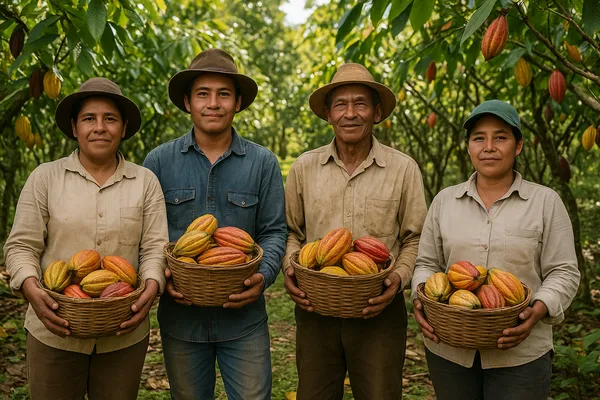
Ecuador’s Cocoa Revolution Gains Global Momentum
Quito, Ecuador — September 22, 2025. The Ecuador Cocoa Grower phenomenon is rewriting the global cocoa narrative. Once known for boutique chocolate beans, Ecuador is now on course to become the world’s second-largest cocoa producer by 2026, surpassing Ghana’s long-held position. With record-breaking yields, supportive pricing models, and forward-thinking agricultural policy, Ecuador is emerging as a formidable force in the international cocoa market.
How Ecuador Transformed Its Cocoa Landscape
Ecuador’s cocoa journey began over a century ago, but for decades, the nation played a modest role in global supply chains dominated by West Africa. In 2015, production levels hovered near 300,000 metric tons, a fraction of Ghana’s output. That changed dramatically when the government and private investors launched a modernization drive that revolutionized the Ecuador Cocoa Grower ecosystem.
According to the National Association of Cocoa Exporters of Ecuador (ANECACAO), production has since doubled, powered by improved seed varieties, structured cooperatives, and consistent state support. Government-backed credit programs have enabled smallholder farmers to invest in irrigation systems, disease-resistant seedlings, and processing facilities.
The reforms also gave rise to traceable supply chains and fair-trade certification programs, making Ecuador’s cocoa a preferred choice among premium chocolate makers in Europe and North America. This combination of modernization and transparency has turned the Ecuador Cocoa Grower into a global model for efficiency and farmer empowerment.
Record Output and Enhanced Farmer Income
Ecuador’s current momentum is nothing short of remarkable. In the 2025/26 season, cocoa output is expected to exceed 570,000 metric tons, with forecasts of 650,000 tons by 2026/27. At this pace, Ecuador will officially overtake Ghana, which has faced declining yields due to pest infestations, erratic rainfall, and smuggling-related losses.
Average yields per hectare have soared to 800 kilograms, nearly double those of Ghana’s aging cocoa farms. The hybrid variety CCN-51, though once criticized for its taste, now anchors national output, supported by improved post-harvest fermentation techniques that boost flavor quality.
Farmers are also earning more than ever before. In Ecuador, producers capture about 90% of the international cocoa price, compared to 60–70% in Ghana and Ivory Coast. This fairer pricing structure empowers local communities and reinvests wealth into rural economies.
“We used to farm for survival,” said Miguel Torres, a third-generation Ecuador Cocoa Grower from Los Ríos Province. “Today, we farm for progress. The prices are fair, and we see a future for our children in cocoa.”
A Global Power Shift in Cocoa Supply
The rise of the Ecuador Cocoa Grower is reshaping global cocoa economics. For decades, Ivory Coast and Ghana supplied over 60% of the world’s cocoa. Now, Ecuador’s surge introduces a Latin American counterbalance that could redefine the market.
The International Cocoa Organization (ICCO) projects Ecuador’s output could hit 800,000 metric tons by 2030, firmly cementing its role as the second-largest exporter worldwide. Major chocolate brands including Nestlé, Barry Callebaut, and Lindt & Sprüngli are diversifying supply chains to include Ecuador as a key partner.
Economic analysts highlight Ecuador’s liberalized market approach as a driving factor behind this ascent. Unlike Ghana’s tightly regulated system under COCOBOD, Ecuador allows open pricing and private export channels, ensuring real-time price reflection and quicker farmer payouts.
“Ecuador’s liberal model incentivizes efficiency and innovation,” explained an economist based in Guayaquil. “By allowing private exporters to compete, the Ecuador Cocoa Grower gains direct exposure to global demand — a luxury African farmers rarely enjoy.”
Ghana’s Response and West Africa’s Challenge
Ghana’s cocoa industry is not standing idle amid Ecuador’s rise. In August 2025, the Ghanaian government announced a record producer price increase, designed to stabilize incomes and curb smuggling. The Ghana Cocoa Board (COCOBOD) has also launched initiatives to rehabilitate old farms and distribute high-yield seedlings to farmers.
However, challenges persist. Ghana’s strict price controls, delayed payments, and recurring pest outbreaks have eroded farmer morale. The gap between field reality and policy promises remains significant, and that contrast is where the Ecuador Cocoa Grower continues to thrive.
Ivory Coast, meanwhile, is testing blockchain-based traceability to comply with EU sustainability laws, hoping to retain access to premium markets. Yet, experts warn that without fairer farmgate pricing, the West African cocoa belt may continue to lose young farmers to urban migration — a problem Ecuador appears to have reversed.
Building a Future-Ready Cocoa Sector
A defining feature of the Ecuador Cocoa Grower movement is its sustainability framework. Over 60% of Ecuador’s cocoa exports are certified organic, fair-trade, or Rainforest Alliance compliant — making it a global leader in ethical production.
Many farms have adopted solar-powered dryers, drip irrigation, and digital payment platforms that allow instant transactions with exporters. Cooperative unions have also partnered with universities to train farmers in soil management and post-harvest technology, reducing waste and improving bean quality.
Ecuador’s government is actively integrating cocoa into its National Climate Adaptation Plan, investing in agroforestry and carbon-credit incentives that reward farmers for preserving tree cover. These climate-smart policies strengthen resilience against diseases like frosty pod rot and mitigate deforestation risks.
Such integrated systems are why many experts describe the Ecuador Cocoa Grower story as not just a production success — but a sustainability revolution.
Economic and Geopolitical Implications: Shifting Global Influence
The emergence of Ecuador as a cocoa powerhouse carries implications that go beyond agriculture. For the first time, Latin America is challenging Africa’s near-monopoly in the global cocoa trade. This diversification could stabilize global prices and reduce dependence on any single region.
International buyers view Ecuador as a “reliable alternative” to West African volatility, especially amid climate threats and political uncertainty. Trade experts predict this will give Ecuador greater leverage in negotiations under organizations like the World Cocoa Foundation (WCF) and ICCO.
Domestically, cocoa now contributes over $1.5 billion annually to Ecuador’s economy — with projections to double by 2030. This growth supports rural infrastructure, education, and gender-inclusive programs that empower women-led cooperatives.
For global chocolate producers, this transition promises a more resilient supply chain, potentially curbing price shocks like those seen in 2024–2025 when poor West African harvests triggered global chocolate shortages.
Balancing Growth with Sustainability
Despite its impressive trajectory, the Ecuador Cocoa Grower sector faces several risks. Overexpansion could strain ecosystems if not carefully managed. Diseases like monilia and frosty pod rot remain persistent threats. Additionally, a global oversupply could depress prices if production outpaces demand.
Ecuador’s Ministry of Agriculture acknowledges these challenges and is implementing proactive solutions, including genetic research for disease-resistant trees and digital weather monitoring systems. Investment in logistics — especially rural roads and storage — will also be critical to sustaining export growth.
Analysts agree that maintaining Ecuador’s reputation for quality and sustainability will determine whether its cocoa dominance endures beyond 2030.
A New Era for Global Cocoa Leadership
The Ecuador Cocoa Grower boom is transforming the geography of global cocoa production. What was once an African-dominated sector is now evolving into a multi-continental marketplace driven by innovation, fairness, and climate resilience.
As Ecuador prepares to surpass Ghana by 2026, its success offers valuable lessons — that empowering farmers, opening markets, and investing in sustainability can reshape entire industries.
For chocolate lovers worldwide, the next decade may mark a historic shift — where the world’s favorite treat increasingly carries the rich, aromatic signature of Ecuadorian beans.
Internal Links
- Cocoa Producer Price Hike Brings Increment—But Not Satisfaction
- Cocoa Smuggling Crisis: Ghana Loses 150,000 Tonnes
- Human Trafficking Victims Rescued at Ngleshie Amanfro