A Defining Moment for Ghana’s Digital Finance Revolution
Accra, Ghana — Mobile Money Ghana has reached an unprecedented milestone, recording GHC354.1 billion in transactions in August 2025, according to the Bank of Ghana. This achievement cements the country’s position as a continental leader in mobile financial services and highlights the growing reliance on digital platforms to power trade, payments, and financial inclusion.
How Mobile Money Ghana Evolved Into an Economic Powerhouse
Over the last decade, Mobile Money Ghana has evolved from a convenience-based transfer service into a cornerstone of the national economy. The Bank of Ghana’s Summary of Economic and Financial Data reveals that transaction volumes have grown by double digits year-on-year since 2015, underscoring its steady expansion and public trust.
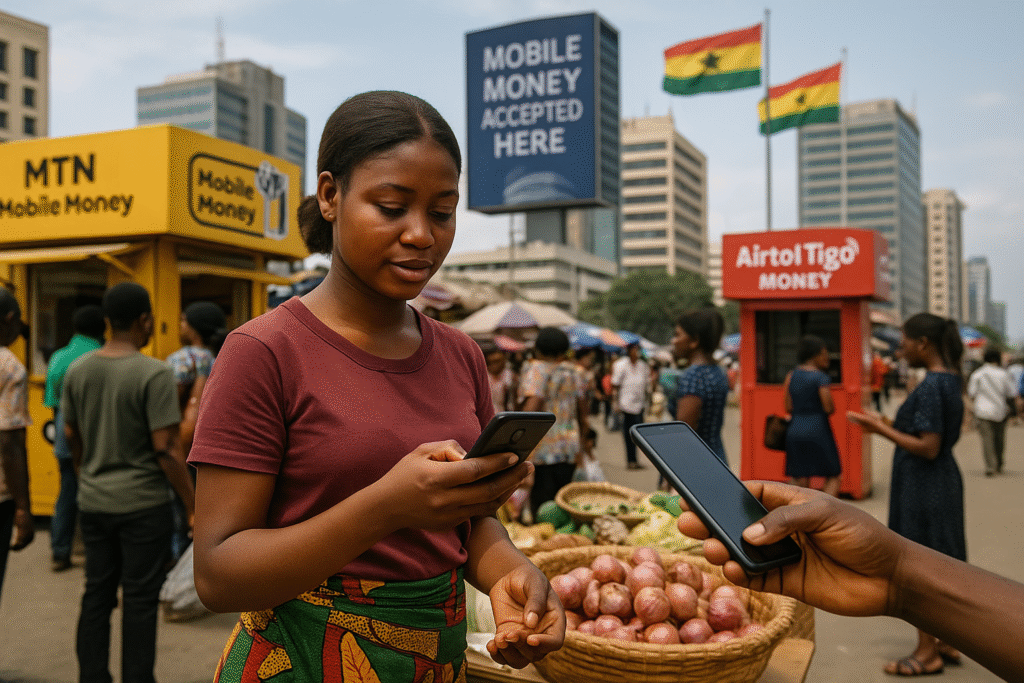
Initially launched to facilitate low-value person-to-person (P2P) transfers, the platform now supports everything from utility bills and school fees to online shopping and government payments. The rise of interoperability — allowing transfers between banks and wallets — has accelerated adoption across both urban and rural populations.
Industry observers attribute this rise to:
- Accessibility: Agents are present in virtually every Ghanaian community.
- Convenience: Payments are instantaneous and paperless.
- Trust: Regulatory oversight by the Bank of Ghana enhances user confidence.
By August 2025, the cumulative impact positioned Mobile Money Ghana as one of Africa’s most successful digital financial ecosystems, rivaling Kenya’s M-Pesa in scope and reach.
Record-Breaking Growth in August 2025
The GHC354.1bn milestone achieved by Mobile Money Ghana in August 2025 represents more than strong numbers—it signals structural change in the nation’s economy. The data shows a 21% increase from the same period in 2024, indicating sustained consumer and business confidence in mobile transactions despite global economic pressures.
Telecommunication companies such as MTN Ghana, AirtelTigo, and Vodafone Ghana continue to drive innovation through new financial products, including savings and micro-credit options. The integration of fintech startups and e-commerce platforms has also played a pivotal role, transforming digital payments into the default mode for millions of Ghanaians.
A senior analyst at a local fintech consultancy told GSN:
“The August data proves that mobile money is now embedded in Ghana’s economic DNA. It supports trade, savings, and revenue mobilization — far beyond what traditional banking ever achieved.”
Financial Inclusion: Bridging Urban–Rural Economic Divides
One of the most profound effects of Mobile Money Ghana is its contribution to financial inclusion. Millions of Ghanaians, especially in rural and peri-urban communities, now have access to digital wallets that allow them to save, send, and receive funds securely without needing bank accounts.
According to the Ghana Chamber of Telecommunications, more than 18 million active mobile money accounts are now operational nationwide. This has narrowed the financial inclusion gap between rural and urban areas, enabling farmers, small traders, and artisans to engage in secure commerce and access credit facilities for the first time.
A local agribusiness trader in Techiman told GSN:
“Mobile money changed how we do business. I can receive payments instantly from customers in Accra or Kumasi and pay my suppliers the same day. No need to travel with cash anymore.”
The empowerment created by Mobile Money Ghana has also improved women’s economic participation, allowing many female entrepreneurs to access financial services and scale their businesses.
Economic Impact: Strengthening SMEs and National Growth
With GHC354.1bn in transactions processed in a single month, Mobile Money Ghana has become a critical pillar of economic growth. Small and medium-sized enterprises (SMEs), which account for over 70% of employment in Ghana, rely heavily on mobile platforms for payments and operations.
The digitization of transactions has produced tangible macroeconomic benefits:
- Transparency and Accountability: Reduces informal cash dealings and enhances traceability.
- Tax Efficiency: Supports government initiatives like the Electronic Transfer Levy (E-Levy) for improved revenue collection.
- Monetary Stability: Less dependency on physical cash eases pressure on currency supply.
Despite concerns over the E-Levy’s impact, August’s record figures prove the system’s resilience and user loyalty. Analysts say the adoption curve shows no signs of slowing, as mobile wallets increasingly replace cash transactions across retail, transport, and service sectors.
The Resilience and Future of Digital Payments
Experts believe the growth trajectory of Mobile Money Ghana illustrates the success of Ghana’s broader digital transformation strategy.
“Mobile finance has democratized access to financial tools,” said an economist familiar with the Bank of Ghana’s data. “It’s now part of Ghana’s social and economic fabric — a model for sub-Saharan Africa.”
Comparatively, Ghana ranks among the top three countries in Africa for digital transaction volume, according to GSMA Mobile Money Metrics. The nation’s interoperability framework — linking bank accounts, mobile wallets, and fintech applications — has made transactions seamless across providers.
International observers also view Ghana’s progress as evidence of Africa’s digital leapfrog, bypassing traditional banking constraints through mobile technology.
Policy and Regulatory Perspectives: Sustaining Growth Through Governance
The rapid expansion of Mobile Money Ghana has prompted calls for updated regulatory measures to maintain system integrity. The Bank of Ghana continues to issue guidelines addressing anti-money-laundering (AML) compliance, transaction monitoring, and cybersecurity frameworks.
However, challenges persist:
- Fraud and Scam Prevention: Criminal networks exploit weak identity verification systems.
- Network Reliability: Outages in remote areas disrupt service continuity.
- Fee Sensitivity: Transaction costs remain high for low-income users.
- Data Protection: Growing digital footprints demand stronger privacy safeguards.
The regulator has urged telecom operators, fintech startups, and consumer associations to collaborate in ensuring transparency, innovation, and user protection remain central to the industry’s evolution.
Regional and Global Impact: Ghana as a Fintech Model
The success of Mobile Money Ghana resonates beyond national borders. Neighboring countries are studying Ghana’s model of interoperability and public-private collaboration. The country’s fintech ecosystem — with over 50 licensed payment service providers — is drawing foreign investment and positioning Accra as a future West African fintech hub.
Globally, development institutions such as the World Bank and International Monetary Fund (IMF) have cited Ghana’s mobile money system as an example of how digital finance can promote resilience, inclusion, and economic diversification in emerging markets.
Ghana’s experience also contributes to continental goals under the African Continental Free Trade Area (AfCFTA) by facilitating cross-border mobile transactions and enabling digital trade across African economies.
The Road to GHC4 Trillion in 2025
If current growth rates continue, analysts project that Mobile Money Ghana could surpass GHC4 trillion in annual transactions by the end of 2025. This would represent nearly 80% of Ghana’s gross domestic product (GDP) circulating digitally.
Industry leaders predict further innovation, including:
- Integration of artificial intelligence (AI) for fraud detection.
- Expansion of cross-border interoperability within ECOWAS.
- Introduction of digital credit scoring for small businesses.
As Ghana’s fintech ecosystem matures, Mobile Money Ghana will remain at the heart of the nation’s journey toward a fully cash-lite economy.
A Cashless Future Anchored in Trust and Innovation
The August 2025 record underscores a powerful truth: Mobile Money Ghana is not just a payment tool but a national asset driving social inclusion and digital empowerment. By linking millions of citizens to the formal economy, it continues to redefine how money moves, businesses grow, and Ghana thrives in the digital age.
The journey toward GHC4 trillion is more than a numbers race—it represents a vision of progress, innovation, and opportunity for every Ghanaian.
Internal Links
- Quack Medical Practitioners Arrested in Ghana Raid
- 2nm Semiconductor Breakthrough: 5 Big Tech Gains Coming Soon