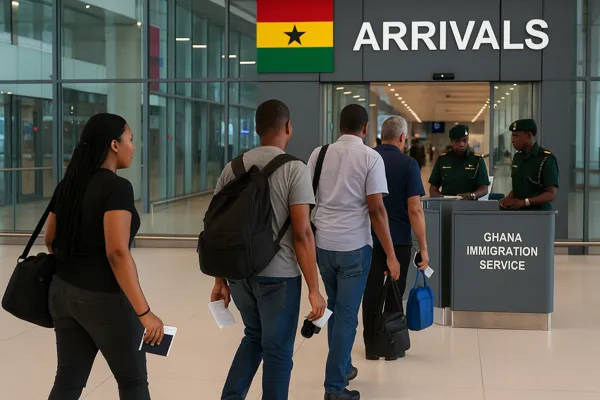
Accra, Ghana — September 18, 2025. Ghana Deportees from US remain a contentious issue as the country prepares for the arrival of 40 more West Africans. Foreign Affairs Minister Samuel Okudzeto Ablakwa confirmed that the United States will deport an additional group in the coming days. The announcement follows the controversial arrival of 14 deportees earlier this month, sparking renewed debate about Ghana’s role in accommodating migrants who are not its citizens.
Ghana Deportees from US: Ablakwa’s Confirmation
According to Ablakwa, the deportees are mainly nationals of Nigeria, The Gambia, and Sierra Leone, not Ghana. He stressed that the government is acting purely on humanitarian grounds by allowing them to transit through Ghana.
“We are receiving them because we are West Africans, not because we struck a deal for profit,” Ablakwa explained. “This is a humanitarian gesture, not an endorsement of America’s immigration policies.”
He clarified that Ghana will not provide permanent settlement for the deportees, but rather facilitate their safe passage to their respective home countries.
Related: Ghana Trade Surplus Hits Record in 2025
Ghana Deportees from US: Political Opposition
The move has drawn sharp criticism from the Parliamentary Minority, who argue that any such arrangement with the United States must first be ratified by Parliament. They insist that government cannot unilaterally decide to receive Ghana Deportees from US without oversight.
“Government cannot bypass Parliament on matters of international cooperation that affect sovereignty and security,” the Minority spokesperson said. “This sets a dangerous precedent.”
The Minority has hinted at filing a motion in Parliament to demand transparency on the Memorandum of Understanding (MoU) signed with Washington.
Humanitarian Grounds vs. Legal Concerns
While the government defends the move as humanitarian, critics raise questions about legality and rights. Some deportees fear persecution or statelessness, as they are not Ghanaian citizens.
International legal experts argue that accepting Ghana Deportees from US who are non-citizens may conflict with international conventions. Deportation to a third country without citizenship links, they note, could expose deportees to serious risks.
External references:
- AP News: Ghana Receives 14 West African Deportees
- Reuters: U.S. Judge Questions Deportations to Ghana
Ghana Deportees from US and Regional Solidarity
Supporters of the move argue that Ghana’s acceptance of deportees demonstrates Pan-African solidarity. They say the decision reflects Ghana’s tradition of being a welcoming hub for Africans in need.
“Ghana has historically played a unifying role in Africa,” a civil society leader explained. “Allowing Ghana Deportees from US to pass through Accra is a continuation of that spirit.”
However, some analysts warn that taking in deportees without clear legal frameworks could put strain on Ghana’s social services, security apparatus, and immigration system.
International Scrutiny of Ghana Deportees from US
The decision has attracted global attention. Reuters and AP News have reported that U.S. courts are questioning the legality of deporting non-Ghanaian Africans to Ghana. Human rights groups say the deportees are being placed in a vulnerable position.
Meanwhile, Ghana’s opposition parties claim the deal with the U.S. could create “hidden costs” for the state, including providing temporary housing, food, and security for deportees.
Read More: Ghana Exploration Wells Set for 2026
Ghana Deportees from US: Security Implications
Security analysts warn that some deportees could be at risk of exploitation by trafficking networks in West Africa. The Ghana Center for Security Studies (GCSS) has urged the government to establish stronger monitoring systems for deportees while they are in transit.
“The government must not only consider the humanitarian angle,” one analyst noted, “but also the potential security vulnerabilities that come with receiving Ghana Deportees from US.”
Ablakwa’s Defense
Ablakwa has remained firm, insisting Ghana is not “America’s dumping ground.” He has emphasized that the deportees are being treated fairly and respectfully, and that no financial package or aid has been offered by the U.S. in exchange for Ghana’s cooperation.
Also Read: France Grants Ghana Debt Relief Under G20 Framework
What Happens Next?
The U.S. is expected to send the 40 deportees within the next few days. They will undergo immigration processing, health screenings, and onward travel arrangements. Civil society groups continue to demand greater transparency about the arrangement, while Parliament prepares for a heated debate.
Conclusion
The issue of Ghana Deportees from US highlights the intersection of humanitarian duty, international law, and domestic politics. With 40 more deportees set to arrive, Ghana finds itself navigating a delicate balance between compassion, sovereignty, and international obligations.