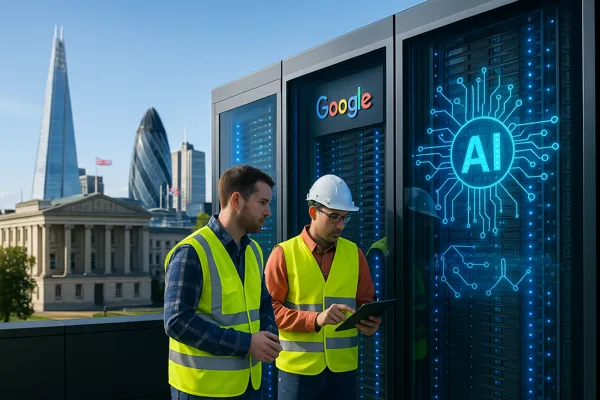
London, UK — September 16, 2025
Google, through its parent company Alphabet, has announced a landmark £5 billion AI investment in the United Kingdom, reaffirming Britain’s emerging role as a world centre for artificial intelligence development.
The Google AI investment arrives days before U.S. President Donald Trump’s state visit to London, during which several major U.S. tech firms are expected to unveil similar commitments as part of a trans-Atlantic “Tech Prosperity” drive.
A Strategic £5 Billion Commitment
The Google AI investment encompasses research and development, new data centres, and a large-scale expansion of DeepMind, Google’s London-based AI subsidiary.
A flagship element is the construction of a next-generation data centre at Waltham Cross, Hertfordshire, designed to boost Britain’s computational power and support AI innovation across sectors.
According to Alphabet, the initiative could sustain 8,250 jobs annually, spanning cloud engineering, cybersecurity, and advanced AI research.
The company says this expansion will “deepen the UK’s innovation ecosystem,” enhance productivity, and empower start-ups building on Google Cloud and DeepMind technologies.
Why the Investment Matters Now
The Google AI investment comes amid a renewed British effort to court global technology giants following Brexit. The UK government has promoted London, Cambridge, and Manchester as innovation clusters to rival Silicon Valley and Berlin.
Officials describe the £5 billion outlay as “a vote of confidence” in Britain’s economic stability and regulatory openness at a time of intensifying global competition for AI leadership.
The timing—just before President Trump’s visit—is also deliberate. His delegation is unveiling a coordinated package of U.S. tech investments: Microsoft’s £22 billion pledge for AI supercomputers, and forthcoming announcements from Amazon, Meta, and Apple. Together, they represent a surge of U.S. capital into Britain’s digital economy.
Energy, Environment & Sustainability
With global attention on the carbon footprint of large data centres, Google emphasized sustainability as a core pillar of its plan.
The company revealed new renewable-energy supply contracts with Shell, ensuring all UK operations under the Google AI investment are powered by low-carbon sources.
These agreements support the UK’s net-zero strategy while offsetting concerns about the energy intensity of AI computation.
Google said its long-term objective is to operate on 24/7 carbon-free energy by 2030, integrating wind and solar generation directly into its grid mix—an approach industry analysts view as a template for future hyperscale infrastructure.
Government & Public Reactions
UK Chancellor Rachel Reeves welcomed the Google AI investment, calling it “a powerful signal that Britain is open for innovation.”
She added that foreign direct investment of this scale not only stimulates GDP but also accelerates the country’s digital-skills agenda.
Prime Minister Keir Starmer echoed the sentiment, describing the deal as “proof that Britain remains at the forefront of technological progress.”
Analysts at the London School of Economics noted that the move could inject over £9 billion into related supply chains and education partnerships over the next decade.
Geopolitical & Industry Context
Beyond economics, the Google AI investment underscores shifting geopolitics in technology.
As the UK positions itself between Washington and Brussels, deeper U.S.–UK cooperation could reshape Europe’s AI landscape.
Britain’s departure from the EU gives it flexibility to craft agile regulatory frameworks—something U.S. companies view as an advantage over continental bureaucracy.
Alphabet’s decision follows a wider pattern: in 2025 alone, U.S. tech firms have committed more than £40 billion to British AI infrastructure.
This collective influx may transform the UK into one of the world’s top three AI hubs, alongside the United States and China.
Economic Impact & Job Creation
Economists predict that the Google AI investment could raise UK GDP growth by 0.3 percentage points annually over the next five years.
New data-centre clusters will attract suppliers in construction, fibre-optics, cooling technology, and cybersecurity, producing ripple effects nationwide.
Regional development agencies are already identifying sites in Scotland, Northern Ireland, and the Midlands for future AI campuses linked to Google’s network.
Training programs co-funded by Google and the UK Department for Education aim to certify 50,000 new AI specialistsby 2030, building long-term human-capital resilience.
Challenges & Criticisms
Despite widespread enthusiasm, the Google AI investment has sparked debate over national sovereignty and regulatory oversight.
Critics argue that reliance on foreign-owned infrastructure may limit the UK’s ability to control data governance and AI standards.
Environmental groups caution that even renewable-powered data centres can stress local grids and water supplies.
Labour unions have also urged transparency on working conditions and automation impacts, warning that “AI-driven efficiency must not come at the expense of human dignity.”
Global AI Competition
The Google AI investment situates the UK squarely in the global race against the U.S., China, and the EU for artificial-intelligence supremacy.
China’s Baidu and Tencent are expanding similar facilities across Southeast Asia, while the EU is launching its AI Act to govern algorithmic transparency.
By partnering closely with U.S. firms, Britain hopes to balance innovation with ethics—maintaining leadership without compromising trust.
Conclusion: Britain’s AI Future
The £5 billion Google AI investment stands as one of the largest technology commitments in British history.
It strengthens the nation’s role as a pivotal AI hub, generating thousands of jobs, advancing sustainable computing, and reaffirming trans-Atlantic cooperation.
As President Trump’s visit unfolds, UK leaders are expected to showcase this milestone as evidence that Britain’s digital future is thriving—anchored in truth, depth, and global reach.
Internal Links
- 2nm Semiconductor Breakthrough: 5 Big Tech Gains Coming Soon
- Android-ChromeOS Merger: Google’s Boldest 2025 Tech Move
- South Sudan VP Treason Charges Spark Political Crisis