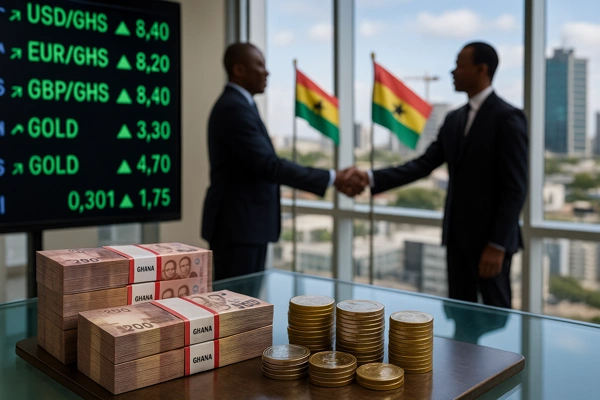
The Ghana Trade Surplus has surged to $6.2 billion within the first eight months of 2025 — one of the highest external balances in recent memory. According to the Bank of Ghana (BoG), gross international reserves rose to $10.7 billion by August end, covering 4.5 months of imports. These figures highlight Ghana’s macroeconomic resilience, underpinned by robust exports and sound policy management despite global financial uncertainty.
Economic Background and Policy Context
Over the past five years, Ghana has transitioned from persistent current-account deficits to consistent surpluses. This reversal is largely due to the fiscal consolidation measures adopted under the IMF-supported program, exchange-rate management, and structural reforms in the extractive and agriculture sectors.
Before 2024, rising import bills and weak commodity prices widened Ghana’s trade gap. The turnaround began in 2024 when commodity prices recovered and the BoG tightened monetary policy to curb inflation. By 2025, the Ghana Trade Surplus more than doubled, reflecting stronger fundamentals and renewed investor confidence.
Export Growth Fuels Economic Stability
The record Ghana Trade Surplus was driven by a mix of higher export receipts and subdued imports.
- Gold remained the largest contributor, supported by elevated global prices amid financial-market volatility.
- Cocoa benefited from favorable harvests, improved logistics, and stronger demand from European and Asian buyers.
- Crude oil exports increased after maintenance shutdowns ended in 2024, while new production fields expanded output.
These sectors collectively outperformed import growth, creating a net positive external position. Analysts note that export diversification and local value addition remain essential to sustain the Ghana Trade Surplus in the medium term.
Currency Appreciation and Investor Confidence
The appreciation of the Ghanaian cedi — up 21 percent year-to-date as of September 2025 — has been one of the clearest outcomes of the Ghana Trade Surplus.
This strengthened currency has:
- Reduced imported inflation pressures;
- Lowered the cost of foreign-currency debt servicing;
- Reinforced investor trust in Ghana’s macroeconomic management.
BoG officials attribute this performance to “consistent foreign-exchange inflows, prudent policy direction, and a credible commitment to price stability.” The cedi’s resilience has made Ghana one of sub-Saharan Africa’s top-performing currencies in 2025.
Inflation Outlook and Monetary Policy Direction
Headline inflation fell to 11.5 percent in August 2025, down sharply from the high double digits of 2024. The decline was aided by the Ghana Trade Surplus, cedi appreciation, and restrained government spending.
The BoG remains cautious, warning that global energy-price volatility, utility tariff adjustments, and food-price shocks could rekindle inflationary pressure.
The central bank’s forward guidance signals readiness to deploy additional monetary tools if external conditions worsen.
Fiscal Reforms and Debt Consolidation
Fiscal indicators reinforce the positive narrative. Ghana’s budget deficit for the first half of 2025 stood at 0.7 percent of GDP — below projections — showing disciplined expenditure and improved revenue collection.
Public-debt ratios have eased thanks to a stronger cedi and enhanced domestic-revenue mobilization. The Ghana Trade Surplus has indirectly supported debt sustainability by reducing reliance on external borrowing and enhancing market confidence.
Economists view this as a critical step toward restoring long-term fiscal credibility.
Financial-Sector Strength and Resilience
The Bank of Ghana’s latest Financial Stability Review shows the sector is stable and well-capitalized. The capital-adequacy ratio reached 19.5 percent in July, far above the regulatory minimum.
Non-performing loans declined to 8.4 percent after provisioning, compared with 21.7 percent a year earlier.
Ongoing reforms emphasize digital transformation, credit-risk management, and sustainable financing, all contributing to the resilience needed to support the broader benefits of the Ghana Trade Surplus.
Potential Headwinds and Risk Factors
While the outlook remains favorable, the BoG Governor highlighted emerging risks:
- Seasonal pressures on the cedi during year-end import surges;
- Slower remittance inflows;
- Uncertain global commodity prices and tighter international financing conditions.
Nonetheless, Ghana’s $10.7 billion reserve buffer provides a meaningful cushion against moderate external shocks, ensuring the sustainability of the Ghana Trade Surplus.
Business and Household Implications
Businesses stand to gain from currency stability and reduced import costs. Exporters in gold, cocoa, and oil benefit from stronger revenues and improved access to credit.
For households, the Ghana Trade Surplus has translated into lower inflation on imported goods such as fuel, electronics, and machinery. However, rising utility costs and global commodity trends could still constrain disposable incomes.
Economists recommend continued diversification to shield citizens from external price shocks.
Expert Analysis and Global Perspective
Analysts regard the Ghana Trade Surplus as a turning point, proving that disciplined fiscal management can coexist with growth. Regional observers note that Ghana now outperforms most West African peers, some of which continue to battle trade deficits.
International institutions, including the IMF and World Bank, have lauded Ghana’s progress in restoring confidence and achieving external stability. Yet they caution that sustaining this performance requires consistent policy coordination and industrial transformation to move beyond raw-commodity dependence.
Conclusion
The Ghana Trade Surplus of $6.2 billion and reserves of $10.7 billion reaffirm Ghana’s path toward economic recovery and sustainable growth. Backed by prudent reforms, strong exports, and an appreciating cedi, Ghana is positioned to maintain macroeconomic stability while building resilience against external shocks. The challenge ahead lies in deepening industrial diversification to ensure the surplus evolves into lasting prosperity.
Internal Links
- Gov’t Recognises Genuine Concerns on Galamsey – Kwakye Ofosu
- Galamsey Pits Central Region: 22 Dead, NADMO Acts
- Ghana-US Deportation Agreement Called ‘Unconstitutional’