A Volatile Currency Faces Renewed Scrutiny
Accra, Ghana — September 16, 2025. The Ghanaian cedi’s erratic movement in recent weeks has reignited national debate about its long-term trajectory. Finance expert Professor Godfred Bokpin has delivered a balanced but cautionary analysis of the cedi forecast, warning that while the currency showed strength earlier this year, its “jump ahead” against the U.S. dollar was unsustainable — a trend now correcting itself.
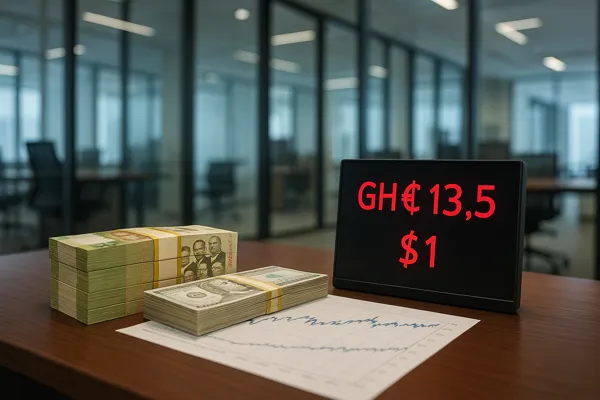
According to the economist, the cedi forecast suggests a year-end exchange rate of around GH₵13.5 to US$1, grounded in both macroeconomic fundamentals and Ghana’s broader fiscal landscape. Bokpin emphasized that this projection is realistic only if the government maintains disciplined spending and structural reforms continue under the IMF programme.
From Early Strength to Market Correction
At the start of 2025, the Ghanaian cedi gained momentum as investors responded positively to the country’s fiscal stabilization measures. Ghana’s gross international reserves rebounded to over $10 billion, buoyed by strong gold and cocoa exports, while inflation showed gradual moderation.
However, the mid-year correction signaled underlying weaknesses. The cedi forecast shifted as currency traders, importers, and analysts began to price in the impact of sustained import demand, high debt service obligations, and limited export diversification.
Prof. Bokpin explained that the cedi’s sharp appreciation in early 2025 reflected optimism rather than structural strength. “The cedi jumped the gun. The correction we are witnessing is part of a normal market adjustment,” he said. “Currency markets respond to fundamentals, not emotions.”
He noted that Ghana’s persistent fiscal deficits and dependence on external borrowing made the early rally unsustainable, underscoring that corrections like these are necessary to realign expectations with reality.
Macroeconomic Drivers Behind the 2025 Cedi Forecast
Prof. Bokpin’s cedi forecast of GH₵13.5 to $1 is based on a blend of supportive and risk-based factors shaping Ghana’s economic landscape.
1. IMF Programme Stability:
Ghana’s $3 billion IMF programme continues to anchor investor confidence and provide policy discipline. The disbursement of the second tranche in July 2025 helped stabilize reserves and ease pressure on the currency.
2. Resilient Commodity Exports:
Strong gold and cocoa exports have underpinned foreign exchange inflows. With global cocoa prices remaining above $4,000 per tonne, Ghana’s export receipts are expected to close the year on a high note.
3. Steady Remittance Inflows:
Ghanaian diaspora remittances, averaging over $5 billion annually, remain a critical support to the current account balance and overall reserves.
4. Fiscal Restraint:
Government adherence to spending limits—especially ahead of the 2026 elections—will determine the extent to which the cedi forecast materializes as projected.
However, risks persist. A drop in commodity prices, delays in external disbursements, or higher global interest rates could undermine the cedi’s recovery. “Fiscal slippages will be the biggest threat,” Bokpin warned, adding that any deviation from budgetary discipline could reverse gains achieved so far.
Expert Insights: Why Ghana’s Currency Correction Is Healthy
While market watchers often perceive depreciation as a sign of weakness, experts argue that the current adjustment supports long-term balance. The cedi forecast reflects a realistic equilibrium point after months of speculative appreciation.
Financial analysts at GSN’s business desk note that a controlled correction prevents asset bubbles and restores competitiveness for exporters. “Currency markets function best when exchange rates align with productivity,” one analyst said. “The correction creates room for sustainable growth rather than artificial stability.”
Indeed, several African currencies—including the Nigerian naira, Kenyan shilling, and Egyptian pound—experienced similar patterns of early-year rallies followed by corrections due to external pressures and domestic policy shifts. Ghana’s experience, therefore, fits within a broader continental context of balancing stability with reform.
Fiscal Discipline and Structural Reform: The Foundation for Stability
For the cedi forecast to hold steady at GH₵13.5 to $1, Ghana must enforce fiscal discipline while diversifying its economic base. Prof. Bokpin stressed that sustainable stability cannot rely on temporary interventions or IMF inflows alone.
He identified four strategic priorities for government and policymakers:
- Diversify Export Portfolios: Expand beyond cocoa, gold, and oil into processed goods, digital services, and renewable energy exports.
- Boost Local Manufacturing: Encourage import substitution through domestic production incentives, reducing forex outflows.
- Adopt Fiscal Restraint: Maintain expenditure limits, particularly during election seasons, to prevent inflationary spending.
- Deepen Structural Reforms: Simplify regulations, improve credit access for SMEs, and promote private-sector competitiveness.
“The IMF has offered Ghana breathing space,” Bokpin noted, “but our real work begins with structural transformation. The cedi forecast will remain fragile until Ghana strengthens its productive capacity.”
Market and Public Reactions to the Cedi Forecast
Market participants have reacted cautiously to the latest projections. While investors see the cedi forecast as achievable, everyday Ghanaians express growing concern over rising prices and currency instability.
Importers at Accra’s Makola Market report increased costs for consumer goods, spare parts, and electronics. “Every container now costs more because the dollar keeps fluctuating,” one importer said.
Exporters, on the other hand, view the currency correction as a mixed blessing. “A slightly weaker cedi helps our revenue, but volatility makes planning difficult,” said a cocoa exporter in Kumasi.
Financial institutions echo this sentiment. A local banker told GSN that stable exchange rates are critical for loan pricing and investment planning. “Businesses need predictability. The government must communicate clearly to manage market expectations,” he urged.
Comparative Outlook: Ghana and Other Emerging Markets
Ghana’s situation mirrors trends seen across Sub-Saharan Africa. Countries like Zambia, Nigeria, and Kenya are also navigating the delicate balance between IMF reforms, fiscal pressures, and market volatility.
In Zambia, the kwacha gained temporarily after debt restructuring but depreciated once commodity exports slowed. Similarly, Nigeria’s naira reforms have led to steep short-term volatility as the market adjusts to liberalization.
Economists argue that Ghana’s cedi forecast could serve as a benchmark for regional resilience if policymakers sustain reform momentum. With disciplined macroeconomic management and export diversification, Ghana can emerge as a model for currency stabilization in Africa.
Broader Implications for Households and Businesses
The cedi forecast has implications far beyond the financial markets. For ordinary Ghanaians, every fluctuation translates into changes in daily expenses and living standards.
- Importers face higher costs for goods and raw materials.
- Households endure increased inflation on food, fuel, and utilities.
- Exporters may enjoy higher returns, though planning remains challenging.
- Investors monitor currency trends to gauge confidence in Ghana’s bonds and equities.
Inflationary pressures linked to exchange rate fluctuations also pose political and social challenges. Rising prices in essential goods often test public patience and government credibility, especially in pre-election years.
Balancing IMF Support with Domestic Responsibility
While the IMF programme has restored some investor confidence, experts caution that reliance on external aid is not sustainable. “The IMF gives us breathing space,” Prof. Bokpin reiterated, “but without internal transformation, the cedi forecast will always depend on external factors.”
He emphasized that Ghana’s long-term economic sovereignty depends on strengthening local production, improving tax efficiency, and building manufacturing capacity. Only then can the cedi maintain stability beyond the life span of IMF interventions.
Future Outlook: Prospects for 2026 and Beyond
Looking ahead, the outlook for 2026 will hinge on global market conditions and Ghana’s ability to stay the course on reforms. Analysts expect moderate stability in the first half of 2026, though external shocks—such as climate-induced cocoa shortages or U.S. interest rate hikes—could alter the trajectory.
According to Prof. Bokpin, “The year-end cedi forecast of GH₵13.5 to the dollar is achievable, but sustaining it will test Ghana’s commitment to reform. The coming year will determine whether stability is temporary or transformative.”
If the government strengthens local industries, manages debt prudently, and maintains transparency, Ghana’s currency could gradually rebuild confidence both locally and internationally.
The Path Forward for Ghana’s Cedi
The cedi forecast of GH₵13.5 to $1 encapsulates Ghana’s delicate balance between optimism and caution. It signals hope for gradual stabilization but underscores the urgency of deep, lasting reform.
Ghana’s journey toward currency stability will depend on more than IMF loans or market optimism — it will rely on productivity, accountability, and economic diversification. As Prof. Bokpin aptly concluded, “We can’t fix the cedi with prayers or politics. We must fix the economy that drives it.”
- BoG UBA Ghana Suspension: 1-Month Forex Halt Explained
- World Bank $360M Ghana Disbursement to Stabilize Economy
- Gold Price Record High: Gold Surges Past $3,500 Mark